
Completed State Budget Highlights Healthcare Champions

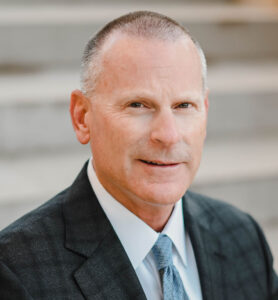
The following statement can be attributed to Brian Peters, CEO of the Michigan Health & Hospital Association.

The passage of Michigan’s state budget highlights the healthcare champions in our state who protected important healthcare funding that maintains access to care for Michiganders and supports our healthcare workers, including our local nurses, doctors, support techs and service workers. Champions like Gov. Gretchen Whitmer, Senate Majority Leader Winnie Brinks, Senate Appropriations Chair Sarah Anthony and House Minority Leader Ranjeev Puri are why Michigan hospitals can always care for their communities and advance our state forward.

We thank those state lawmakers who recognized the need to support the Healthy Michigan Plan and Michigan’s Medicaid health plans, obstetrical services, care at rural and critical access hospitals and more in this year’s budget.

Michiganders count on our hospitals to be there during our time of need, whether that be in the middle of the night or on a holiday, and on our state lawmakers to maintain access to healthcare. This state budget allows hospitals to continue to care for everyone who walks through their doors, at all hours of the day, every day of the year.
State House Minority Leader Addresses Legislative Policy Panel

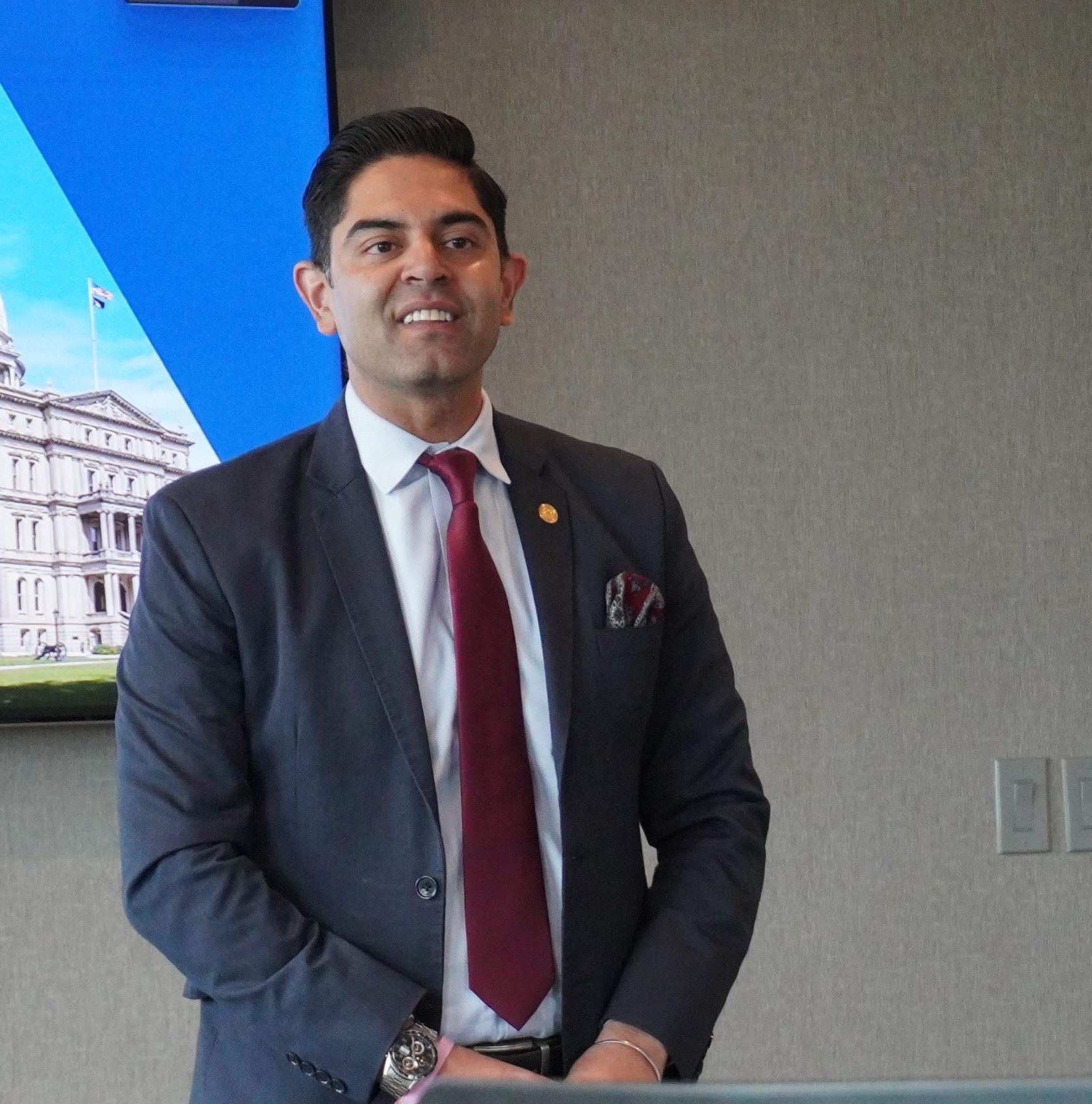
Rep. Ranjeev Puri (D-Canton) during the MHA Legislative Policy Panel at the MHA Capitol Advocacy Center.

State House Minority Leader Ranjeev Puri (D-Canton) addressed the MHA Legislative Policy Panel May 13 at the MHA Capitol Advocacy Center, providing the panel with a legislative and political update and sharing his commitment to protecting access to care for Michiganders. During the meeting, the panel developed recommendations for the MHA Board of Trustees on legislative initiatives affecting Michigan hospitals.

MHA Capitol Advocacy Center staff provided updates on healthcare activity at the federal and state levels. Adam Carlson, senior vice president, advocacy, MHA, shared additional details on the state budget, including timelines and current proposals.

Taylor Alpert, director, government relations, MHA, presented Senate Bill (SB) 910, which would establish a commission to review the cost of legislatively mandated healthcare coverage.

Elizabeth Kutter, vice president and deputy general counsel, MHA, provided presentations on federal legislation related to 340B rebate program exemptions and SB 914, which could require insurers to recognize patient prescription drug payments toward deductibles and annual out-of-pocket maximums.

The panel also received an update on Certificate of Need legislation.

The panel recommended that the MHA support legislation establishing a process to review government mandates on health insurers and providers.

For more information on the MHA Legislative Policy Panel, contact Adam Carlson at the MHA.

2024 General Election: What’s Ahead in Michigan

Below is a summary of the projected results for Michigan’s top races that will influence healthcare following the 2024 General Election. Official state and local outcomes will be available in the coming days on the Michigan Secretary of State website.

  • U.S. Rep. Elissa Slotkin (D-Holly) will take the U.S. Senate seat following a close race with opponent Mike Rogers (R-White Lake). Slotkin is a former national security official currently serving Michigan’s 7th Congressional District, which includes all of Ingham, Livingston, Shiawassee and Clinton counties, as well as parts of Eaton, Genesee and Oakland counties. In Congress, Slotkin worked across the aisle to help pass legislation to make prescription drug prices more transparent. She also fought to pass laws that capped the cost of insulin for seniors and allowed Medicare to negotiate for lower drug prices. In addition, she worked closely with the MHA and the hospitals in her district during the COVID-19 pandemic.
  • Justice Kyra Harris Bolden (D-Wayne) will serve a partial term on the Michigan Supreme Court after a projected win against Patrick W. O’Grady (R-Macomb). Once elected, Justice Bolden will take office in January 2025 and fill the remainder of a term that is underway. Justice Bolden is an incumbent candidate serving her second year on the Michigan Supreme Court since being appointed in January 2023. After receiving her Juris Doctorate, Justice Bolden became a criminal defense attorney and later a civil litigation attorney. Prior to joining the Supreme Court, she served in the Michigan House of Representatives for two terms, where she sat on the Judiciary Committee.
  • Kimberly Ann Thomas (D-Wayne) will take the full-term seat after a projected win against Andrew Fink (R-Hillsdale). She will take office at the start of the new term and serve for a full eight years. Thomas is a professor at the University of Michigan Law School and co-founder of the university’s Juvenile Justice Clinic. She also served on the bipartisan Michigan Task Force on Juvenile Justice Reform and has been recognized for her service by the Criminal Defense Attorneys of Michigan and has served as an expert for the American Bar Association (ABA) Rule of Law Initiative.
  • Republicans will flip the Michigan House of Representatives from Democratic control beginning in January of 2025. Although official results are not in, Matt Hall (R-Richland Township) is presumed to serve as speaker of the House and Rep. Ranjeev Puri (D-Canton) as minority House leader for the 2025-26 term.

Beyond election cycles, the MHA encourages Michiganders to stay informed on state and federal issues and engage with lawmakers on both sides of the aisle. Attend coffee hours, host facility tours and take the time to educate local decision-makers on what issues impact Michigan hospitals, staff, patients, communities and access to care.

For more information regarding election results, contact the MHA advocacy team.