Second Wave Michigan published a story Jan. 7 on how state officials, healthcare providers and community organizations are focusing on expanding the continuum of care for people experiencing a mental health crisis.
Lauren LaPine, senior director of legislative and public policy at the MHA, was interviewed in the story to share the role hospitals place in crisis care. She mentioned the high utilization of hospital emergency departments for people in a behavioral health crisis and the long wait times involved in finding the appropriate placement for the patient. LaPine also mentioned how the MHA is advocating for more resources that can support crisis intervention before hospitalization becomes necessary.
“We are working to build partnerships that can offer more specialized crisis care options,” said LaPine. “Similar to community paramedics initiatives, MDHHS [Michigan Department of Health and Human Services] has been committed to expanding access to mobile crisis units so when an individual is in some type of behavioral health crisis, there are mobile crisis units you can call through local community mental health agencies.”
Members with any questions regarding media requests should contact John Karasinski at the MHA.
The Michigan Senate unanimously passed several MHA-supported bills aimed at improving mental health treatment for individuals involved in the criminal justice system during the week of Dec. 2. Senate Bills (SB) 915 (Hertel-D), 916 (Santana-D), 917 (Irwin-D) and 918 (Wonjo-D) are designed to divert individuals with mental health issues from jail and into treatment programs.
SB 915 grants law enforcement officers the authority to take someone in for a psychiatric evaluation if they have “reasonable cause” to believe the person needs community mental health treatment. This change allows officers to act based on concerns from family members or treatment providers, rather than waiting for signs of uncontrolled mental illness. Supporters argue this will help individuals get treatment before symptoms escalate.
Similarly, SB 916 establishes a system where prosecuting attorneys, defendants or their counsel can request a mental health evaluation after misdemeanor charges are filed. If treatment is needed, the court can place the individual in an Assisted Outpatient Treatment program. Upon completion, the misdemeanor charges can be dismissed, offering an alternative to the criminal justice system. This bill aims to prioritize treatment over punishment and focuses on recovery without the pressure of legal consequences.
In addition, SB 802 (Wonjo-D) moved out of the Senate Health Policy Committee, following MHA-member testimony. This bill aims to enhance the transparency and accountability of Michigan’s behavioral health system by providing critical information on service availability and capacity.
Currently, there is no requirement for Community Mental Health (CMH) agencies to share data on treatment availability, leaving hospitals and policymakers without a clear understanding of what services are available statewide. This lack of data often leads to delays in care, especially for patients with behavioral health needs.
SB 802 addresses this concern by requiring CMH agencies to report real-time data on service capacity and availability. This will provide hospitals, healthcare providers and policymakers with better insight into service availability, helping patients access the care they need more quickly. The goal of SB 802 is to create a more transparent system, reduce wait times, improve patient outcomes, and inform decisions on expanding behavioral health services.
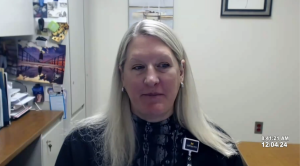
Kathy Dollard, Psy.D., L.P., director, behavioral health service line, MyMichigan Health, providing testimony via Zoom to the Senate Health Policy Committee in support of SB 802.
Two MHA members provided testimony to the Senate Health Policy Committee in support of SB 802; Kathy Dollard, Psy.D., L.P., director, behavioral health service line, MyMichigan Health and Bibhas Singla, MD, vice president & medicaid director of hospital & residential services, Pine Rest Christian Mental Health Services.
Dollard highlighted the lack of transparency in Michigan’s behavioral health system, particularly the absence of data-sharing requirements for CMH agencies regarding substance use disorder treatment options. She also addressed the issue of behavioral health boarding, where patients with behavioral health needs are often left waiting in emergency departments for extended periods due to a shortage of inpatient psychiatric beds or community-based services. MHA data shows that more than 150 patients experience this delay daily.
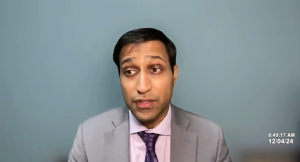
Bibhas Singla, MD, vice president & medicaid director of hospital & residential services, Pine Rest Christian Mental Health Services providing testimony via Zoom to the Senate Health Policy Committee in support of SB 802.
Dr. Singla highlighted the difficulty in transitioning patients from inpatient care to community-based services, particularly for Medicaid recipients. He shared the experience of a Medicaid patient in the addiction unit who struggled to find appropriate community-based care after discharge. Despite being motivated to seek help, the patient spent days calling programs across the state without success. The lack of available services and clear timelines for increasing capacity left the patient unable to access the care needed.
Dr. Singla explained that SB 802 would improve the system by requiring CMH agencies to report service availability in real-time, making it easier for healthcare providers and patients to access care. The bill was voted out of committee unanimously and will now move to the Senate floor.
Members with questions may contact Lauren LaPine at the MHA.
Laura Appel, executive vice president of government relations and public policy, MHA (middle), is pictured during a panel discussion at the SWBH 9th annual regional healthcare policy forum.
Southwest Michigan Behavioral Health (SWMBH) hosted Oct. 4 the ninth annual regional healthcare policy forum in Kalamazoo. Moderated by Dr. Colleen Allen, CEO, Autism Alliance of Michigan, the forum focused on the theme of “Working Together” to discuss the future landscape of Michigan healthcare.
The event convened association leaders, policymakers and behavioral health professionals to focus on fostering collaboration, addressing the needs of mutually served populations and advancing whole person care.
Laura Appel, executive vice president of government relations and public policy, MHA, joined a panel discussion alongside Meghan Groen, senior deputy director, Behavioral and Physical Health Services, Michigan Department of Health and Human Services; Dominick Pallone, executive director, Michigan Association of Health Plans; Phillip Bergquist, chief executive officer, Michigan Primary Care Association; State Representative Julie Rogers, chair, House Health Policy; and Alan Bolter, associate director, Community Mental Health Association of Michigan to discuss Psychiatric Residential Treatment Facilities, opioid settlement dollars and treatment for substance use disorders.
SWMBH is the Prepaid Inpatient Health Plan for eight Michigan counties and is in partnership with the Community Mental Health (CMH) agencies of these counties. SWMBH, in partnership with the CMH’s and local providers, provides mental health services to adults with severe and persistent mental illness, children with severe emotional disturbance, individuals with intellectual/developmental disabilities and individuals with substance use disorders.
The event also held an awards presentation which honored Gov. Gretchen Whitmer and Van Buren County Commissioner Richard Godfrey.
Members with questions about the event or SMBH are encouraged to contact Lauren LaPine at the MHA.
The MHA Keystone Center celebrated Melissa Burgess, RN at McLaren Port Huron Hospital as its quarterly MHA Keystone Center Speak-up! Award recipient in September. The quarterly MHA Keystone Center Speak-up! …
The United States Departments of Labor, Health and Human Services and the Treasury issued a set of final rules Sept. 9 on the Mental Health Parity and Addiction Equity Act of 2008. The rulings …
The Michigan Department of Health and Human Services (MDHHS) Division of Maternal and Infant Health is partnering with the Michigan Perinatal Quality Collaborative yo offer its Statewide Maternal and Infant Health Data Meeting from 4 to 6 …
The September edition of Trustee Insights, a monthly digital package from the American Hospital Association (AHA), outlines how artificial intelligence (AI) will change healthcare operations and how trustees can provide meaningful leadership and guidance. The issue …
“In my report June 10, I wrote: “The major sources of physician discontent are administrative hassles and unwelcome clinical oversight that create dissonance. They conflict with a false sense of autonomy that the majority of physicians imagined when choosing medicine. Cuts to reimbursement, participation in alternative payment models and medical inflation are manifestations of a system in which ‘suits’ are intruders who make rules, exact handsome salaries, generate corporate profits and distance physicians from patient care purposely… “
This assessment remains true today. Discontent among physicians is palpable and it’s magnified by a growing sense of financial despair among many clinicians. And it poses a unique challenge to hospitals that now employ more than half of America’s physician workforce. …
The core beliefs held by employed physicians about their hospitals may not be fair, objective or accurate, but they’re no less deeply felt and impactful. Hospital boards and C suite leaders would be well-served to refresh plans accordingly.”
The MHA received media coverage the week of Sept. 16 regarding Michigan healthcare careers and what’s next for digital health. Second Wave Michigan published a story Sept. 17 on healthcare careers and the existing healthcare …
The United States Departments of Labor, Health and Human Services and the Treasury issued a set of final rules Sept. 9 on the Mental Health Parity and Addiction Equity Act (MHPAEA) of 2008.
The rulings aim to promote equitable access to mental health and Substance Use Disorder (SUD) benefits and reduce barriers to accessing these services. They also reinforce the requirement that mental health and SUD benefits be on par with medical and surgical benefits (M/S).
If a health plan provides benefits for a mental health condition or SUD, it must provide meaningful benefits for that condition or disorder in every classification for which meaningful M/S benefits are offered. The rulings also restrict self-funded, non-federal governmental plans from opting out of providing mental health/SUD benefits. Additionally, it provides concrete factors used to determine out-of-network reimbursement rates.
The final rules also provide protection from non-quantitative treatment limitations (NQTLs) on mental health and substance use disorder benefits. NQTLs are conditions that restrict the scope of benefits, such as prior authorization requirements. The rulings prohibit insurance plans from using biased information when applying NQTLs. Issuers must also collect and assess data on the NQTLs they place and adapt accordingly if the data shows they are negatively impacting access to MH/SUD services compared to M/S benefits.
The final rules apply to:
Group health insurance coverage beginning on or after Jan. 1, 2025. The meaningful benefits standard, the prohibition on discriminatory factors and evidentiary standards, the relevant data evaluation requirements and the related requirements in the provisions for comparative analyses will apply beginning on or after Jan. 1, 2026.
Health insurance issuers offering individual health insurance coverage for policy years beginning on or after Jan. 1, 2026.
Members with questions may contact Lauren LaPine at the MHA.
Gov. Whitmer signed Michigan’s first mental health parity law May 21. The bipartisan legislation requires insurance coverage for mental health and substance use disorder treatments at the same level as physical health services. Senate Bill …
Applications for the 2024 – 2025 MHA Excellence in Governance Fellowship, held from October 2024 through June 2025, are due June 28. Governing board members enrolled in the fellowship will learn how to frame problems …
The MHA Health Foundation is hosting the Balancing Workplace Safety Privacy Laws webinar scheduled from 11 a.m. to noon, June 11. The webinar will address how hospitals balance the safety, security and privacy of patients, …
Following National EMS Week, it’s important to recognize how we can continue to support the dedicated teams providing lifesaving care every day to Michigan patients and communities. In my role as director of health policy …
Registration closes May 29 for the MHA webinar Recruitment Models that Grow a Strong and Patient-Centered Workforce scheduled from noon to 1 p.m. May 30. The webinar highlights the MHA Person & Family Engagement Roadmap, …
“Academic researchers and economists have concluded that hospital price transparency has not led to reduced heath spending overall nor lower hospital prices. Per a recent systematic review: “No evidence was found for impact on the outcomes volume, availability or affordability. The overall lack of evidence on policies promoting price transparency is a clear call for further research… Price-aware patients chose less costly services that led to out-of-pocket cost savings and savings for health insurers; however, these savings did not translate into reductions in aggregate healthcare spending. Disclosure of list prices had no effect, however disclosure of negotiated prices prompted supply-side competition which led to decreases in prices for shoppable services.”
Per Wall Street Journal actuaries, hospital price increases account for 23% of annual health spending increases but vary widely based on factors other than their underlying costs. Determining how hospital prices are set remains beyond the scope of conventional pricing models. …
Is the Juice worth the Squeeze for hospital price transparency efforts? To date, proponents say yes, opponents say no, and each side has valid concern about use by consumers. But unless one believes the role of consumers as purchasers and users of the system’s service will diminish in coming years, the safe bet is hospital price transparency will play a bigger role. …”
The Michigan Senate advanced their chamber budgets for the upcoming fiscal year during the week of May 13. The Senate’s budget recommendations for the Department of Health and Human Services continues vital funding for Medicaid, …
The MHA Legislative Policy Panel met at the MHA Capital Advocacy Center May 15 to develop recommendations for the MHA Board of Trustees on legislative initiatives impacting Michigan hospitals. The meeting was highlighted by presentations …
The 2024 Centers for Disease Control and Prevention (CDC) national survey of Maternity Practices in Infant Nutrition and Care (mPINC) will close June 10. The CDC seeks to assess maternity care practices that influence how …
U.S. Sens. Jerry Moran (R-KS) and Tina Smith (D-MN) introduced the Rural Emergency Hospital Improvement Act May 14 to bolster rural healthcare. Senate Bill 4322 aims to address critical gaps in rural healthcare infrastructure by …
The MHA released a new episode of the MiCare Champion Cast exploring how clinicians are navigating virtual care in the behavioral health space. The episode, released during Mental Health Awareness Month, features two providers from Pine Rest Christian Mental Health Services. …
“The U.S. economy is strong but growing numbers in the population face financial insecurity and economic despair. Increased out-of-pocket costs for food, fuel and housing (especially rent) have squeezed household budgets and contributed to increased medical debt—a problem in 41% of U.S. households today. Hospital bills are a factor. …
For most hospitals, a decision to invest and behave as if the future is a repeat of the past is a calculated risk. Others with less stake in community health and wellbeing and greater access to capital will seize this opportunity and, in the process, disable hospitals might play in the process.
Near-term reactive navigation vs. long-term proactive orchestration–that’s the crossroad in front of hospitals today. Hopefully, during National Hospital Week, it will get the attention it needs in every hospital board room and C suite. …”
Crain’s Grand Rapids published an article May 16 on the release of Rand Corp. study on hospital pricing. Michigan reportedly has the third lowest hospital care costs relative to Medicare in the country, although the …





 McLaren Port Huron Nurse Receives MHA Keystone Center Speak-up! Award
 Final Rules Strengthen Access to Mental Health, Substance Use Disorder Benefits
 The Four Core Beliefs of Hospital-Employed Physicians
 MHA in the News
 Governor Signs Mental Health Parity Law and Other Legislative Updates
 MHA Webinar Reviews Workplace Safety and Privacy Laws
 Collaborating to Address EMS Challenges
 News to Know
 House Campaign Committee Chairs Address Legislative Policy Panel
 MHA Podcast Explores Benefits, Challenges of Virtual Care in Behavioral Health
 MHA in the News