

MHA Monday Report Sept. 23, 2024

Speak up awardMcLaren Port Huron Nurse Receives MHA Keystone Center Speak-up! Award

The MHA Keystone Center celebrated Melissa Burgess, RN at McLaren Port Huron Hospital as its quarterly MHA Keystone Center Speak-up! Award recipient in September. The quarterly MHA Keystone Center Speak-up! …


Final Rules Strengthen Access to Mental Health, Substance Use Disorder Benefits

The United States Departments of Labor, Health and Human Services and the Treasury issued a set of final rules Sept. 9 on the Mental Health Parity and Addiction Equity Act of 2008. The rulings …


Upcoming MDHHS Maternal Health Offerings

The Michigan Department of Health and Human Services (MDHHS) Division of Maternal and Infant Health is partnering with the Michigan Perinatal Quality Collaborative yo offer its Statewide Maternal and Infant Health Data Meeting from 4 to 6 …


Latest AHA Trustee Insights Explores AI in Healthcare, Workplace Equity and Community Partnerships

The September edition of Trustee Insights, a monthly digital package from the American Hospital Association (AHA), outlines how artificial intelligence (AI) will change healthcare operations and how trustees can provide meaningful leadership and guidance. The issue …


Keckley Report

The Four Core Beliefs of Hospital-Employed Physicians

“In my report June 10, I wrote: “The major sources of physician discontent are administrative hassles and unwelcome clinical oversight that create dissonance. They conflict with a false sense of autonomy that the majority of physicians imagined when choosing medicine. Cuts to reimbursement, participation in alternative payment models and medical inflation are manifestations of a system in which ‘suits’ are intruders who make rules, exact handsome salaries, generate corporate profits and distance physicians from patient care purposely… “

This assessment remains true today. Discontent among physicians is palpable and it’s magnified by a growing sense of financial despair among many clinicians. And it poses a unique challenge to hospitals that now employ more than half of America’s physician workforce. …

The core beliefs held by employed physicians about their hospitals may not be fair, objective or accurate, but they’re no less deeply felt and impactful. Hospital boards and C suite leaders would be well-served to refresh plans accordingly.”

Paul Keckley, Sept. 16, 2024


Laura AppelMHA in the News

The MHA received media coverage the week of Sept. 16 regarding Michigan healthcare careers and what’s next for digital health. Second Wave Michigan published a story Sept. 17 on healthcare careers and the existing healthcare …


MHA Monday Report Sept. 16, 2024

Leaders Convene for Crucial Healthcare Workforce Discussion

The MHA hosted nearly 150 thought leaders from healthcare, post-secondary education and workforce talent development Sept. 11 in Lansing for a discussion to help strengthen connections across the sectors focused on building the pipeline for …


MDHHS Issues Final Maternal Infant Health Services Policy

The Michigan Department of Health and Human Services (MDHHS) issued a final Medicaid Policy Bulletin Sept. 9 to expand coverage for Maternal Infant Health Program services. ​​ The final policy was issued in response …


2024 Election Materials Available for Michigan Hospitals

The MHA is offering election communication materials geared toward hospital staff, volunteers, patients and visitors to encourage voter participation in the 2024 general election. Additionally, the MHA elections webpage will be updated regularly with relevant …


Michigan Doula Advisory Council Membership Application Opens

The Michigan Doula Advisory Council (DAC) invites doulas across the state to apply for membership as its first council term ends in Dec. 2024. The DAC works to improve doula services in Michigan, particularly with …


What’s Ahead in Healthcare? Insights from the American Hospital Association
The MHA released a new episode of the MiCare Champion Cast featuring Rick Pollack, president and CEO of the American Hospital Association. Pollack joined MHA CEO Brian Peters to discuss a variety of topics …


Keckley Report

The Presidential Debate will Frustrate Healthcare Voters

“The healthcare system per se is not a major concern to voters this year, but its affordability is. Out-of-pocket costs for prescription drugs, insurance premiums and co-pays and deductibles for hospitals and physician services are considered unreasonable and inexplicably high. They contribute to public anxiety about their financial security alongside housing and food costs. And majorities think the government should do more by imposing price controls and limiting corporate consolidation. …

Misinformation, disinformation and AI derived social media messaging are standard fare in winner-take-all politics. When used in addressing health issues and policies, they’re effective because the public’s basic level of understanding of the health system is embarrassingly low: studies show 4 in 5 American’s confess to confusion citing the system’s complexity and, regrettably, the inadequacy of efforts to mitigate their ignorance is widely acknowledged. Thus, terms like affordability, value, quality, not-for-profit healthcare and many others can be used liberally by politicians, trade groups and journalists without fear of challenge since they’re defined differently by every user. …

Long-term, the system will proceed incrementally. Bigger players will fare OK and others will fail. I remain hopeful thoughtful leaders will address the near and long-term future with equal energy and attention. Regrettably, the tyranny of the urgent owns the U.S. health system’s attention these days: its long-term destination is out-of-sight, out-of-mind to most. And the complexity of its short-term issues lend to magnification of misinformation, disinformation and public ignorance.

That’s why this debate will frustrate healthcare voters.”

Paul Keckley, Sept. 9, 2024


MHA in the News

WWMT-TV Newschannel 3 aired a story Sept. 9 on the radiology workforce shortage in hospitals, including a shortage of radiologists and radiology technicians. MHA Executive Vice President Laura Appel was interviewed for the story, explaining …

What I Learned as a Provider Working in Public Policy

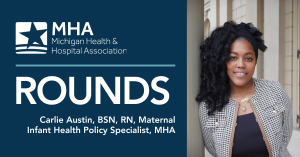
Carlie Austin, BSN, RN, shares her journey serving as the maternal infant health policy specialist at the MHA.

As a clinician, what drew you to a role tied to public policy?

If I had to sum it up in two words, I’d say problems and solutions. The challenges I’ve encountered at the clinical level and my quest for generating solutions at the hospital and community level naturally led me to this role. The reality is that the nursing profession is inherently tied to public policy.

One of my favorite documents to read is the Guide to Nursing’s Social Policy Statement. It essentially tells us that it’s our professional duty to address the problems faced by the people we serve, including disparities and inequities. My favorite line says, “In some instances nursing will be in the vanguard of emerging health-related issues. Nursing will participate in the promulgation of healthcare policy at regional, state, national and global levels. Protection of the public through advocacy also includes whistleblowing.”

Although “whistleblowing” may have a negative connotation, I interpret it as meaning that we all should be productive disruptors of the systems, practices and barriers that make it difficult to deliver equitable care to all of our communities. Public policy is about intentionally targeting problems and creating meaningful solutions to support the greater good.

What are some of the things you learned about public policy in your time at MHA?

I learned that public policy truly requires the engagement of issue experts. The saying “people closest to the problem are closest to the solution” has taken on a new meaning during my time at the MHA. I learned that public policy is reliant on relationship and true collaboration among diverse stakeholders in order to foster solutions that best serve Michigan communities.

How did your clinical background inform or influence conversations around public policy? Why should providers and clinicians be involved in public policy?

To quote my supervisor, Lauren LaPine, Senior Director, Legislative and Public Policy, MHA, “having perspective from the bedside helps the MHA create policy and legislative efforts statewide that are directly informed by experience treating patients. Having your insight helps us more deeply focus on public policy that is patient-centered.”

Lauren’s words perfectly capture why clinical providers should be involved in public policy and the strong influence we can have. Before taking this role, fellow bedside nurses questioned my decision. They saw a public narrative that shaped their perceptions of the health policy environment; however, I took the role to challenge that narrative, to inspire systematic change, and to bridge the voice of the bedside with the power of policy.

I was able to show up authentically because I was a part of a team that granted me the space to challenge our system to be better. I’ve worked on efforts to improve maternal regionalization, used my lived experience to advance health equity solutions and regularly engaged with community stakeholders. We’re facing unprecedented times in healthcare, but serving in this role has shown me what we can accomplish by being more intentional about unifying in areas that often divide us.

How can providers get involved in public policy and healthcare advocacy?

Start where you can. It’s our professional duty as providers to seek solutions for the problems we see. Engage with your executive leadership, community advocates, legislators and associations – including the MHA – that will listen and amplify your voice. Most importantly, be open. Never allow a narrative to deter you from writing your own. Public policy requires us all to creatively color outside of the lines.