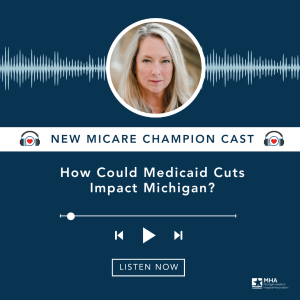
How Could Medicaid Cuts Impact Michigan?

MiCare Champion Cast Header Photo

The MHA released a new episode of the MiCare Champion Cast exploring how proposed reductions to Medicaid could disrupt access to care and harm Michigan hospitals, patients and communities.

Laura Appel, executive vice president of government relations & public policy, MHA, first explored the history and purpose of Medicaid and the Healthy Michigan Plan, which has been hailed a success for improving access to care, reducing the uninsured rate and supporting economic stability for families across the state.

Appel explained the potential impact of recent federal proposals, which include instructions to cut Medicaid by at least $880 billion over 10 years. Changes like block grants, per capita caps and reduced federal matching rates could lead to a staggering $1.73 billion shortfall in the state budget, jeopardizing access to healthcare for millions.

“Cutting funding is cutting care,” said Appel. “Not every hospital is on the financial footing it wishes it were and there are a lot of hospitals across the country that are already in difficult financial straits…this could be the reason that they close all together.”

Michigan hospitals are asking members of Congress to protect the Medicaid program and oppose proposed reductions. Appel noted those interested in helping with this effort and reaching members of Congress are encouraged to visit the MHA Legislative Action Center.

Listeners can also expect to learn more about the impact proposed cuts would have on rural healthcare and Michigan’s economy. The episode is available to stream on Apple PodcastsSpotifySoundCloud and YouTube.

Medicare and Medicaid Enrollment Update

The MHA updated its analysis of Medicaid and Medicare enrollment based on December 2024 data. The analysis includes program enrollment as a percentage of each county’s total population and the split between fee-for-service (FFS) and managed care organization (MCO). Just over 27% of Michigan’s total population is enrolled in Medicaid and 22% is enrolled in Medicare.

Roughly two-thirds of Michigan’s 2.66 million Medicaid beneficiaries are enrolled in one of nine managed care plans.

Total Medicare enrollment is 2.25 million, with 62% of beneficiaries enrolled in a Medicaid Advantage (MA) plan and only three counties having less than 50% of total Medicare enrollment in MA plans. MA enrollment by county ranges from 45% to 77%, with 66 counties having 55% or more of their Medicare population enrolled in an MA plan, as highlighted below.

December enrollment is spread across 54 MA plans, with up to 29 plans covering beneficiaries in several Michigan counties and a minimum of 5 plans available in each county.

Members with enrollment questions should contact the MHA Health Finance team.

2025 Medicare Fee-for-Service Home Health Final Rule Released

The Centers for Medicare & Medicaid Services (CMS) recently released a final rule for the home health (HH) prospective payment system (PPS) for calendar year (CY) 2025. The rule includes updates to the Medicare fee-for-service (FFS) HH PPS payment rates based on changes by the CMS and those previously adopted by the U.S. Congress.

Highlights of the final rule, which takes effect Jan. 1, 2025, include:

  • A negative 2% adjustment to base payment rates to achieve budget neutrality following the transition to the Patient-driven Groupings Model (PDGM).
  • A 30-day standard payment rate of $2,057.35, up 0.9% from the current $2,038.13, for HHs that submit the required quality data.
  • Updating core-based statistical areas for wage index purposes, consistent with recent fiscal year 2025 final rules.
  • Recalibrating the PDGM case-mix weights, low utilization payment adjustment thresholds, functional levels and comorbidity adjustment subgroups.
  • Revising the fixed dollar loss ratio from 0.27 to 0.35, reducing outlier payments.
  • Requiring HH agencies to report four new patient assessment items in the HH agency Outcome and Assessment Information Set under the social determinants of health category beginning with CY 2027.
  • Adding a new standard within the Medicare Conditions of Participation requiring HH agencies to develop, implement and maintain a patient acceptance to service policy that is applied consistently to each prospective patient referred for HH care.
  • Requiring long-term care facilities to electronically report information about COVID-19, influenza and respiratory syncytial virus in a standardized format weekly through National Healthcare Safety Network beginning Jan. 1, 2025. The CMS notes that the Secretary will have the discretion to revise the reporting frequency based on changing needs for data collection.

The MHA will provide an updated impact analysis in the near future. Members with questions should contact Vickie Kunz at the MHA.

MHA CEO Report — Site-Neutral Payment Policies: The Latest Threat to Patient Access

MHA Rounds graphic of Brian Peters

The worst form of inequality is to try to make unequal things equal.” Aristotle

MHA Rounds graphic of Brian PetersOperating a hospital has never been more challenging than it is today. At the most fundamental level, hospitals are small towns that operate 24/7, year-round, built around expert clinicians, as well as a wide variety of highly skilled employees in multiple disciplines. Collectively, they are tasked with the awesome responsibility of delivering a broad spectrum of high-quality healthcare services to everyone in their respective communities, regardless of their health or socio-economic status.

Our MHA Chief Medical Officer, Gary Roth, DO, often says “healthcare is everyone’s destiny.” He’s right: at some point, all of us – or our loved ones – will require the assistance of our healthcare system. And when that day comes, we as patients can and should expect that we have ready access to care. Michigan hospitals take that expectation very seriously, whether that comes in the form of physician recruitment, retention and call coverage, drug acquisition, facilities maintenance and expansion, or ensuring that the latest diagnostic and treatment technology is on-site.

Here is an economic reality: being prepared to care for anyone, for any diagnosis, at any time, creates high fixed costs. In classic business terminology, hospitals are “price takers” when it comes to government payers, because Medicaid and Medicare effectively tell hospitals what they will receive in reimbursement.

Against this backdrop, our field is currently facing a strong push at the federal level to prevent hospitals from receiving Medicare reimbursement at a level that appropriately recognizes the higher fixed and operational costs referenced above. Referred to as “site-neutral payments,” this policy would force hospitals to accept the same rates as those paid at other sites of care. This ignores the fact that the cost structures between the two settings are very different because hospitals go to great lengths to have the infrastructure in place to save lives every day. Non-hospital settings serve a very valuable but different role, and the reimbursement they receive today reflects those differences. In addition to being open 24/7/365 to all patients – including those with multiple comorbidities, and little or no health insurance coverage, hospitals must have redundant systems for energy and water so surgeries and other patient care can continue uninterrupted when the power goes out or other systems are compromised. Physician offices have no such requirements and don’t bear these costs.

Hospital outpatient departments also provide convenient access to care for the most vulnerable and medically complex patients. These settings are more likely to treat Medicare patients who have more chronic and severe conditions, have been recently hospitalized or in an emergency department and are dually eligible for Medicare and Medicaid. These patients are more expensive to care for and rely on hospital outpatient departments for their increased healthcare needs.

Implementing site-neutral payment policies would be detrimental to access to care for patients across Michigan and the country. If reimbursement is slashed across the board, hospitals will be forced to reduce their costs, which will come in the form of reduced hospital beds, service lines or even potentially hospital closures. This plan for inadequate payment can be particularly harmful for hospitals serving a high percentage of vulnerable patients, including rural hospitals. When a hospital closes services due to site-neutral payment policy, they will close to everyone, not just people covered under Medicare.

I was recently honored to be appointed to the American Hospital Association Board of Trustees and this issue is clearly a key focus of their advocacy work on Capitol Hill. The MHA is joining that effort by advocating with Michigan’s members of Congress, and our message is unambiguous: comparing hospitals with other sites of care is not comparing apples and oranges – it’s comparing apples and space shuttles. More importantly, reducing healthcare costs can’t come at the expense of reduced access to care.

As always, I welcome your thoughts.

MHA Monday Report Aug. 19, 2024

MHA Submits Comments on Speech-Language Pathologist Proposed Policy

The MHA recently provided comments to the Michigan Department of Health and Human Services (MDHHS) regarding a proposed policy change for Medicaid enrollment of speech-language pathologists. The MHA supports MDHHS’s efforts to align Michigan licensure …


Registration Open for Safe Table on Just Culture

The MHA Keystone Center Patient Safety Organization is hosting a Just Culture Safe Table from noon to 4 p.m., Thursday, Sept. 19 at the MHA headquarters in Okemos, MI. The peer-led discussion about Just …


Special Pathogen Preparedness and the Revised Infection Control Joint Commission Standards Webinar

The National Emerging Special Pathogens Training & Education Center, in collaboration with the Association for Professionals in Infection Control and Epidemiology, are hosting the webinar Special Pathogen Preparedness and the Revised Infection Control Joint Commission Standards …


Kelley Cawthorne Ad


New CMS Requirements for Reporting of Hospital Respiratory Data

The MHA recently submitted formal comments to the Centers for Medicare & Medicaid Services (CMS) on the proposed updates to the Medicare Inpatient Prospective Payment System for fiscal year 2025. Updates to the hospital and …


MHA Provides Comment on Proposed Medicaid Reimbursement for Group Prenatal Care

The MHA submitted a comment letter to the Michigan Department of Health and Human Services regarding the proposed Medicaid coverage of group prenatal care, set to begin in October 2024. The MHA expressed support for …


The Keckley Report

Healthcare’s Three Big Tents have Much in Common

“Arguably, three trade groups have emerged at the center of healthcare system transformation efforts in the U.S.: the American Hospital Association (AHA), America’s Health Insurance Plans (AHIP) and the Pharmaceutical Research and Manufacturers of America (PhRMA). Others weigh in—the American Medical Association, AdvaMed, the American Public Health Association and others—but this trio is widely regarded as the Big Tents under which policy changes are pursued. …

The Boards of the Big Tent trio weigh in, but senior staff in each of the Big Tents drive the organization’s strategy. They’re experienced in advocacy, well-paid and often heavy-handed in dealing with critics.

Operationally, the 3 Big Tents have much in common. Strategically, they’re far apart and the gap appears to be widening. Each blames the other for medical inflation and unnecessary cost. Each alleges the others use unfair business practices to gain market advantages. And each thinks their vision for the future of the U.S. health system is accurate, complete and in the best interest of the public good.

And none of the three has put-forth a vision for the long-term future of the U.S. health system.  Protecting the immediate interests of their members against unwelcome regulatory changes is their focus.”

Paul Keckley, Aug. 12, 2024


News to Know

The MHA Keystone Center is partnering with the Community Foundation of Southeast Michigan to host a two-part, virtual series about peer recovery services for substance and opioid use disorders from 10 a.m. to 12 p.m. on Sept. 17 and Sept. 23.


MHA CEO Brian Peters

MHA in the News

U.S. Representative Elissa Slotkin (D-MI) issued a press release Aug. 8 highlighting her introduction of the American Made Pharmaceuticals Acts that included a quote of support from MHA CEO Brian Peters. The bipartisan bill, introduced with U.S. Rep. Don …

MHA Monday Report Aug. 12, 2024

MHA Shares State Impacts and Insights at Regional 340B Roundtable

MHA staff attended the Regional 340B Roundtable Aug. 7 in Florence, IN to join colleagues from the Indiana Hospital Association, Ohio Hospital Association, Kentucky Hospital Association and endorsed business partner, SunRx, to share best practices …


MHA Keystone Center Offers Learning Collaboratives for Peer Recovery Services

The MHA Keystone Center is partnering with the Community Foundation of Southeast Michigan to host a two-part, virtual series about peer recovery services for substance and opioid use disorders from 10 a.m. to 12 p.m. …


CMS Releases FY 2025 Final Rule for Skilled Nursing Facilities

The Centers for Medicare & Medicaid Services (CMS) recently released a final rule to update the Medicare fee-for-service prospective payment system for skilled nursing facilities for federal fiscal year (FY) 2025. Key provisions …


Kelley Cawthorne Ad


MHA Webinar Tying Person and Family Engagement to Culture Performance Deadline Approaching

One week remains before the registration deadline for the MHA webinar Tying Person and Family Engagement to Culture and Performance. Scheduled from noon to 1 p.m. Aug. 20, the webinar provides an opportunity for hospitals to …


CMS Releases FY 2025 LTCH Prospective Payment System Final Rule

The Centers for Medicare & Medicaid Services (C recently released a final rule to update the Medicare fee-for-service long-term care hospital (LTCH) prospective payment system for fiscal year 2025. Specifically, the final rule: Increases …


CMS Releases FY 2025 Hospital Inpatient Prospective Payment System Final Rule

The Centers for Medicare & Medicaid Services recently released a final rule to update the Medicare fee-for-service hospital inpatient prospective payment system for fiscal year (FY) 2025. Highlights of the final rule include: …


The Keckley Report

Big Sky is Cloudy for Hospitals

“As state hospital association leaders assemble in Big Sky, Montana this week, the environment for hospital-friendly legislation is threatening at best:

The public’s trust in hospitals has eroded. Hospital financial performance is a mixed bag: some are profitable and many aren’t. Congress thinks hospitals need more regulation to increase price transparency, require ownership disclosure, verify community benefits that justify tax exemptions and impose restrictions on hospital private equity investments. And programs through which state and federal health policies are authorized—HHS, CMS, FTC, FDA, CMMI et al—are in limbo as a result of the June 28, 2024 Chevron ruling by the Supreme Court. …

For hospitals, effective advocacy is imperative: the reservoir of good will enjoyed for decades is evaporating. Advertising “we’re there for you” is timely as rural providers need a lifeline, and public castigation of “corporate insurers and billionaire critics” necessary to rally supporters. But beyond these, two things are clear:

  • The marketplace for “hospitals” is fundamentally different than the past requiring a clearer value proposition and fresh messaging.
  • And in states, hospitals will encounter unique opportunities and challenges in plotting strategies for their future. No two are alike.

Big Sky is a symbolic locale for this week’s meeting of state health executives: the Big Sky over hospitals is cloudy.”

Paul Keckley, Aug. 5, 2024

MHA Monday Report Aug. 5, 2024

Michigan Supreme Court Issues Ruling on Paid Sick Leave & Minimum Wage

The Michigan Supreme Court issued a ruling July 31 in Mothering Justice v. Attorney General that upholds voter initiative petitions on paid sick leave and minimum wage. Those laws, as originally enacted, will go into …


Michigan Medicaid Facility Rates Increased for Dental Procedures Under General Anesthesia

The Michigan Department of Health and Human Services issued a final policy to increase Medicaid payment rates for dental services provided to patients under general anesthesia in ambulatory surgical centers and outpatient hospitals, …


MDHHS and Michigan 211 Launches New Website for Grief and Bereavement Support

The Michigan Department of Health and Human Services (MDHHS), in partnership with Michigan 211, recently launched a new website aimed to providing support services for families who have experienced loss of a mother or infant. …


Kelley Cawthorne Ad


CMS Releases FY 2025 Final Rule for Inpatient Psychiatric Facilities

The Centers for Medicare & Medicaid Services (CMS) recently released a final rule to update the Medicare fee-for-service prospective payment system for inpatient psychiatric facilities for federal fiscal year (FY) 2025. Key provisions …


Applications Open for MI Behavioral Health Internship Stipend Program

The Michigan Department of Health and Human Services has allocated $3.5 million for the Behavioral Health Internship Stipend Program. This program will offer up to $15,000 stipends to student interns enrolled in behavioral health …


CMS Releases FY 2025 Final Rule for Inpatient Rehabilitation Facilities

The Centers for Medicare & Medicaid Services (CMS) recently released a final rule to update the Medicare fee-for-service prospective payment system for inpatient rehabilitation facilities for federal fiscal year (FY) 2025. Key provisions …


The Keckley Report

The Five Characteristics of the Blame and Shame Game in Healthcare

“The Blame and Shame Game spikes in election cycles as candidates pit themselves against their opponents. Healthcare plays its own version: last week is indicative: …

As Congress heads home for their August recess this week and Campaign 2024 intensifies, there’s no doubt healthcare issues will be prominent in local, state and national news. It’s also likely much of that coverage will be negative due to mounting cynicism about the industry’s business, consolidation, and opaque pricing and intensifying blame and shame games between hospitals and insurers, primary care and specialty physicians, PBMs and drug manufacturers, public health and healthcare delivery and others.

Blame and shame rhetoric about these tensions is not new, but its intensity is higher than ever as are the stakes. Blame and Shame is Chapter Two in most organization’s playbooks. Chapter One, the organization’s mission, vision, purpose and strategic plan is often missing and frequently premised on false assumptions. Thus, the “strategy” defaults to calling out the wrongdoings/shortcoming of adversaries and critics and little more. And their rhetoric is laced with terms for which accountability is suspect i.e. community benefit, affordability, value, quality and others. …

Here’s too much at stake to expect any inside sector to do this on its own: Blame and Shame is easier.”

Paul Keckley, July 29, 2024


News to Know 

The Primary Election is Tuesday, Aug. 6. Polls open at 7 a.m. and close at 8 p.m. Voters in line at 8 p.m. can still cast ballots. Those who missed the deadline to register online or by mail can do so in-person through Election Day with their local clerk. To check registration status, polling location or preview a ballot, visit the Michigan voter webpage.

MHA Monday Report July 29, 2024

Governor Signs FY 25 Budget and FY 24 Supplemental


Gov. Whitmer signed the fiscal year (FY) 2025 state budget on July 24. The budget proposal fully funds the Michigan Medicaid program, including significant increases to provider-funded Medicaid reimbursements in FY 24 and 25. The budget also …


Governor Signs Law Reducing Medical Waste

Gov. Whitmer signed Senate Bill 482, now Public Act (PA) 105 of 2024, on July 23, which extends the timeline for the disposal of sharps containers. Previously, state law mandated that sharps containers be removed …


June Medicaid and Medicare Enrollment in Michigan


The MHA updated its analysis of Medicaid and Medicare enrollment to reflect June 2024 data. The analysis now includes program enrollment as a percentage of each county’s total population and the split between fee-for-service and …


CMS Releases 2025 Physician Fee Schedule Proposed Rule

The Centers for Medicare & Medicaid Services (CMS) recently released a proposed rule to update the physician fee schedule (PFS) payment system effective Jan. 1, 2025. The proposal would: Reduce the PFS conversion factor by …


Webinar Explores Connection Between Person and Family Engagement and Performance

The MHA is hosting the webinar Tying Person and Family Engagement (PFE) to Culture and Performance from noon to 1 p.m. Aug. 20. The webinar will provide examples of how peers at hospitals are creating a PFE …


Engaging Providers and Transforming Revenue and Quality Performance Simultaneously

The MHA’s Endorsed Business Partner (EBP) program promotes industry-leading firms and connects member hospitals to solutions that alleviate pain points. The MHA recently endorsed ModusOne Health, which is the only physician-founded and operated clinical diagnosis improvement company (CDxI®) …


MDHHS

MDHHS Seeks Feedback from Older Adults and Caregivers on the 988 Suicide & Crisis Lifeline

The Michigan Department of Health & Human Services (MDHHS) is now surveying adults aged 60 and older and their caregivers about their experience with the 988 Suicide & Crisis Lifeline. The survey is scheduled to …


Expanding Peer Recovery Coach Services to Improve Patient Outcomes

The fiscal year (FY) 2025 budget includes critical funding to support the work of peer recovery coaches (PRCs) in Michigan hospitals. Kelsey Ostergren, director of health policy initiatives, MHA, and Michelle Norcross, senior director of safety & quality, MHA Keystone Center, share the impact these resources have on patients and communities …


Applications are Now Open for the Infection Prevention and Control Scholarship

The Association for Professionals in Infection Control and Epidemiology (APIC) has opened applications for the 2025 Critical Access Hospital (CAH) Scholarship program …


The Keckley Report

Campaign 2024 and US Healthcare: 7 Things we Know for Sure

“Over the weekend, President Biden called it quits and Democrats seemingly coalesced around Vice President Harris as the Party’s candidate for the White House. While speculation about her running mate swirls, the stakes for healthcare just got higher. Here’s why: …

Healthcare, to the Democratic-leaning voters is a right, not a privilege. Its majority think it should be universally accessible, affordable, and comprehensive akin to Medicare. They believe the status quo isn’t working: the federal government should steward something better. …

Regardless of the election outcome November 5, the U.S. healthcare industry will be under intense scrutiny in 2025 and beyond. It’s unavoidable.

Discontent is palpable. No sector in U.S. healthcare can afford complacency. And every stakeholder in the system faces threats that require new solutions and fresh voices.”

Paul Keckley, July 22, 2024


News to Know 

  • July 22 was the deadline to register by mail or online to be eligible to vote in the Primary Election on Aug. 6.


MHA in the NewsMHA CEO Brian Peters

Becker’s Hospital Review published an article July 23 that includes MHA CEO Brian Peters as one of 76 healthcare executives sharing their focus for the second half of 2024. Peters covered the importance of the …


June Medicaid and Medicare Enrollment in Michigan

The MHA updated its analysis of Medicaid and Medicare enrollment to reflect June 2024 data. The analysis now includes program enrollment as a percentage of each county’s total population and the split between fee-for-service and managed care organization. Nearly 27% of Michigan’s total population are enrolled in Medicaid and 22% are enrolled in Medicare.

The Michigan Department of Health and Human Services completed the Medicaid redetermination process, as required by the Consolidated Appropriations Act.  June 2024 enrollment, including the Healthy Michigan Plan, is at nearly 2.7 million, which is down approximately 603,000 since July 2023. 67% of Medicaid beneficiaries are enrolled in one of nine managed care plans.

The impact on hospitals is unknown since many enrollees had other coverage and their services were not billed to Medicaid. Many individuals who lost coverage have subsequently reenrolled in the program, have other third-party coverage or have sought coverage on the federal marketplace.

Total Medicare enrollment is 2.26 million, with 62% of beneficiaries enrolled in a Medicaid Advantage (MA) plan and only two counties having less than 50% of total Medicare enrollment in MA plans. MA enrollment by county varies from 45% to 77%, with most counties having 55% or more of their Medicare population enrolled in an MA plan, as highlighted below.

June enrollment is spread across 48 MA plans, with up to 28 plans covering beneficiaries in several Michigan counties.

Members with enrollment questions should contact the Health Finance team at the MHA.

MHA Monday Report July 22, 2024

Introducing New Infection Prevention Education

The MHA Keystone Center, in partnership with the Michigan Department of Health and Human Services, created a series of online learning modules for infection control and prevention education. The modules cater to the needs …


CMS Releases Medicare 2025 Outpatient Prospective Payment System Proposed Rule

The Centers for Medicare & Medicaid Services (CMS) recently released a proposed rule to update the Medicare fee-for-service outpatient prospective payment system effective Jan. 1, 2025. The proposed rule: Provides a net 2.3% increase …


MHA Webinar Reviews CMS Medication Administration and Management Requirement Updates

The MHA is hosting the webinar CMS Medication Administration and Management: IV Medication, Blood Administration and Safe Opioid Use from 10 a.m. to noon ET Aug. 27. Knowing medication is involved in 80% of treatment …


MHA Podcast Welcomes New Board Chair, Explores Healthcare Priorities in Michigan

The MHA released a new episode of the MiCare Champion Cast kicking off the 2024-2025 program year discussing healthcare viability, public health, workforce, cybersecurity, the election and more. The episode, hosted by MHA CEO Brian Peters, features MHA Board Chair Julie Yaroch, DO …


The Keckley Report

Most Hospitals Fall Short on Affordability, Vision and Trust

“This weekend, the American Hospital Association kicks-off its annual Leadership Summit in San Diego. Its agenda is organized around 8 themes: Transforming Care Delivery and Payment, Patient Centricity Through Digital Transformation, Building a More Flexible and Sustainable Workforce, Financial and Operating Excellence, Igniting Innovation, Elevating Health Equity, Improving Behavioral Health and Governance Excellence. They’re important. …

Collectively, that’s welcome news for a nation that’s anxious and divided. The current state in U.S. healthcare is much the same. It needs its hospitals to step up.

Some Boards and their hospital leadership teams take affordability, vision and trust seriously. Some don’t.”

Paul Keckley, July 15, 2024


News to Know

  • July 22 is the deadline to register by mail or online to be eligible to vote in the Primary Election on Aug. 6.

MHA CEO Brian Peters

MHA in the News

The MHA received media coverage the week of July 15 on healthcare priorities in Michigan, the state budget and the intersection between public health and healthcare. Hillsdale Hospital published an episode of the Rural Health …