The Michigan Department of Health and Human Services (MDHHS) recently announced a new grant opportunity to expand mobile crisis intervention services across the state. The expansion of mobile crisis services aims to increase access to behavioral health services statewide, irrespective of someone’s location, insurance coverage or other social factors.
The grant can be used to establish an array of mobile crisis response services, such as a two-person mobile crisis team, as long as services are offered 24/7. Services can include health screenings, de-escalation, stabilization and coordination of referrals to other services for a continuum of care.
Any public organization, including federally recognized tribal governments and local health departments, can apply for this grant. MDHHS plans to issue up to seven grants. The initial grant period will run from April 1, 2025, to Sept. 30, 2025, and approved applicants can be awarded up to $225,000. The second period will grant up to $775,000 in continuation awards per applicant from Oct. 1, 2025, to Sept. 30, 2027.
Grant applications must be submitted electronically through the EGrAMS system by 3 p.m. Tuesday, Feb. 11.
Members with questions may contact Lauren LaPine at the MHA.
The Michigan Legislature officially commenced their 103rd session on Wednesday, Jan. 8, including the introduction of legislation to amend Michigan’s Earned Sick Time Act . The session brings a new partisan divide with the Senate …
The U.S. Department of Health and Human Services (HHS) recently submitted a proposed rule to update the HIPAA Security Rule and enhance the protection of electronic protected health information. The changes aim to address the …
The enrollment deadline for the MHA Healthcare Leadership Academy is Feb. 3. The cohort meets Feb. 19 – 21 and April 10 and 11 at the MHA headquarters in Okemos. The Healthcare Leadership Academy, in partnership …
Qualifying rural hospitals may now apply for new residency positions created by Section 126 of the Consolidated Appropriations Act of 2021 and Section 4122 of the CAA of 2023, which allow hospitals to expand …
The Health Resources and Services Administration (HRSA) recently announced the establishment of the Addiction Medicine Fellowship Program, which trains physicians to become addiction medicine specialists. The program aims to expand the number of fellows at …
The Michigan Department of Health and Human Services is offering the Behavioral Health Internship Stipend Program, a key initiative aimed at increasing Michigan’s behavioral health workforce. Now in its second year, the program provides up …
The Michigan Public Health Week Partnership is now accepting nominations for the 2025 Hometown Health Hero Award. This award recognizes individuals and organizations that made a meaningful impact on improving the health of their community.
As we turn the page on 2024 (and celebrate our success in preventing harmful government-mandated nurse staffing ratio legislation, as well as harmful changes to our medical liability system, during the lame-duck session of the legislature), …
In late 2025, two events reset the U.S. health system’s future at least through 2026 and possibly beyond…
Transforming the U.S. health system is a bodacious ambition for the incoming Trump team. Early wins will be key—like expanding price transparency in every healthcare sector, softening restrictions on private equity investments, targeted cuts in Medicaid and Medicare funding and annulment of the Inflation Reduction Act. In tandem, it has promised to cut Federal government spending by $2 trillion and lower prices on everything including housing and healthcare—the two spending categories of highest concern to the working class. Healthcare will figure prominently in Team Trump’s agenda for 2025 and posturing for its 2026 mid-term campaign. And equally important, healthcare costs also figure prominently in quarterly earnings reports for companies that provide employee health benefits forecast to be 8% higher this year following a 7% spike the year prior. Last year’s 23% S&P growth is not expected to repeat this year raising shareholder anxiety and the economy’s long-term resilience and the large roles housing and healthcare play in its performance.”
Second Wave Michigan published a story Jan. 7 on how state officials, healthcare providers and community organizations are focusing on expanding the continuum of care for people experiencing a mental health crisis. Lauren LaPine, senior …
The Michigan Department of Health and Human Services (MDHHS) is offering theBehavioral Health Internship Stipend Program, a key initiative aimed at increasing Michigan’s behavioral health workforce. Now in its second year, the program provides up to $15,000 per student to cover costs such as tuition, fees, books and living expenses, helping address the growing need for mental health services across the state.
Eligible students must be enrolled in accredited bachelor’s or master’s degree programs that prepare them for behavioral health professions, such as:
Marriage or family therapy
Behavioral analysis
Social Work
Professional counseling
Psychology
MDHHS allocated $1 million for the program, which is expected to benefit approximately 100 interns, depending on individual funding needs.
Eligibility Requirements
To qualify for the stipend, applicants must:
Be enrolled in an accredited behavioral health degree program within the United States.
Have an approved unpaid internship in Michigan that meets the programs requirements.
Participate in program surveys and evaluation activities.
Commit to seeking employment in Michigan’s behavioral health sector after graduation (encouraged but not required).
Stipend Distribution
The stipend is a one-time award distributed in two payments, based on the total hours required by the internship site. Only hours accrued on or after Oct. 1, 2024 are eligible for stipend calculation. The tiered scale is as follows:
80-200 Hours: $5,000
201-400 Hours: $10,000
401-600 Hours: $15,000
Applications must be completed by 11:59 p.m. Jan. 22, 2025. Students should fill out the online application form and submit all required documentation to MDHHS. Applicants will be notified of their acceptance status within three weeks of the application deadline.
Members with questions may contact Lauren LaPine at the MHA.
The Health Resources and Services Administration (HRSA) recently announced the establishment of the Addiction Medicine Fellowship Program, which trains physicians to become addiction medicine specialists.
The program aims to expand the number of fellows at accredited Addiction Medicine Fellowship (AMF) and Addiction Psychiatry Fellowship (APF) programs. Program participants will be trained to work in underserved, community-based settings that provide primary care services, along with mental health disorder and substance use disorder services.
$23 million will be awarded to 28 fellows over a five-year period through this program. Applicants must be based at an accredited AMF or APF program. The sponsoring institution must be accredited by the Accreditation Council of Graduate Medical Education.
For more information and to access the application, members are encouraged to visit the HRSA website.
Members with questions may contact Lauren LaPine at the MHA.
Qualifying rural hospitals may now apply for new residency positions created by Section 126 of the Consolidated Appropriations Act (CAA) of 2021 and Section 4122 of the CAA of 2023, which allow hospitals to expand their resident physician programs, particularly in rural and healthcare provider shortage areas.
Sec. 126 of the CAA created 1,000 new Medicare funded residency slots to train physicians. Hospitals that qualify for these slots include:
Hospitals in rural areas (or treated as such legally).
Hospitals training a number of residents that exceeds their current GME cap.
Hospitals located in states with new medical schools and/or campuses.
Hospitals in areas designated as health professional shortage areas (HPSAs).
Under Sec. 126, at least 10 percent of the slots must be awarded to hospitals in each of the four categories, and each hospital can receive a maximum of 25 resident cap slots. The new residency slots available through Section 126 can be applied for residencies of any specialty, based on their need.
Sec. 4122 of the CAA, 2023 created 200 new Medicare funded residency slots. A minimum of 100 slots must be psychiatry or psychiatry subspecialty residency programs. Each qualifying hospital will receive one slot before any hospital receives additional slots. CMS will then distribute remaining slots by HPSA score. The criterion for qualification is the same as that outlined above. Section 4122 requires that at least 10% of the cap slots go to hospitals in each of the four categories.
The Rural Residency Planning and Development Technical Assistance Center will also host a webinar on how to apply for Sec. 126 and 4122 residency positions Jan. 16 from 1 – 2 p.m. ET.
Second Wave Michigan published a story Jan. 7 on how state officials, healthcare providers and community organizations are focusing on expanding the continuum of care for people experiencing a mental health crisis.
Lauren LaPine, senior director of legislative and public policy at the MHA, was interviewed in the story to share the role hospitals place in crisis care. She mentioned the high utilization of hospital emergency departments for people in a behavioral health crisis and the long wait times involved in finding the appropriate placement for the patient. LaPine also mentioned how the MHA is advocating for more resources that can support crisis intervention before hospitalization becomes necessary.
“We are working to build partnerships that can offer more specialized crisis care options,” said LaPine. “Similar to community paramedics initiatives, MDHHS [Michigan Department of Health and Human Services] has been committed to expanding access to mobile crisis units so when an individual is in some type of behavioral health crisis, there are mobile crisis units you can call through local community mental health agencies.”
Members with any questions regarding media requests should contact John Karasinski at the MHA.
The Michigan Department of Health and Human Services recently announced the 2025 application period for the Michigan State Loan Repayment Program (MSLRP). The program aims to aid in recruiting primary care, dental and mental health providers. MSLRP requires participants to practice full-time in designated Health Professional Shortage Areas at not-for-profit health clinics for at least two years, then provide up to $300,000 to repay educational debt for up to 10 years. The 2025 MSLRP application period opens Feb. 3, 2025 and closes April 30, 2025. Members with questions may contact Lauren LaPine at the MHA.
The Michigan Senate passed the Momnibus, a group of bills designed to improve equity and accountability in prenatal and maternal healthcare during the week of Dec. 2. The legislation includes Senate Bills 818–823, 825 and House Bill 5826, which focus on addressing systemic barriers, improving access to care and ensuring better patient outcomes for all birthing individuals, particularly those from Black and Brown communities.
The Momnibus makes several changes aimed at improving maternal healthcare, including creating opportunities for patients to directly engage in their treatment experience, implementing policies that support patient rights and providing funding to train more doulas to work in underserved areas. The bills also expand midwifery services, improve data transparency about maternal health outcomes and protect patient rights related to pregnancy and childbirth.
The bills will now move to the Michigan House of Representatives for further consideration. The MHA worked closely with the bill sponsors to improve access to maternal care and supported Senate Bills 818, 819, 820, and 825 as well as House Bill 5826. We will continue to report on further action on this legislation.
Members with questions may contact Lauren LaPine at the MHA.
The Michigan Senate unanimously passed several MHA-supported bills aimed at improving mental health treatment for individuals involved in the criminal justice system during the week of Dec. 2. Senate Bills (SB) 915 (Hertel-D), 916 (Santana-D), 917 (Irwin-D) and 918 (Wonjo-D) are designed to divert individuals with mental health issues from jail and into treatment programs.
SB 915 grants law enforcement officers the authority to take someone in for a psychiatric evaluation if they have “reasonable cause” to believe the person needs community mental health treatment. This change allows officers to act based on concerns from family members or treatment providers, rather than waiting for signs of uncontrolled mental illness. Supporters argue this will help individuals get treatment before symptoms escalate.
Similarly, SB 916 establishes a system where prosecuting attorneys, defendants or their counsel can request a mental health evaluation after misdemeanor charges are filed. If treatment is needed, the court can place the individual in an Assisted Outpatient Treatment program. Upon completion, the misdemeanor charges can be dismissed, offering an alternative to the criminal justice system. This bill aims to prioritize treatment over punishment and focuses on recovery without the pressure of legal consequences.
In addition, SB 802 (Wonjo-D) moved out of the Senate Health Policy Committee, following MHA-member testimony. This bill aims to enhance the transparency and accountability of Michigan’s behavioral health system by providing critical information on service availability and capacity.
Currently, there is no requirement for Community Mental Health (CMH) agencies to share data on treatment availability, leaving hospitals and policymakers without a clear understanding of what services are available statewide. This lack of data often leads to delays in care, especially for patients with behavioral health needs.
SB 802 addresses this concern by requiring CMH agencies to report real-time data on service capacity and availability. This will provide hospitals, healthcare providers and policymakers with better insight into service availability, helping patients access the care they need more quickly. The goal of SB 802 is to create a more transparent system, reduce wait times, improve patient outcomes, and inform decisions on expanding behavioral health services.
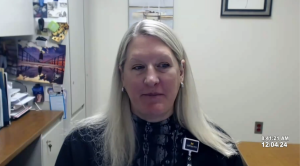
Kathy Dollard, Psy.D., L.P., director, behavioral health service line, MyMichigan Health, providing testimony via Zoom to the Senate Health Policy Committee in support of SB 802.
Two MHA members provided testimony to the Senate Health Policy Committee in support of SB 802; Kathy Dollard, Psy.D., L.P., director, behavioral health service line, MyMichigan Health and Bibhas Singla, MD, vice president & medicaid director of hospital & residential services, Pine Rest Christian Mental Health Services.
Dollard highlighted the lack of transparency in Michigan’s behavioral health system, particularly the absence of data-sharing requirements for CMH agencies regarding substance use disorder treatment options. She also addressed the issue of behavioral health boarding, where patients with behavioral health needs are often left waiting in emergency departments for extended periods due to a shortage of inpatient psychiatric beds or community-based services. MHA data shows that more than 150 patients experience this delay daily.
Bibhas Singla, MD, vice president & medicaid director of hospital & residential services, Pine Rest Christian Mental Health Services providing testimony via Zoom to the Senate Health Policy Committee in support of SB 802.
Dr. Singla highlighted the difficulty in transitioning patients from inpatient care to community-based services, particularly for Medicaid recipients. He shared the experience of a Medicaid patient in the addiction unit who struggled to find appropriate community-based care after discharge. Despite being motivated to seek help, the patient spent days calling programs across the state without success. The lack of available services and clear timelines for increasing capacity left the patient unable to access the care needed.
Dr. Singla explained that SB 802 would improve the system by requiring CMH agencies to report service availability in real-time, making it easier for healthcare providers and patients to access care. The bill was voted out of committee unanimously and will now move to the Senate floor.
Members with questions may contact Lauren LaPine at the MHA.
The Michigan Department of Health and Human Services (MDHHS) recently developed improvements to current substance use disorder (SUD) programs and a new SUD mapping tool to identify SUD treatment service locations throughout the state, with the goal to increase SUD treatment access for Michigan residents.
The new SUD mapping tool allows users to search for SUD treatment and recovery facilities by ZIP code, city or county. The tool outlines each location’s services, specifying if treatment is inpatient or outpatient, whether medication-assisted treatment is available and if Medicaid is accepted.
Improvements to Health Home services for SUD have also been implemented. Opioid Health Homes have been changed to SUD Health Homes to broaden access. MDHHS also added the Alcohol Use Disorder and Stimulant Use Disorder as diagnoses to broaden service eligibility.
MDHHS released a proposed policy Nov. 19 to increase the payment rate for the administration of methadone to at least $19.00 per unit, as well as increase access to related services for Medicaid beneficiaries. The funds to support this increase come from the state general fund that is federally matched.
Members with questions may contact Lauren LaPine at the MHA.
 103rd Legislature Begins With Introduction of Earned Sick Time Bills
 HHS Submits New HIPAA Security Proposed Rule
 MHA CEO Report — Impacting Communities
 The Two Events that Changed U.S. Healthcare for Everyone