
Veiled Attacks on Hospitals by Secretive Special Interests are Growing Tired

The following statement can be attributed to Brian Peters, CEO of the Michigan Health & Hospital Association.

Today’s Michigan Healthcare Purchaser’s Coalition publication on hospital margins is just another attempt by a secretive special interest group, hiding behind the veil of claiming to represent the employer community at large, to smear hospitals for being able to keep their doors open. Hospitals are committed to providing safe, high quality, affordable care in every community they serve. Hospitals save lives and put patients first – not profits. Hospitals have and continue to welcome conversations with actual employers, large and small, community members and legitimate business groups about healthcare pricing, access and quality so that they can work together on solutions, rather than spending time responding to blatantly misleading reports like this one.

Not only is this report published by a group that does not disclose on its website who is funding it or who it claims as members (or what their profit margins are), but its methodology based on the National Academy for State Health Policy’s Hospital Cost Tool is flawed. This report does not use the industry-standard method for calculating operating margins; it fails to account for costs associated with running a hospital. In the latest RAND Hospital Price Transparency study, Michigan has the third lowest average commercial price relative to Medicare in the entire country and one of just five states with case mix-adjusted hospital prices below 200% of Medicare prices. Lastly, the Kaiser Family Foundation in December 2024 published a study which found Michigan was one of only four states in the country where hospitals had, on average, a negative margin.

As always, we welcome open and transparent conversations about what is driving hospitals’ cost structures, such as:

  • Good workers who can take care of you and save your life demand, and deserve, high wages. According to Lightcast data, advertised salaries for registered nurses have grown 26.6% faster than the rate of inflation over the past four years.
  • People are sicker and need more care. Emergency department visits related to heart failure increased 126.7% per capita between 2010 and 2019, with associated spending growing 177.2%.
  • Medicare reimbursement continues to lag behind inflation — covering just 83 cents for every dollar spent by hospitals in 2023, resulting in over $100 billion in underpayments, according to the American Hospital Association (AHA) analysis of AHA Annual Survey data. Comparing commercial prices to government reimbursement, which has almost never even come close to covering what it costs a hospital to deliver that care, is irresponsible and misleading.

If the Michigan Healthcare Purchaser’s Coalition wants a transparent conversation about the price of healthcare, we again extend an invitation to their leadership and members, whoever they are, to have a solutions-focused dialogue together. Unfortunately, their continued public attacks using bad information indicates their true intention isn’t more affordable healthcare; it’s to bash community hospitals and the 220,000 workers taking care of Michigan patients.
MHA Monday Report June 23, 2025

Senate Health Policy Holds Testimony on Opioid Legislation

The Senate Health Policy Committee held testimony on legislation related to treating patients with opioid use disorders during the week of June 16. Collectively, Senate Bills 397–405 make numerous changes to improve coverage and access for Michiganders to receive …


MHA Shares Recent Medicare and Medicaid Enrollment Analysis

The MHA recently updated its analysis of Medicaid and Medicare enrollment based on May 2025 data. The analysis includes program enrollment as a percentage of each county’s total population and the split between fee-for-service and …


Recording and Materials Available from Medicare Quality Based Program Webinars

The MHA recently partnered with DataGen to host two webinars focused on the three Medicare fee-for-service (FFS) quality-based programs. These programs, mandated by the Affordable Care Act of 2010, can reduce hospital inpatient FFS payments …


MHA Guide to Behavioral Health Sites of Care Now Available

In an effort to help Michigan communities make informed decisions about where to seek behavioral healthcare services, the MHA has developed the Guide to Michigan’s Behavioral Healthcare Crisis Continuum. This material offers a broad overview of …


Michigan CNOs Convene at MHA Headquarters for Statewide Meeting

Chief nursing officers from across Michigan convened June 12 at the MHA headquarters in Okemos for a statewide, in-person meeting focused on healthcare policy, leadership and workforce safety. The meeting was led by Amy Brown, …


Latest AHA Trustee Insights Examines How Boards are Reimagining Workforce

The June edition of Trustee Insights, a monthly digital publication from the American Hospital Association, highlights how board members can support workforce planning and leverage innovation to strengthen healthcare delivery. One article outlines key questions …


Keckley Report

The May 2025 CPI Report: Good News, Bad News for Healthcare

“Last Wednesday, the Bureau of Labor Statistics issued its Consumer Price Index Report for May, 2025: “The Consumer Price Index for All Urban Consumers (CPI-U) increased 0.1% on a seasonally adjusted basis in May, after rising 0.2% in April. Over the last 12 months, the all-items index increased 2.4% before seasonal adjustment.” …

The public’s appetite to slow health spending, expose prices and costs and address the system’s waste, fraud and abuse is strong and growing. It’s certain to figure prominently in Congress’ budget negotiations and increasingly in household spending decisions.

The CPI is a lag indicator. It does not foretell the health economy of the future. That’s the discussion that’s needed.”

Paul Keckley, June 16, 2025


News to Know

MHA Endorsed Business Partner SUNRx is inviting 340B member hospitals to register for the Regional 340B Roundtable July 8 at Belterra Resort in Florence, IN.


MHA in the News

The Becker’s Healthcare Podcast published an episode June 16 that features MHA CEO Brian Peters joining host Scott Becker to discuss the current healthcare landscape and what the future looks like. Peters spent time discussing …

News to Know – June 23, 2025

MHA Endorsed Business Partner SUNRx is inviting 340B member hospitals to register for the Regional 340B Roundtable July 8 at Belterra Resort in Florence, IN. This roundtable offers valuable insights aiding in decision-making and ensuring compliance and optimization of the 340B pharmacy program. This event also includes valuable networking opportunities with other 340B hospitals from Indiana, Kentucky, Ohio and Michigan. Registration is available exclusively for 340B eligible entities. For additional information, contact John Bretz, director of strategic relations, SUNRx or Dwayne Dodd, regional manager, SUNRx. Members with questions may contact Rob Wood at the MHA.

Senate Health Policy Holds Testimony on Opioid Legislation

The Senate Health Policy Committee held testimony on legislation related to treating patients with opioid use disorder during the week of June 16.

Collectively, Senate Bills (SB) 397405 make numerous changes to improve coverage and access for Michiganders to receive treatment for opioid use disorder. SBs 397, 400, 401, 402 and 403 specifically apply commercial insurer and Medicaid coverage modifications to reduce delays and remove additional barriers in prescribing opioid-related treatment and dosages.

SB 398 modifies opioid treatment program requirements under the Department of Licensing and Regulatory Affairs, while SBs 404405 would require nurses to carry naloxone in select schools. Lastly, SB 399 amends the Public Health Code to specify that the term “drug paraphernalia” does not include testing products.

The MHA-supported bills now await a final vote in the Senate Health Policy Committee before moving to the full Senate chamber. The MHA Behavioral Health Integration Council reviewed and recommended changes for SBs 397, 398, 399, 400 and 402.

Members with additional questions should contact the MHA Advocacy Team.

MHA Guide to Behavioral Health Sites of Care Now Available

MHA Guide to Michigan’s Behavioral Healthcare Crisis Continuum

In an effort to help Michigan communities make informed decisions about where to seek behavioral healthcare services, the MHA has developed the Guide to Michigan’s Behavioral Healthcare Crisis Continuum.

This material offers a broad overview of the behavioral health services available across the state, the populations they serve and a specific listing of inpatient and outpatient facilities by name. The guide specifically lists all known:

  • Mobile Crisis Units (MCUs)
  • Certified Community Behavioral Health Clinics (CCBHCs)
  • Emergency Psychiatric Assessment, Treatment and Healing (EmPATH) Units
  • Partial Hospitalization Programs (PHPs)
  • Crisis Stabilization Units (CSUs)
  • Psychiatric Residential Treatment Facilities (PRTFs)

Michigan hospitals are encouraged to make use of this resource and contact the MHA Policy Team with questions, feedback or additions to the guide.

Michigan CNOs Convene at MHA Headquarters for Statewide Meeting

MHA Events

Chief nursing officers from across Michigan convened June 12 at the MHA headquarters in Okemos for a statewide, in-person meeting focused on healthcare policy, leadership and workforce safety.

The meeting was led by Amy Brown, chief nursing officer at the MHA, and provided an opportunity for fellowship, discussion and knowledge sharing among nursing leaders.

The agenda featured presentations from MHA staff Jason Jorkasky, senior vice president of health finance, and Elizabeth Kutter, senior director of government and political affairs. Jorkasky led a discussion on payment systems, regulations, and private payor trends, while Kutter provided updates on key policy developments at the state and federal levels.

With the meeting focused on workplace violence prevention, attendees heard from Brian Uridge, senior director, department of public safety and security, Michigan Medicine; and Jerry Dumond, director of public safety, chief of police authority, and K9, University of Michigan Health–Sparrow. Their insights supported a robust conversation on strategies to improve safety for healthcare workers.

The meeting concluded with remarks from Tim Johnsen, a nurse who reflected on his professional journey and the value of leadership in nursing, leaving attendees with a renewed sense of purpose.

The MHA appreciates the continued engagement of Michigan’s nurse leaders and their commitment to improving care and safety for patients and staff.

Members with questions regarding CNO meetings may contact Amy Brown at the MHA.

Recording and Materials Available from Medicare Quality Based Program Webinars

The MHA recently partnered with DataGen to host two webinars focused on the three Medicare fee-for-service (FFS) quality-based programs. These programs, mandated by the Affordable Care Act of 2010, can reduce hospital inpatient FFS payments by up to 6% based on performance.

The Medicare value-based purchasing (VBP) program is funded by a 2% contribution from inpatient operating payments of eligible prospective payment system hospitals with these funds, totaling approximately $1.7 billion, redistributed among hospitals nationally. Each hospital’s total performance score is determined based on four program domains, comprised of various measures. Materials and the recording of the June 11 webinar are available.

The second webinar, focusing on the Hospital Readmissions Reduction Program (RRP) and Hospital-Acquired Conditions (HAC) Reduction Programs, was also held. The RRP evaluates Medicare FFS patients with six medical conditions and penalizes hospitals for exceeding expected readmission rates. The HAC program evaluates performance on six measures and penalizes hospitals in the worst performing quartile compared to all other eligible hospitals nationally. For these two programs, hospitals can remain whole or be subject to payment penalties of up to 3% for the RRP and 1% for the HAC program, with all penalties benefiting the Centers for Medicare & Medicaid Services. Materials and the recording from the June 17 webinar are also available.

The MHA recently provided prospective payment system hospitals with the latest VBP and HAC program estimates through the hospital association reporting portal.

Members with questions should contact Vickie Kunz at the MHA.

MHA Shares Recent Medicare and Medicaid Enrollment Analysis

The MHA recently updated its analysis of Medicaid and Medicare enrollment based on May 2025 data. The analysis includes program enrollment as a percentage of each county’s total population and the split between fee-for-service and managed care organizations. Just over 26% of Michigan’s total population is enrolled in Medicaid and 23% is enrolled in Medicare.

Roughly two-thirds of Michigan’s 2.63 million Medicaid beneficiaries, are enrolled in one of nine managed care plans.

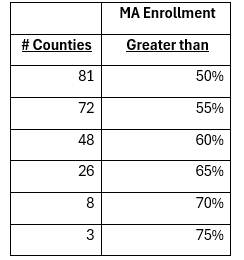
Total Medicare enrollment is 2.27 million, with 63% of beneficiaries enrolled in a Medicaid Advantage (MA) plan and only two counties having less than 50% of total Medicare enrollment in MA plans. MA enrollment by county ranges from 46% to 78%, with 72 counties having 55% or more of their Medicare population enrolled in an MA plan.

May enrollment is spread across 46 MA plans, with up to 29 plans covering beneficiaries in several Michigan counties and a minimum of six plans available in each county.

Members with enrollment questions should contact the Health Finance team at the MHA.

Latest AHA Trustee Insights Examines How Boards are Reimagining Workforce

The June edition of Trustee Insights, a monthly digital publication from the American Hospital Association, highlights how board members can support workforce planning and leverage innovation to strengthen healthcare delivery.

One article outlines key questions trustees should ask to ensure workforce priorities are embedded in enterprise planning, resourcing decisions and performance oversight. It also encourages boards to examine how work is structured to support updated roles and more efficient processes.

A second article explores how embracing “ecosystem-ness” and leveraging artificial intelligence can help create stronger networks that promote accessibility, cost effectiveness and collaborative care. It identifies four actions boards can take to shift from inward-focused system strategies to a broader, interconnected approach.

Members with questions about MHA trustee resources or webinars may contact Erin Steward at the MHA

MHA Monday Report June 16, 2025

Nurse Licensure Compact Legislation Clears House, Next of Kin Bills Advance

Legislation on the Nurse Licensure Compact and next of kin designations advanced in the Michigan House during the week of June 9. House Bill 4246, sponsored by Rep. Phil Green (R-Millington), passed the full …


MHA Testifies on Hospital Cost Drivers in House Insurance Committee

The MHA testified before the Michigan House Insurance Committee June 11 on healthcare cost issues affecting hospitals and communities across the state. Laura Appel, executive vice president, government relations & public policy, MHA and Elizabeth …


MHA Testifies on IMLC in House Health Policy

The MHA testified in support of Senate Bill 303 during a hearing in the Michigan Senate Health Policy Committee June 11. The legislation would reinstate Michigan’s participation in the Interstate Medical Licensure Compact (IMLC). …


MDHHS Launches New Mental Health Framework

The Michigan Department of Health and Human Services (MDHHS) is launching a new approach to mental healthcare under Medicaid as part of its MIHealthyLife initiative. The “Mental Health Framework” is designed to make care …


MHA Keystone Center to Support CMS’ Quality Improvement Program

Superior Health Quality Alliance (Superior Health) has been selected as the Great Lakes Region’s Quality Improvement Organization (QIO) to support the Centers for Medicare & Medicaid Services’ (CMS) 13th Scope of Work. As a member …


MiHIN in Negotiations to Sell Velatura Stake, Refocus Efforts on Michigan

The Michigan Health Information Network Shared Services (MiHIN), the state’s health information exchange, recently announced it is in negotiations to sell its interest in Velatura Public Benefit Corporation to Capernaum Investments. Velatura was established by MiHIN …


HHS Replaces ACIP Members, Future Vaccine Policy Unclear

The U.S. Department of Health and Human Services (HHS) Secretary Robert F. Kennedy Jr. announced June 9 the removal of all 17 members of the Advisory Committee on Immunization Practices (ACIP). This independent body is comprised …


MHA Keystone Center PSO Hosts Cybersecurity and Regulatory Inspection Safe Table Events

The MHA Keystone Center Patient Safety Organization (PSO) hosted a safe table focused on Adapting Clinical Risk Management for Cybersecurity June 4 at the MHA Headquarters in Okemos. In partnership with MHA Endorsed Business Partner CyberForce|Q, the …


MHA Cybersecurity Communications Toolkit Available

A new MHA-member cybersecurity communications toolkit is now available to assist hospitals and health systems in preparing for and responding to a cyber incident. The available resources are focused on providing guidance in communicating with …


Keckley Report

The Hourly Workforce in Healthcare Deserves Attention

“Two government reports this week point to a familiar theme: healthcare employment is the backbone of the U.S. civilian workforce …

Arguably, their questions aren’t unique to hourly workers in healthcare: lower- and low-middle income employee cohorts in other industries feel the same. What’s unique to healthcare is the context: new technologies, new regulations, new transparency requirements, new ways of staffing and constant pressure to do more with less. Tension between workers and leaders in provider organizations is palpable—arguably more widespread than other industries in the economy. And human resource functions in these settings are understaffed and underfunded despite the mounting urgency of workforce issues since the pandemic. …

The hourly workforce in healthcare is important to its future. But most are worried about how to pay their bills at home and do a job with an uncertain future. These issues deserve attention.”

Paul Keckley, June 9, 2025


News to Know

MHA offices will be closed and no formal meetings will be scheduled June 19 in honor of Juneteenth.


MHA in the News

The MHA received news coverage during the week of June 9 that included local TV news stories on the Michigan House of Representatives passing a bill that would have the state join the National Nurse …