Bronson Battle Creek Hospital Nurse Honored with Q1 MHA Keystone Center Speak-up! Award

speak up
Brian Peters, CEO, MHA pictured with Season Willi, RN, Pre-Operative Nurse, Bronson Battle Creek Hospital and Gary L. Roth, DO, MBA, FACOS, Chief Medical Officer, MHA.

The Michigan Health & Hospital Association (MHA) Keystone Center recognized Season Willi, RN at Bronson Battle Creek Hospital, as its quarterly MHA Keystone Center Speak-up! Award recipient May 8.

The Speak-up! Award honors individuals or teams in Michigan hospitals who demonstrate an exceptional commitment to preventing harm to patients or staff. Willi was honored for speaking up when she noticed a patient’s guardian needed medical intervention during a pre-operative admissions call.

Willi noticed irregularities in the guardian’s speech before their call was disconnected. After attempting to reconnect multiple times, Willi contacted local authorities to conduct a welfare check. First responders brought the individual to the hospital to be treated for a stroke following Willi’s request.

“I’m relieved that the individual I spoke to over the phone received the medical attention they needed,” said Willi. “We are trained to remain vigilant for life-threatening symptoms, such as changes in speech patterns, and we hold a responsibility to intervene — even when the individual is not directly under our care.”

It was later learned that the individual was home alone and would have been for several more hours had Willi not intervened.

“Season’s critical thinking, life-saving instincts and deep compassion are at the core of who she is as a nurse. Her proactive intervention ensured that the patient received timely, emergent care — ultimately saving his life, “said Lindsey Wyman, Director of Nursing, Bronson Battle Creek Hospital. “Because of her swift action, he was able to return home to his family and resume the hobbies that he loves. We are all incredibly grateful for her expertise and decisive action, and thankful that this patient is now on the path to recovery.

Additional Speak-up! finalists for the first quarter of 2025 included:

  • Gabe Pierce, RN, University of Michigan Health-Sparrow
  • Kevin Komara, Corewell Health Farmington Hills Hospital

“It’s a privilege to celebrate nurses like Season that go above and beyond,” said MHA CEO Brian Peters. “”Her quick action reflects Bronson Healthcare’s commitment to the safety of the communities it serves, extending beyond the walls of its facilities.

More information about the MHA Keystone Center Speak-up! Award, including criteria and a nomination form, are available online.

The Five Things I Love Most About Nurses

Amy Brown, chief nursing officer, field engagement, MHA

In a few short days, I will celebrate one year as the inaugural chief nursing officer for the MHA. This position has given me the privilege of bringing together nurse leaders from across the state and country, gathering insights, sharing best practices and collaborating to drive meaningful change that advances care delivery.

When I visit with hospitals throughout Michigan, one constant remains true: nurses represent the essential foundation that supports our patients and communities. With this in mind, it seems fitting that the theme of National Nurses Week (May 6-12) focuses on recognizing the power of nurses as a driving force behind compassionate care, innovation and transformative changes in healthcare.

Before joining the MHA, I worked as a bedside nurse for six years and in hospital leadership for 16. As I reflect on my career, here are the top five things I love most about this workforce:

  1. Our authenticity: Nothing is off the table, whether you’re out to dinner with colleagues or interacting with patients and their families. Nurses keep it real.
  2. Our speed: Being a fast walker, a fast learner and a fast problem-solver is a must when it comes to this work.
  3. Our ability to connect: Nurses are required to get up close and personal. Because of this, we know how to reach others in a way that is meaningful and genuine.
  4. Our problem-solving skills: When you tell a nurse what you need, they will find a way to get the job done.
  5. Our resilience: Regardless of the hardship we’ve witnessed and endured, we continue to show up for our team, our patients and our communities every day.

I hope you’ll join me in thanking all the dedicated nurses across Michigan for their unwavering commitment to protecting our patients, enhancing care safety and quality and for the countless acts of kindness they perform that make a profound difference every day.

McLaren Port Huron Nurse Receives Q2 MHA Keystone Center Speak-up! Award

speak up
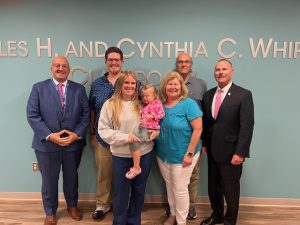
Melissa Burgess, RN at McLaren Port Huron Hospital pictured with her family, McLaren leadership and MHA CEO Brian Peters.

The Michigan Health & Hospital Association (MHA) Keystone Center celebrated Melissa Burgess, RN at McLaren Port Huron Hospital as its quarterly MHA Keystone Center Speak-up! Award recipient in September.

The quarterly MHA Keystone Center Speak-up! Award celebrates individuals or teams in Michigan hospitals demonstrating a commitment to the prevention of patient or staff harm.

Burgess was recognized for her swift intervention for a behavioral health patient. Working closely with the patient, she noticed a status change that prompted her to consult additional team members. Following a reevaluation, the patient was able to be provided with the adequate level of enhanced care they required.

“Melissa’s action is a direct reflection of her dedication to her patients and the trusted care we deliver to our community,” said McLaren Port Huron President and CEO Eric Cecava. “The level of her commitment is inspiring to our organization and empowering to her fellow caregivers, and we are grateful and proud to have her as an influential member of our team.”

Additional award finalists for the second quarter of 2024 include:

  • Tim Carew, Bronson Healthcare
  • Tiffany Holloway, Trinity Health Livonia Hospital
  • Jessica Winkelman, Corewell Health Dearborn Hospital

“We feel honored to celebrate alongside healthcare workers like Melissa who advocate for their patients every day in Michigan hospitals,” said MHA CEO Brian Peters. “Her decisive action demonstrates her commitment to her patient’s well-being and McLaren’s dedication to promoting a safety culture.”

More information about the MHA Keystone Center Speak-up! Award, including criteria and a nomination form, are available online.

What I Learned as a Provider Working in Public Policy

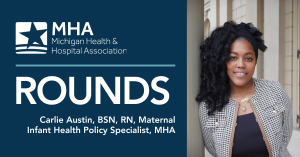
Carlie Austin, BSN, RN, shares her journey serving as the maternal infant health policy specialist at the MHA.

As a clinician, what drew you to a role tied to public policy?

If I had to sum it up in two words, I’d say problems and solutions. The challenges I’ve encountered at the clinical level and my quest for generating solutions at the hospital and community level naturally led me to this role. The reality is that the nursing profession is inherently tied to public policy.

One of my favorite documents to read is the Guide to Nursing’s Social Policy Statement. It essentially tells us that it’s our professional duty to address the problems faced by the people we serve, including disparities and inequities. My favorite line says, “In some instances nursing will be in the vanguard of emerging health-related issues. Nursing will participate in the promulgation of healthcare policy at regional, state, national and global levels. Protection of the public through advocacy also includes whistleblowing.”

Although “whistleblowing” may have a negative connotation, I interpret it as meaning that we all should be productive disruptors of the systems, practices and barriers that make it difficult to deliver equitable care to all of our communities. Public policy is about intentionally targeting problems and creating meaningful solutions to support the greater good.

What are some of the things you learned about public policy in your time at MHA?

I learned that public policy truly requires the engagement of issue experts. The saying “people closest to the problem are closest to the solution” has taken on a new meaning during my time at the MHA. I learned that public policy is reliant on relationship and true collaboration among diverse stakeholders in order to foster solutions that best serve Michigan communities.

How did your clinical background inform or influence conversations around public policy? Why should providers and clinicians be involved in public policy?

To quote my supervisor, Lauren LaPine, Senior Director, Legislative and Public Policy, MHA, “having perspective from the bedside helps the MHA create policy and legislative efforts statewide that are directly informed by experience treating patients. Having your insight helps us more deeply focus on public policy that is patient-centered.”

Lauren’s words perfectly capture why clinical providers should be involved in public policy and the strong influence we can have. Before taking this role, fellow bedside nurses questioned my decision. They saw a public narrative that shaped their perceptions of the health policy environment; however, I took the role to challenge that narrative, to inspire systematic change, and to bridge the voice of the bedside with the power of policy.

I was able to show up authentically because I was a part of a team that granted me the space to challenge our system to be better. I’ve worked on efforts to improve maternal regionalization, used my lived experience to advance health equity solutions and regularly engaged with community stakeholders. We’re facing unprecedented times in healthcare, but serving in this role has shown me what we can accomplish by being more intentional about unifying in areas that often divide us.

How can providers get involved in public policy and healthcare advocacy?

Start where you can. It’s our professional duty as providers to seek solutions for the problems we see. Engage with your executive leadership, community advocates, legislators and associations – including the MHA – that will listen and amplify your voice. Most importantly, be open. Never allow a narrative to deter you from writing your own. Public policy requires us all to creatively color outside of the lines.