News to Know – March 24, 2025

New to Know
  • New to KnowIn order to continue sharing with key stakeholders the important impact hospitals make to their communities, the MHA invites members to share examples of strong community impact programming through a brief surveySubmissions can include efforts big or small that are improving the overall health, wellness and quality of life of patients and communities. Throughout the year, these programs will be featured on the MiCareMatters website and shared across MHA digital platforms. For more information, members may contact Lucy Ciaramitaro at the MHA.
  • The Michigan Alliance for Innovation on Maternal Health (MI AIM) is offering regional training sessions April 23 for inpatient maternal health providers focused on implementing the hypertension safety bundle and addressing common challenges with implementation. The one-hour sessions will include time for discussion and collaboration among regional hospital teams following the presentation. Nurses, physicians and other maternal health inpatient clinicians are encouraged to attend and may choose from either a morning session from 8 to 9 a.m.or an evening session from 5 to 6 p.m.. There is no cost to participate, but registration is required with the links provided. Members may contact the MHA Keystone Center for registration questions. Dominique Abram and Meagan Chuey at the Michigan Department of Health and Human Services are available for event related questions.

News to Know – March 10, 2025

New to Know
  • New to KnowThe MHA Human Resources Conference is quickly approaching on March 25, 2025 from 8:30 a.m. to 3:30 p.m. at the Crowne Plaza Lansing. Members must register by March 14 to network with colleagues, learn best practices and earn 5.25 credit hours for the SHRM-CP® or SHRM-SCP®.  Members with questions about registration may contact Brenda Carr at the MHA. Questions regarding the conference should be directed to Erica Leyko at the MHA.
  • In order to continue sharing with key stakeholders the important impact hospitals make to their communities, the MHA invites members to share examples of strong community impact programming through a brief surveySubmissions can include efforts big or small that are improving the overall health, wellness and quality of life of patients and communities. Throughout the year, these programs will be featured on the MiCareMatters website and shared across MHA digital platforms. For more information, members may contact Lucy Ciaramitaro at the MHA.

Hospitals Help: Learning More About Street Medicine Oakland

The MHA released a new episode of the MiCare Champion Cast featuring Laura Ortiz, MD, Emergency Medicine Provider at Corewell Health William Beaumont University Hospital, exploring a collaborative effort that’s enhancing access to care for all communities.

The program, known as Street Medicine Oakland, is a collaborative effort between Corewell Health William Beaumont University Hospital and Oakland University William Beaumont School of Medicine that delivers free medical care to those experiencing homelessness in Oakland County.  

During the episode, Ortiz explains how the program came to be, how it works and the strong, positive impact it’s having on patients, providers and medical students.

“If you don’t see the barriers and what patients are experiencing, you can’t understand how hard it is to do what seems like a simple thing like calling your doctor or finding transportation,” said Ortiz, who serves as the assistant medical director for the program.

Unsheltered populations face higher rates of chronic illness, mental and behavioral health conditions, substance use disorder and emergency department admissions. With this in mind, Street Medicine Oakland is focused on addressing barriers to care and tackling medical mistrust.

Ortiz, who also serves as the director of faculty development and the hospital’s medical education fellowship, shares how being involved in Street Medicine Oakland has changed her approach to care delivery in the hospital.

“[This work] reminds you why you got into medicine,” said Ortiz. “Getting to help people, learn people stories, see what their life is like…it’s very meaningful and makes me a better doctor.”

Street Medicine Oakland received an MHA Ludwig Community Benefit Award in 2024 and was recently featured in the 2024 MHA Community Impact Report. Those interested in sharing hospital programming in Michigan that is having a strong community impact are encouraged to contact Lucy Ciaramitaro at the MHA.

The episode is available to stream on Apple PodcastsSpotifySoundCloud and YouTube.

Dr. Ortiz received her bachelor’s degree from Kalamazoo College and is a graduate of the charter class of Oakland University William Beaumont School of Medicine. She completed her residency in Emergency Medicine at Indiana University where she served as chief resident in her final year. She completed a medical education fellowship at Corewell Health William Beaumont University Hospital, culminating in a Master of Health Professions Education from the University of Michigan.

News to Know – Feb. 24, 2025

New to Know

In order to continue sharing with key stakeholders the important impact hospitals make to their communities, the MHA invites members to share examples of strong community impact programming through a brief surveySubmissions can include efforts big or small that are improving the overall health, wellness and quality of life of patients and communities. Throughout the year, these programs will be featured on the MiCareMatters website and shared across MHA digital platforms. For more information, members may contact Lucy Ciaramitaro at the MHA.

News to Know – Feb. 17, 2025

New to Know
  • MHA Endorsed Business Partner CorroHealth and the American Hospital Association will host the webinar Strategies to Strengthen Hospital Financial Health Amid Payer Pressures 2 p.m. ET Feb. 20 to share proven strategies and real world insights into combating payer denial tactics and how to protect hospitals. Speakers will review a case study with Mercy Health to explore effective payer strategies. There is no cost to register. Members with questions may contact Laura Penton at CorroHealth or Rob Wood at the MHA.
  • In order to continue sharing with key stakeholders the important impact hospitals make to their communities, the MHA invites members to share examples of strong community impact programming through a brief surveySubmissions can include efforts big or small that are improving the overall health, wellness and quality of life of patients and communities. Throughout the year, these programs will be featured on the MiCareMatters website and shared across MHA digital platforms. For more information, members may contact Lucy Ciaramitaro at the MHA.
  • MHA offices will be closed Monday, Feb. 17 in observance of President’s Day.

MHA Monday Report Sept. 30, 2024

Legislation Impacting Hospitals Introduced in State Legislature

A variety of bills impacting hospitals and health systems were introduced and discussed in the state legislature during the week of Sept. 23. Senate Bill 701, introduced by Sen. Singh (D-East Lansing), updates the statutory framework for the rural and obstetrical …


NAIC Meeting Evaluates Impact of Pharmaceutical Costs on Rural Hospitals

Michigan Department of Insurance and Financial Services Director Anita Fox invited the MHA and Munson Healthcare to present to the Midwest Zone meeting of the National Association of Insurance Commissioners (NAIC) held Sept. 25. The …


CE Credits Available for Health Equity Regulatory Requirements Webinar

The MHA and the MHA Keystone Center are hosting an educational webinar from 8:30 to 9:30 a.m. Oct. 10 about the current and future state of regulatory and accrediting health equity requirements from the Centers …


2024 Election Materials Available for Michigan Hospitals

The MHA is offering election communication materials geared toward hospital staff, volunteers, patients and visitors to encourage voter participation in the 2024 general election. Additionally, the MHA elections webpage will be updated regularly with relevant …


Keckley Report

The Commonwealth Health System Study in Context: Will it Prompt Meaningful Action in the U.S.?

“Last Thursday, the Commonwealth Fund released its assessment of how the U.S. health system compares to other developed systems of the world. The title says it all: Mirror, Mirror 2024: A Portrait of the Failing U.S. Health System.

The real question prompted by the Commonwealth study is this: is the ineffectiveness of the U.S. system fixable? Private investors, operators and trade groups say yes so long as a transition is smooth and their interests are protected. Systemic change is unwelcome. Healthcare in the U.S. is an industry that does well financially so, for many politicians, pensioners and insiders, they’d prefer it be left alone.

But the majority of Americans, including the majority in the 18-million healthcare workforce, aren’t sure. They see corporate profits, executive compensation, mergers and takeovers as indicators of its corporatization and business acumen but its layoffs, cost-cutting, surprise bills and inexplicable prices as evidence the system puts profit ahead of fixing problems that matter to them.

This study is worth discussion in every Boardroom in healthcare and in every household interested in health reforms. At a minimum, It merits collaborative action led by AHA, AHIP, AMA and others to develop meaningful, long-term solutions to its flaws that subordinate their proprietary preferences for the greater good.”

Paul Keckley, Sept. 23, 2024


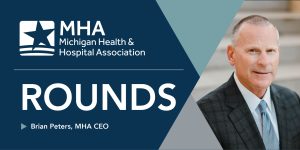
MHA CEO Brian Peters

MHA in the News

Detroit’s WJR 760 AM interviewed MHA CEO Brian Peters Sept. 22 for a segment on healthcare as part of “The Capital Report,” a new show focused on exploring issues happening within state politics and Michigan’s …

MHA Podcast Welcomes New Board Chair, Explores Healthcare Priorities in Michigan

MHA Board Chair Julie Yaroch, DO, joined MHA CEO Brian Peters for an episode of the MiCare Champion Cast.

The MHA released a new episode of the MiCare Champion Cast kicking off the 2024-2025 program year discussing healthcare viability, workforce, cybersecurity, the upcoming election and more.

The episode, hosted by MHA CEO Brian Peters, features MHA Board Chair Julie Yaroch, DO, president of ProMedica Charles and Virginia Hickman Hospital. Listeners can expect to learn more about Yaroch’s journey becoming a healthcare leader, along with her aspirations for the new board and her longstanding passion for public health.

“Hospitals don’t have all the solutions,” noted Yaroch. “We can’t carry out all the directives, but we can bring people to the table. We all want to have healthy communities, and I do think we can achieve that goal, but we’ve got a lot of steps in front of us.”

Alongside Yaroch, officers of the 2024-2025 MHA Board of Trustees include Bill Manns, chair-elect; and Brittany Lavis, treasurer, among many others. With a record number of physician leaders serving, Peters and Yaroch spent time discussing healthcare priorities tied to workforce challenges and care delivery.

“In healthcare, we can’t always build it and people will come,” said Yaroch. “We have to really understand the patient population, the community and the directives of the providers. Without providers, we don’t have healthcare.”

Peters and Yaroch also spent time discussing key healthcare issues including mandated nurse staffing ratios, 340B, cybersecurity and more.

The episode is available to stream on Spotify, Apple Podcasts, SoundCloud and YouTube. Questions or idea submissions for future MiCare Champion Cast episodes can be sent to Lucy Ciaramitaro at the MHA.

MHA Podcast Explores the Role of Artificial Intelligence (AI) in Healthcare

MiCare Champion Cast graphic featuring an episode focused on the role of Artificial Intelligence (AI) in Healthcare

The MHA released a new episode of the MiCare Champion Cast exploring the role artificial intelligence (AI) plays in healthcare today and what it will look like in the future. The episode features Bruce Brandes, president of Care.ai and Monica Holmes, a PhD candidate in bioinformatics at the University of Michigan and current member of the MHA AI Task Force.

Early in the discussion, Brandes and Holmes highlighted the ways smart technologies have been used for years when it comes to data analysis, disease diagnosis, radiology, clinical documentation, language processing and more.

“For the first time – maybe in my career in healthcare – it’s obvious that the status quo is no longer an acceptable option,” said Brandes, who has over 30 years of experience in executive management and entrepreneurial thought leadership. “This is real – you need to understand it, you need to be intentional and deliberate and have a strategic plan.”

Both Brandes and Holmes emphasized throughout the episode that AI cannot replace the essential role humans play in healthcare. The goal, in most cases, is to optimize a more efficient workflow, improve healthcare quality, advance diagnostics and enhance medical research.

“On the academic side, it’s improving our ability to do better research, which leads to better insights and ultimately better health outcomes for patients when it’s translated over to the bedside,” said Holmes, who also serves on the board of Trinity Health’s Chelsea Hospital as chair of patient quality and safety.

Listeners can expect to learn more about how patients and providers are responding to AI tools (including virtual nursing) and get answers to commonly asked questions related to transparency, health equity, regulation and cybersecurity.

Care.ai, an MHA endorsed business partner, powers more human care through the first and only AI-enabled Smart Care Facility Operating Platform, which deploys smart sensors throughout care facilities. These sensors continuously and ambiently monitor clinical and operational workflows, learning from them to predict, prevent and protect; alerting and engaging care teams in real-time and improving common challenges such as fall prevention, pressure injury prevention, hand hygiene compliance, rounding adherence, automated documentation, virtual rounding, virtual sitting and more.

The episode is available to stream on Spotify, Apple Podcasts, SoundCloud and YouTube. Those interested in learning more about Care.ai or the MHA EBP program can visit the business services webpage or contact Rob Wood at the MHA. Questions or idea submissions for future MiCare Champion Cast episodes can be sent to Lucy Ciaramitaro at the MHA.

MHA Podcast Explores Benefits, Challenges of Virtual Care in Behavioral Health

The MHA released a new episode of the MiCare Champion Cast exploring how clinicians are navigating virtual care in the behavioral health space.

The episode, released during Mental Health Awareness Month, features two providers from Pine Rest Christian Mental Health Services. Dr. Heide Rollings, M.D., child and adolescent psychiatry fellowship director and Dr. Lisa Vroman Stokes, Ph.D., manager of Forest Hills Clinic and child and adolescent project coordinator, joined to share insights about the advantages and challenges of telemedicine in the behavioral health setting.

“We know that for children and adolescents – especially in rural communities – it can be really wonderful to have [telehealth] as an option,” said Dr. Rollings, who also serves as an assistant clinical professor in the division of psychiatry at Michigan State University.

Flexibility plays a big part in the new normal. Although virtual options have helped improve access, both Rollings and Stokes noted that it can’t always substitute in-person screenings and treatment. In many cases, clinicians must communicate expectations to patients early on to develop effective treatment plans within virtual and hybrid formats.

“We’re finding ourselves in a position as providers of re-educating and acclimating our patients to how they can most effectively engage and benefit from treatment,” said Dr. Stokes, who also oversees predoctoral psychology interns at Pine Rest.

As demand for behavioral healthcare services increases, staffing shortages continue to impact the workforce. In an effort to grow the talent pipeline, Pine Rest offers a variety of educational opportunities to those entering the field. This includes:

As the third-largest non-profit mental health care provider in the country, Pine Rest offers a full continuum of care for mental health and substance use disorders in West Michigan. In addition to their outpatient locations and psychiatric urgent care, the health system is also building a pediatric behavioral health center slated to open in 2026. Pine Rest was one of six organizations to receive grant funding following a $50 million appropriation from the Michigan legislature as part of the 2023 State Budget, which aimed at increasing the number of inpatient beds available for pediatric psychiatric patients across the state.


The episode is available to stream on SpotifyApple PodcastsSoundCloud and YouTube. Those interest in learning more about the services, Questions or idea submissions for future MiCare Champion Cast episodes can be sent to Lucy Ciaramitaro at the MHA.

MHA Podcast Uplifts Importance of Submitting Adverse Event Data to Improve Patient, Staff Safety

Nadine Post, MSN, RN (Left), manager of Quality and Patient Safety at MyMichigan Health, and Nicole Stefan, CNMT, MBA, CPPS, CPHRM (Right), manager of Risk Management at Trinity Health Livonia joined for the March episode of the MiCare Champion Cast.

The MHA released a new episode of the MiCare Champion Cast during Patient Safety Awareness Week to uplift why hospitals should prioritize submitting adverse event data, in addition to what can be done to improve the culture around reporting. The episode features Nadine Post, MSN, RN, manager of Quality and Patient Safety at MyMichigan Health, and Nicole Stefan, CNMT, MBA, CPPS, CPHRM, manager of Risk Management at Trinity Health Livonia.

Data is critical for advancing healthcare safety. With this in mind, the MHA Keystone Center Patient Safety Organization (PSO) collects data every day from hospitals and health systems throughout Michigan. The team assembled in June 2023 the Adverse Events Review Committee (AERC) to review adverse events and identify the root cause of medical errors. In addition to providing guidance to hospitals on a case-by-case basis, the committee aims to establish standardized practices and proactive solutions to prevent staff and patient harm.

“Data is knowledge,” said Stefan. “It allows us to see where we’re vulnerable, benchmark and prioritize what we need to work on.”

Organizational culture can often be a barrier for incident reporting. According to the Occupational Safety and Health Administration, studies of hospital-based healthcare workers found that those who perceived that their institution had a strong commitment to safety were much more likely to be compliant with standard precautions than those who did not.

“One of the components of building a culture of safety is having leaders at unit levels being active listeners so that frontline employees understand that they have executive support,” said Post, who serves as co-chair of the committee. “Psychological safety is so important,” Stefan added. “If they [frontline staff] feel safe, they will take the time to report – they will feel comfortable to.”

Those interested in the MHA Keystone Center PSO or the AERC should contact the MHA Keystone Center. Current PSO members are also encouraged to submit nominations for the quarterly Speak-up! Award to acknowledge the efforts of individuals or teams who are preventing harm to patients or fellow staff members.

The episode is available to stream on SpotifyYouTubeApple Podcasts and SoundCloud. Questions or idea submissions for future MiCare Champion Cast episodes can be sent to Lucy Ciaramitaro at the MHA.

MiCare Champion Cast · Patient Safety Awareness Week: The Important Role of Hospital Adverse Event Data