MHA CEO Report — Prioritizing Rural Health

MHA Rounds graphic of Brian Peters

“Be sure you put your feet in the right place, then stand firm.” – Abraham Lincoln

MHA Rounds graphic of Brian PetersWhile snow continues to fall in northern Michigan, spring is officially here, and for many, that means our weekend travel plans shift from skiing and snowmobiling to camping, hiking and boating. Rural Michigan is an amazing travel destination for many, but it also is home year-round to 20% of our state’s population, and access to affordable, high-quality healthcare remains absolutely crucial. Rural hospitals are an integral part of the local fabric of their communities, treating the ill and improving the health and well-being of their residents. They work extremely hard to make sure they’re able to provide the best quality of care, while operating on a budget with slim to nonexistent margins. In a small town, there is nowhere to hide when the hospital is experiencing challenges of any kind. This is especially true when the hospital is the largest employer in the community and a vital economic engine, which is very often the case in rural Michigan.

I recently had the opportunity to attend the annual American Hospital Association (AHA) Rural Health Care Leadership Conference, along with a number of MHA senior staff and Michigan rural healthcare leaders, including Tina Freese Decker, CEO of Corewell Health and current chair of the AHA Board of Trustees; Julie Yaroch, DO, CEO of ProMedica Charles and Virginia Hickman Hospital and current chair of the MHA Board of Trustees; and JJ Hodshire, CEO of Hillsdale Hospital, current MHA Board member and host of the Rural Health Today podcast. We focused on the latest rural health challenges and innovations, as well as our shared federal advocacy priorities. Key topics included rural obstetrical care, cybersecurity, long-term care transformation and strategic partnerships.

According to the latest U.S. census and other demographic resources, rural Americans are notably older, sicker and poorer than their urban and suburban counterparts. While rural areas currently cover 97% of the nation’s land, they are home to only 19.3% of the total population. Demographers believe that we are moving toward a future state in which an even higher concentration of the population will be in non-rural settings – and that in the next five years, more than 40% of Michigan counties will have more than a quarter of their population older than 65, with nearly all of those counties being rural. As we have learned – especially during the COVID pandemic – traditional volume-based healthcare reimbursement methods do not adequately address the fixed costs inherent in healthcare delivery, a reality that is exacerbated for rural hospitals with smaller patient volumes and more constricted resources and economies of scale.

Although Medicaid expansion (a major accomplishment resulting from MHA advocacy) improved the viability of rural hospitals – a fact that is borne out when benchmarking Michigan to non-expansion states – that funding is currently in severe jeopardy given the current state of play in Washington, D.C., as discussed at length in last month’s CEO Report. In addition, the 340B program is another critically important part of the rural healthcare ecosystem, as the cost savings from the program are used by healthcare providers to offer critically important services to everyone in their respective communities, regardless of their socioeconomic status. The MHA continues to advocate at the state and federal level, in the legislative arena and in the courts, to protect and defend the 340B program.

With guidance from the MHA Council on Small or Rural Hospitals, currently chaired by Peter Marinoff, CEO of Munson Healthcare Southern Region (see Peter’s recent insights on rural healthcare), and staffed by Lauren LaPine, MHA senior director of Legislative and Public Policy, the MHA is also advocating for continuation of the rural access pool and obstetrical stabilization fund in the state budget, and promoting good public policy with respect to critical access hospitals, rural emergency hospitals and a host of other key issues.

Our rural healthcare leaders continue to prove they are exceptional at delivering extraordinary value, despite challenging circumstances. I know from first-hand experience that our rural hospitals provide high quality care and deserve to be fully supported. And we absolutely must support them, as the fragility of the current environment is real: there have been some 151 rural hospitals that have closed across the country since 2010 due to financial variables that make it extremely difficult to maintain hospital facilities in rural areas.

Now more than ever, we need to think about our rural hospitals, stand firm and do all we can to protect these vital institutions.

As always, I welcome your thoughts.
Report: Michigan Hospital Programming, Investments Improve Health and Well-being of Residents

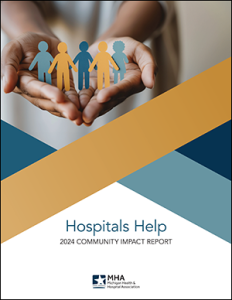
2024 MHA Community Impact Report

The Michigan Health & Hospital Association (MHA) released the 2024 Community Impact Report highlighting how Michigan hospitals are strengthening the healthcare workforce, enhancing access to care and building community health and wellness. This report shares 15 hospital-led community impact programs from nearly every region of the state.2024 MHA Community Impact Report

Michigan hospitals are advancing the health of patients and communities beyond the traditional healthcare setting with a variety of community-focused programs. These efforts are a result of strategic community benefit investments, in addition to local partnerships and support from state and federal healthcare champions.

“The MHA Community Impact Report demonstrates a long-standing commitment by Michigan hospitals to advance the well-being of patients and communities beyond the traditional four walls of the hospital,” said MHA CEO Brian Peters. “It also showcases the strong, lasting impact of investments in health education, community outreach services, clinical research and workforce development.”

Examples of stories include Corewell Health William Beaumont University Hospital’s Street Medicine Oakland program that provides free medical care to patients experiencing homelessness; MyMichigan Health’s Grow Our Own initiative, which provides financial assistance to individuals who want to further their education in healthcare; and Schoolcraft Memorial Hospital’s Community Connect program that is reducing health disparities related to mental health, substance abuse and adverse childhood events.

The investments total more than $4.5 billion in community impact activities in fiscal year (FY) 2022, from education and prevention services to community outreach, research and workforce development.

“At ProMedica Health, we’re always looking for innovative ways to address the specific health needs of our patient population and reach communities where they are,” said MHA Board Chair Julie Yaroch, DO, president of ProMedica Charles and Virginia Hickman Hospital. “It’s inspiring to see the work of other hospitals featured in the report that are focused on bringing solutions to the table, especially when it comes to closing gaps in public health and enhancing access to care in rural communities.”

The full report and community impact stories from hospitals across the state can be accessed on the MHA website.

MHA Podcast Welcomes New Board Chair, Explores Healthcare Priorities in Michigan

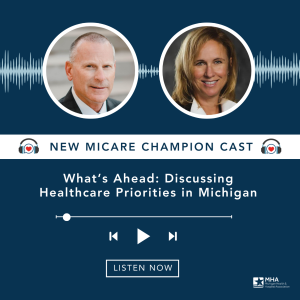
MHA Board Chair Julie Yaroch, DO, joined MHA CEO Brian Peters for an episode of the MiCare Champion Cast.

The MHA released a new episode of the MiCare Champion Cast kicking off the 2024-2025 program year discussing healthcare viability, workforce, cybersecurity, the upcoming election and more.

The episode, hosted by MHA CEO Brian Peters, features MHA Board Chair Julie Yaroch, DO, president of ProMedica Charles and Virginia Hickman Hospital. Listeners can expect to learn more about Yaroch’s journey becoming a healthcare leader, along with her aspirations for the new board and her longstanding passion for public health.

“Hospitals don’t have all the solutions,” noted Yaroch. “We can’t carry out all the directives, but we can bring people to the table. We all want to have healthy communities, and I do think we can achieve that goal, but we’ve got a lot of steps in front of us.”

Alongside Yaroch, officers of the 2024-2025 MHA Board of Trustees include Bill Manns, chair-elect; and Brittany Lavis, treasurer, among many others. With a record number of physician leaders serving, Peters and Yaroch spent time discussing healthcare priorities tied to workforce challenges and care delivery.

“In healthcare, we can’t always build it and people will come,” said Yaroch. “We have to really understand the patient population, the community and the directives of the providers. Without providers, we don’t have healthcare.”

Peters and Yaroch also spent time discussing key healthcare issues including mandated nurse staffing ratios, 340B, cybersecurity and more.

The episode is available to stream on Spotify, Apple Podcasts, SoundCloud and YouTube. Questions or idea submissions for future MiCare Champion Cast episodes can be sent to Lucy Ciaramitaro at the MHA.

MHA Podcast Explores Important Role Hospitals Play in Public Health

The MHA released a new episode of the MiCare Champion Cast during National Public Health Week to explore how hospitals are engaged in public health. Featured guests include Julie Yaroch, D.O., president of ProMedica Charles and Virginia Hickman Hospital and senior vice president of ProMedica Inpatient and Retail Pharmacy, and Frank Nagle, MBA, director of Community Impact in Michigan at ProMedica.

One of the public health issues that continues to be a priority for Michigan hospitals and health systems is food insecurity. With this in mind, Yaroch and Nagle highlight the strong impact the ProMedica Farms and Veggie Mobile are having on residents and communities by improving access to fresh, affordable produce and nutrition education.

Located on the hospital campus, ProMedica Farms includes a hoop house, outdoor garden, education center, walking trails and playground, all of which are open to the community. The Veggie Mobile, which has served 50,000 residents since 2013, is a market on wheels that travels to 17 locations throughout Lenawee County to offer residents an assortment of fresh, low-cost produce. ProMedica received a Ludwig Community Benefit award for both initiatives in 2023, which is presented annually to MHA-member organizations integrally involved in collaborative programs to improve the health and well-being of area residents.

In the episode, Yaroch and Nagle share how these efforts began while highlighting the important role hospitals play in public health alongside government agencies, educational institutions and the community.

“When you go back in history, public and medical health used to be under the same roof,” said Yaroch, who serves as current chair of the MHA Public Health Task Force. “We just need to dust things off and remember the importance of coming together preventatively rather than reactively. We need to continue to have those relationships and touch bases so that we understand each other’s role and have trust.”

Born out of a partnership with Lenawee Health Network, both the Farms and Veggie Mobile were implemented over the course of 10 years following a community health needs assessment that screens social determinants of health and identifies areas of vulnerability.

“It started small and really grew just by raising awareness, forming connections and responding to community and patient needs,” said Yaroch. As efforts expand, Nagle noted that the goal is to have these models replicated to serve communities across the country.

Both the Farms and the Veggie Mobile have had significant impact since their start. In 2011, about 5% of adults reported eating the recommended servings of fruits and vegetables. In 2022, that increased to 21%. Yaroch noted that “getting outside of the four walls of your operation” is key to making public health efforts successful.

“Really take the time to ask, what can we do better?” said Nagle. “Let’s get to the root cause of these barriers and make informed and data-driven decisions with community member input that help overcome those.”

Additional results from the Farms and Veggie Mobile collected by the hospital, include:

  • 7,300 pounds (more than three tons) of produce harvested since 2018.
  • 13,626 pounds (seven tons) of produce donated and distributed to the community since 2018 from the Farm, Gus Harrison Correctional Facility and local farmers.
  • 100 gardening, nutrition and cooking workshops have served nearly 500 community members since 2018 from the Farm and Michigan State University Extension.
  • 340+ patients screened for food insecurity who received food at discharge or at their primary care provider’s office.

The episode is available to stream on Spotify, YouTube, Apple Podcasts and SoundCloud. Those interested in learning more can visit the ProMedica Farms and Veggie Mobile websites. To get involved or learn more about the MHA Public Health Task Force, contact Lauren LaPine at the MHA. To nominate a hospital or health system for future Ludwig Community Benefit awards, visit the MHA website.

MiCare Champion Cast · National Public Health Week: Learning More About ProMedica Farms and the Veggie Mobile

Questions or idea submissions for future MiCare Champion Cast episodes can be sent to Lucy Ciaramitaro at the MHA.