
CMS Releases FY 2026 Final Rule for Inpatient Psychiatric Facilities

The Centers for Medicare & Medicaid Services (CMS) recently released a final rule to update the Medicare fee-for-service (FFS) prospective payment system (PPS) for inpatient psychiatric facilities (IPFs) for fiscal year (FY) 2026.

Key provisions of the include:

  • Increasing the IPF PPS federal per diem base rate by a net 1.9% after all adjustments, from $876.53 to $892.87 for IPFs that comply with the CMS IPF quality reporting program (QRP) requirements. The rate for providers that failed to report quality data is $875.44.
  • Increasing the Electroconvulsive Therapy payment per treatment by a net 1.9% from $661.52 to $673.85 for IPFs that comply with IPF QRP requirements and $660.70 for IPFs that fail to report data.
  • Revising the labor-related share from the current 78.8% to 79%.
  • Increasing the cost outlier threshold by 3.3% from the current $38,110 to $39,360 to achieve the 2% target for outlier payments as compared to aggregate IPF payments, decreasing the number of cases that qualify for outlier payments.
  • Modifying the facility-level adjustment factors:
    • Rural adjustment from 1.17 to 1.18
    • Teaching adjustment from 0.5150 to 0.7957
  • Maintaining the 1.54 adjustment factor for IPFs with qualifying emergency departments.
  • Updating the IPFQR Program to:
    • Remove four measures beginning with the calendar year 2024 reporting period/FY 2026 payment determination:
      • Facility Commitment to Health Equity
      • COVID-19 Vaccination Coverage among Health Care Personnel
      • Screening for Social Drivers of Health
      • Screen Positive Rate for Social Drivers of Health
    • Modify the reporting period of the 30-day-Risk-Standardized All Cause Emergency Department Visit Following an Inpatient Psychiatric Facility Discharge measure (referred to as the IPF ED Visit measure) from a one year, calendar year to a two-year, fiscal year period.
  • Finalizing changes to the IPFQR program’s extraordinary circumstances exception (ECE) policy to include extensions as a type of relief that the agency may grant in response to an ECE request

The MHA will provide IPFs with an updated hospital-specific impact analysis and additional details on the final rule in the near future. Members with questions should contact Vickie Kunz at the MHA.

CMS Releases FY 2026 Hospital Inpatient Prospective Payment System Final Rule

The Centers for Medicare & Medicaid Services (CMS) recently released a final rule to update the Medicare fee-for-service (FFS) inpatient prospective payment system (IPPS) for fiscal year (FY) 2026.

Highlights of the final rule include:

  • Increasing the standard operating rate by a net 1.9%, after the 0.7% productivity cut and budget neutrality adjustments, from $6,624.39 to $6,752.61, for hospitals that successfully comply with the CMS quality reporting program and electronic health record requirements. Hospitals that do not meet requirements for these programs are subject to a reduced annual update.
  • Increase the federal capital rate by 2.3%, from $512.14 to $524.15.
  • Decrease the cost outlier threshold by 12.6% from $46,217 to $40,397 to maintain the target of paying 5.1% of aggregate IPPS payments as outlier.
  • Rebasing and revising the labor-related share of the standardized operating rate from 67.6% to 66% for hospitals with a wage index greater than 1.0.
  • Increasing disproportionate share hospital and uncompensated care (UCC) payments by approximately $2 billion nationally. UCC payments will be allocated using the average of three most recent years of audited Worksheet S-10 data.
  • Adding five new Medicare Severity Diagnosis Related Groups (MS-DRGs) while deleting six MS-DRGs, with most changes within Major Diagnostic Category 05, Diseases and Disorders of the Circulatory System.
  • Removing four measures from the Hospital Inpatient Quality Reporting Program effective with the 2024 reporting and FY 2026 payment period:
    • COVID-19 vaccination coverage among health care personnel.
    • Hospital commitment to health equity structural measure.
    • Screening for social drivers of health.
    • Screen positive rate for social drivers of health.
  • Modifying the Hybrid hospital-wide readmission and mortality measures and the stroke mortality and elective total hip and knee arthroplasty measures.
  • Updating and codifying the Extraordinary Circumstances Exception (ECE) policy to clarify that the CMS has discretion to grant an extension in response to an ECE request from a hospital.
  • Removing the health equity adjustment from the hospital value-based purchasing program scoring methodology beginning with the FY 2026 program.
  • Modifying the six measures in the Readmissions Reduction Program to include Medicare Advantage (MA) beneficiaries in the patient cohorts and shortening the applicable performance period from three years to two years. For example, FY 2027 HRRP penalties would be based on performance July 1, 2023, through June 30, 2025. The CMS did not finalize its proposal to include MA data in the calculations of aggregate payments for excess readmissions; as a result, aggregate penalties are expected to include 2% instead of 13% under the proposed update.
  • Making a technical update to the National Healthcare Safety Network healthcare associated infection measures baseline.

The MHA continues to review the final rule and will provide hospitals with an updated estimated impact analysis and rule brief in the next few weeks. Members with questions should contact Vickie Kunz at the MHA.
CMS Releases CY 26 PFS Proposed Rule

The Centers for Medicare & Medicaid Services (CMS) recently released a proposed rule to update the physician fee schedule (PFS) for calendar year (CY) 2026.

Highlights of the proposal include:

  • Implementing the one-time 2.5% statutory increase included in the One Big Beautiful Bill Act.
  • Establishing two separate conversion factors: one for qualifying alternative payment model participants (QP) and another for non-qualifying physicians and practitioners.
    • The QP conversion factor would increase by 3.8% to $33.59.
    • The non-QP conversion factor would increase by 3.6% to $33.42.
  • Modifying several telehealth waivers, including:
    • Permanently removing the frequency limitations for subsequent inpatient visits, nursing facility visits and critical care consultations.
    • Permanently adopting a definition of direct supervision to include virtual presence via audio/video real-time communications technology.
      • Does not propose to continue allowing virtual supervision of residents when the service is performed virtually across all teaching settings; this would be allowed only for services provided in non-metropolitan statistical areas.
    • Extending the ability for federally qualified health centers and rural health clinics to bill telehealth services through Dec. 31, 2026.
  • Enhancing integration of behavioral health into primary care by:
    • Clarifying that marriage and family therapists and mental health counselors can bill Medicare directly for Community Health Integration and Principal Illness Navigation Services.
    • Creating add-on codes for Advanced Primary Care Management services that complement previously established Behavioral Health Integration or psychiatric Collaborative Care Model services.
    • Proposing deletion of the HCPCS code that describes social determinants of health risk assessment and altering language to refer to “upstream drivers” of health rather than “social determinants.”
  • Using new methodologies to calculate units of Medicare Part D drugs purchased under the 340B drug pricing program that must be excluded from the calculation of Medicare drug inflation rebates beginning Jan. 1, 2026, as required under the Inflation Reduction Act of 2022. The CMS proposes a claims-based methodology that would determine which Part D drug units are 340B eligible for exclusion. The CMS seeks comments on two methodologies: a prescriber-pharmacy methodology and a beneficiary-pharmacy methodology.
  • Implementing the Ambulatory Specialty Model, a mandatory payment model within selected core-based statistical areas, focused on specialists who frequently treat beneficiaries with congestive heart failure and low back pain, to begin Jan. 1, 2027, and run through Dec. 31, 2031.
  • Establishing a MIPS performance threshold of 75 points for the 2026 performance period through the 2028 performance period, as well as adopting six new MIPS Value Pathways (MVPs) and modifying performance categories under the Quality Payment Program. The new MVPs are proposed for the following:
    • Diagnostic radiology
    • Interventional radiology
    • Neuropsychology
    • Pathology
    • Podiatry
    • Vascular surgery
  • The CMS is seeking input on Executive Order 14192, “Unleashing Prosperity Through Deregulation.”

Hospitals are encouraged to contact Vickie Kunz by Sept. 2 regarding issues identified and submit comments to the CMS by Sept. 12. The MHA will provide an impact analysis in the coming weeks. A final rule is expected early November for the Jan. 1, 2026, effective date. Members with questions should contact Vickie Kunz at the MHA.

MHA Shares Recent Medicare and Medicaid Enrollment Analysis

The MHA recently updated its analysis of Medicaid and Medicare enrollment based on June 2025 data. The analysis includes program enrollment as a percentage of each county’s total population and the split between fee-for-service and managed care organizations. More than 26% of Michigan’s total population is enrolled in Medicaid and 23% is enrolled in Medicare.

Roughly two-thirds of Michigan’s 2.63 million Medicaid beneficiaries are enrolled in one of nine managed care plans.

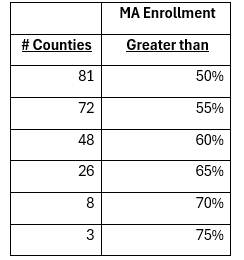
Total Medicare enrollment is 2.27 million, with 63% of beneficiaries enrolled in a Medicaid Advantage (MA) plans, and only two counties having less than 50% of total Medicare enrollment in MA plans. MA enrollment by county ranges from 46% to 79%, and 73 counties having 55% or more of their Medicare population enrolled in an MA plan as highlighted below.


June enrollment is spread across 46 MA plans with up to 29 plans covering beneficiaries in several Michigan counties and a minimum of five plans available in each county.

Members with enrollment questions should contact the Health Finance team at the MHA.

MHA Shares Recent Medicare and Medicaid Enrollment Analysis

The MHA recently updated its analysis of Medicaid and Medicare enrollment based on May 2025 data. The analysis includes program enrollment as a percentage of each county’s total population and the split between fee-for-service and managed care organizations. Just over 26% of Michigan’s total population is enrolled in Medicaid and 23% is enrolled in Medicare.

Roughly two-thirds of Michigan’s 2.63 million Medicaid beneficiaries, are enrolled in one of nine managed care plans.

Total Medicare enrollment is 2.27 million, with 63% of beneficiaries enrolled in a Medicaid Advantage (MA) plan and only two counties having less than 50% of total Medicare enrollment in MA plans. MA enrollment by county ranges from 46% to 78%, with 72 counties having 55% or more of their Medicare population enrolled in an MA plan.

May enrollment is spread across 46 MA plans, with up to 29 plans covering beneficiaries in several Michigan counties and a minimum of six plans available in each county.

Members with enrollment questions should contact the Health Finance team at the MHA.

CMS Releases FY 2026 Proposed Rule for Inpatient Psychiatric Facilities

The Centers for Medicare & Medicaid Services (CMS) recently released a proposed rule to update the Medicare fee-for-service prospective payment system (PPS) for inpatient psychiatric facilities (IPFs) for fiscal year (FY) 2026.

Key provisions of the proposed rule include:

  • Increasing the IPF PPS federal per diem base rate by a net 1.8% after all adjustments, from $876.53 to $891.99. IPFs that fail to comply with the CMS IPF Quality Reporting Program (QRP) requirements would be paid using a base rate of $874.57.
  • Increasing the Electroconvulsive Therapy payment per treatment by a net 1.8% from $661.52 to $673.19 for IPFs that comply with IPF QRP requirements and $660.04 for IPFs that fail to report data.
  • Increasing the labor-related share from the current 78.8% to 78.9%.
  • Increasing the cost outlier threshold by 3.3% from the current $38,110 to $39,360 to achieve the 2% target for outlier payments as compared to aggregate IPF payments, decreasing the number of cases that qualify for outlier payments.
  • Revising facility-level adjustment factors:
    • Rural adjustment from 1.17 to 1.18
    • Teaching adjustment from 0.5150 to 0.7981
  • Updating the IPF QRP to:
    • Remove four measures beginning with the calendar year 2024 reporting period and or FY 2026 payment determination:
      • Facility Commitment to Health Equity.
      • COVID-19 Vaccination Coverage among Health Care Personnel.
      • Screening for Social Drivers of Health.
      • Screen Positive Rate for Social Drivers of Health.
    • Modify the reporting period of the 30-day-Risk-Standardized All Cause Emergency Department Visit Following an Inpatient Psychiatric Facility Discharge measure (referred to as the IPF ED Visit measure) from a one year, calendar year to a two-year, fiscal year period.
  • Seeking feedback on three topics through requests for information for:
    • A potential future star ratings system for IPFs.
    • Future measures for the IPF QRP.
    • Using the Fast Healthcare Interoperability Resources standard for electronic exchange of healthcare information for patient assessment reporting.

The CMS is seeking comments on opportunities to streamline regulations and reduce administrative burdens on providers, suppliers, beneficiaries and other interested parties participating in the Medicare program.

The MHA will provide IPFs with a facility-specific impact analysis and additional details on the proposed rule in the near future. The MHA also encourages members to submit comments to the CMS by June 10 and to contact Vickie Kunz at the MHA with questions and  issues identified by May 27.

CMS Releases FY 2026 Hospital IPPS Proposed Rule

The Centers for Medicare & Medicaid Services (CMS) recently released a proposed rule to update the Medicare fee-for-service inpatient prospective payment system (IPPS) for fiscal year (FY) 2026.

The rule proposes to:

  • Increase the standard operating rate by a net 3.2%, after the 0.8% productivity cut and budget neutrality adjustments, from $6,624.39 to $6,835.47, for hospitals that successfully comply with the CMS quality reporting program and electronic health record requirements. Hospitals that do not meet the requirements for these programs are subject to a reduced annual update.
  • Increase the federal capital rate by 3.3%, from $512.14 to $528.95.
  • Decrease the cost outlier threshold by 4.1%, from $46,217 to $44,305, to maintain the target of paying 5.1% of aggregate IPPS payments as outlier.
  • Rebase and revise the labor-related share of the standardized operating rate from 67.6% to 66% for hospitals with a wage index greater than 1.0.
  • Increase disproportionate share hospital and uncompensated care (UCC) payments by $1.5 billion nationally. UCC payments will be allocated using the average of three most recent years of audited Worksheet S-10 data.
  • Add seven new Medicare-Severity (MS) Diagnosis Related Groups, while deleting six MS-DRGs, with most changes within Major Diagnostic Category 05, Diseases and Disorders of the Circulatory System.
  • Remove four measures from the Hospital Inpatient Quality Reporting Program, effective with the 2024 reporting and FY 2026 payment period:
    • COVID-19 vaccination coverage among health care personnel.
    • Hospital commitment to health equity structural measure.
    • Screening for social drivers of health.
    • Screen positive rate for social drivers of health.
  • Modify the Hybrid hospital-wide readmission and mortality measures and the stroke mortality and elective total hip and knee arthroplasty measures.
  • Update and codify the Extraordinary Circumstances Exception (ECE) policy to clarify that the CMS has discretion to grant an extension in response to an ECE request from a hospital.
  • Remove the health equity adjustment from the hospital value-based purchasing program scoring methodology beginning with the FY 2026 program.
  • Include Medicare Advantage patients in the calculation of multiple claims-based measures across several programs, including the Hospital Readmissions Reduction program, beginning with the FY 2027 program.
  • Shorten the Hospital RRP’s performance period from three years to two years. For example, FY 2027 HRRP penalties would be based on July 1, 2023 through June 30, 2025 performance.
  • Seek stakeholder comments in response to the Request for Information on opportunities to streamline regulations and reduce administrative burden on providers, suppliers, beneficiaries and other interest parties in the Medicare program.

The MHA continues to review the proposed rule and will provide hospitals with an estimated impact analysis in the next few weeks. The MHA encourages hospitals to review the proposed rule and submit comments to the CMS by June 10 and to notify Vickie Kunz at the MHA regarding questions or issues identified by May 27.

Healthcare Finance Trends for 2025

MHA Endorsed Business Partner (EBP) CommerceHealthcare® recently released its 2025 Healthcare Trends Report, a comprehensive analysis of critical themes shaping the healthcare industry.

This in-depth report was developed in collaboration with business line leaders, customers and prospects while also incorporating insights from industry events and conferences. The report explores the four pivotal themes below:

  • Financial resilience and strategies.
  • Enhancing the patient financial experience.
  • New technological innovations.
  • Emerging paradigms in the industry.

While primarily designed for healthcare leaders, this report offers valuable insights for vendors, contractors and financial institutions. It provides a high-level perspective on developing trends and challenges, equipping readers with the knowledge to navigate an uncertain economic climate.

“This yearly report is incredibly well-researched and well-organized, designed to benefit our readers across all the major healthcare focal areas,” said Sue Martin, director of specialty healthcare services, CommerceHealthcare®. “The insights and talking points hit home in the spaces where our customers are focused and demonstrates how Commerce is aligned with the pulse of the market and the healthcare space.”

Members with questions may contact Dan VandenBosch, vice president, Michigan healthcare banking. To learn more about the EBP program, contact Rob Wood at the MHA.

Medicare and Medicaid Enrollment Update

The MHA updated its analysis of Medicaid and Medicare enrollment based on December 2024 data. The analysis includes program enrollment as a percentage of each county’s total population and the split between fee-for-service (FFS) and managed care organization (MCO). Just over 27% of Michigan’s total population is enrolled in Medicaid and 22% is enrolled in Medicare.

Roughly two-thirds of Michigan’s 2.66 million Medicaid beneficiaries are enrolled in one of nine managed care plans.

Total Medicare enrollment is 2.25 million, with 62% of beneficiaries enrolled in a Medicaid Advantage (MA) plan and only three counties having less than 50% of total Medicare enrollment in MA plans. MA enrollment by county ranges from 45% to 77%, with 66 counties having 55% or more of their Medicare population enrolled in an MA plan, as highlighted below.

December enrollment is spread across 54 MA plans, with up to 29 plans covering beneficiaries in several Michigan counties and a minimum of 5 plans available in each county.

Members with enrollment questions should contact the MHA Health Finance team.

MHA Monday Report Nov. 18, 2024

Advocacy image tileWorkforce Bills Highlight Healthcare Legislation Advanced in the State Legislature

Several workforce bills highlighted the healthcare legislation that advanced in the state legislature during the week of Nov. 11. The Senate Appropriations Committee approved Senate Bills (SBs) 406 and 407, led by Sen. Sarah Anthony (D-Lansing). The bills provide …


MHA Board of Trustees Considers Election Impact and Association Priorities

The MHA Board of Trustees began its Nov. 13 meeting with a review of the results from the federal election and its potential impact on key association priorities, led by Carlos Jackson and Mike Goodman with Washington D.C.-based Cornerstone Government …


CMS Releases 2025 Physician Fee Schedule Final Rule

The Centers for Medicare & Medicaid Services (CMS) recently released a issued a final rule to update the physician fee schedule payment system effective Jan. 1, 2025. The rule will: Reduce the PFS conversion …


MDHHS Shares 2022 Maternal and Infant Health Statistics

The Michigan Department of Health and Human Services (MDHHS) Maternal and Child Health Epidemiology Section recently led a webinar on 2022 maternal and infant health statistics for the state. Infant mortality refers to the death …


Enrollment Open for 2025 MHA Healthcare Leadership Academy

The MHA is offering its popular Healthcare Leadership Academy program in February and April 2025, with sessions at the MHA headquarters in Okemos. In partnership with Executive Core and Grand Valley State University, two power-packed …


Medical SolutionsBuilding a Culture of Retention

MHA Endorsed Business Partner Medical Solutions recently released an episode of their “Staffing Unplugged” podcast, featuring Chief Human Resources Officer Rich Thompson sharing insights on the critical role of culture in healthcare staffing. He …


Latest AHA Trustee Insights Focuses on Post-Merger Board Restructuring

The November edition of Trustee Insights, the monthly digital package from the American Hospital Association (AHA), includes CEO insights about the integration of two major health systems which resulted in stronger governance. The article explains the …


What’s Top of Mind in Rural Healthcare?

Peter Marinoff, president and CEO, Munson Healthcare’s Southern Region and MHA Small and Rural Hospital Council Chair

The following article was written by Peter Marinoff, president and CEO, Munson Healthcare’s Southern Region and MHA Small and Rural Hospital Council Chair. National Rural Health Day celebrates the remarkable efforts of hospitals, healthcare teams, …


Keckley Report

The Four Core Pillars of Trump Healthcare 2.0

“While speculation swirls around key cabinet appointments in the incoming Trump administration, much is being written about how things might change for industries and the companies that compose them. Healthcare is no exception.

Speculation about possible changes originates from media coverage, healthcare trade associations, law firms, consultancies, think tanks and academics. Their views are primarily based on Trump Healthcare 1.0 initiatives (2017-2021), presumed Trump 2.0 leverage in the U.S. Senate, House and conservative Supreme Court and a belief by the Trump-team leaders that their mandate is to lower costs for “everyday Americans” and tighten border security.

Thus, Trump Healthcare 2.0 policy changes will be extensive, leveraging legislation, executive orders, agency administrative actions, court decisions and appropriations processes to reset the U.S. health system.”

Paul Keckley, Nov. 11, 2024


News to Know

  • The Centers for Medicare & Medicaid Services (CMS) recently announced the 2025 Medicare Part A and B Premiums and Deductibles, with details available in the CMS Fact Sheet.
  • The Michigan Department of Health and Human Services has increased reimbursement rates for Behavioral Health Treatment – Applied Behavior Analysis services to improve autism treatment access for Medicaid beneficiaries.