

MHA Monday Report Oct. 13, 2025

Healthcare Funding Protected in New State Budget Signed by Gov. Whitmer

The Michigan Legislature’s newly passed state budget, which protects all existing healthcare funding, was signed into law Oct. 7 by Gov. Whitmer. Public Act 22 of 2025, sponsored by Rep. Ann Bollin (R-Brighton), passed by both …


Community Benefit Collaborative Members Gather for Kickoff Event

The MHA brought together the Community Benefit Collaborative members for a daylong kickoff event on Oct. 2 to network and learn from peers across the state conducting community benefit work in chronic disease, behavioral health …


CDC Updates Guidance for COVID-19 and Chickenpox Vaccines

The Centers for Disease Control and Prevention (CDC) recently updated its guidance for the COVID-19 and varicella (chickenpox) vaccines. The CDC’s decision uses an individual-based decision-making framework, referring to vaccination decisions made through shared clinical …


Strengthening Rural Healthcare Through Smarter Physician Recruitment

MHA Endorsed Business Partner AMN Healthcare recently released the Rural Physician Recruiting Challenges and Solutions white paper, produced by its Physician Solutions division (formerly Merritt Hawkins). The resource identifies several approaches to address these challenges: Recruiting physicians …


Investing in Rural Hospitals Means Investing in Rural Michigan

When the One Big Beautiful Bill Act was signed into law in July, it created the Rural Health Transformation Program, a five-year, $50 billion investment in rural healthcare. The MHA Board of Trustees took swift action empowering an MHA board-appointed task force charged with creating …


Keckley Report

Shutdown Impact: The Affordable Care Act 2.0 Takes Center Stage

“In 2009, I facilitated discussions with key health industry trade associations and the White House Office of Health Reform focused on reforms to reduce costs, increase insurance coverage and improve quality by 2019. It was the Obama administration’s aim to use the health system’s bulk as a lever to stimulate recovery from the 2008-2009 recession and simultaneously increase coverage through Medicaid expansion and marketplace subsidies that for lower-income households. …

The current federal government shutdown is a tipping point for healthcare in the U.S. It’s about more than extended subsidies per Dem’s and holding the line on spending per Republicans. It’s about a growing sense of helplessness among the majority and resentment among many that institutions like the federal government, higher education, big business and healthcare are no longer motivated to serve interests beyond themselves. …

Some will harken back to the Affordable Care Act in 2010 when coverage was also the issue. We’re there again. But the bigger issue is this: extending subsidies and maintaining coverage will not lower spending or transform U.S. healthcare to an affordable, accessible, appropriately structured system of health.

The moral high ground for healthcare is in jeopardy and its direction unclear. Perhaps PPACA 2.0 is an answer. Doing nothing isn’t.”
Paul Keckley, Oct. 5, 2025

HHS Replaces ACIP Members, Future Vaccine Policy Unclear

The U.S. Department of Health and Human Services Secretary Robert F. Kennedy Jr. announced June 9 the removal of all 17 members of the Advisory Committee on Immunization Practices (ACIP). This independent body is comprised of experts in infectious disease, epidemiology, pediatrics, internal medicine and public health. ACIP plays a central role in guiding U.S. vaccine policy through the evidence-based recommendations it puts forth to the Centers for Disease Control and Prevention (CDC), which directly influences vaccine schedules, insurance coverage, provider reimbursement and programs such as Vaccines for Children.

Kennedy announced eight replacements June 11 on social platform X. The appointments mark a potential significant change in the future of federal vaccine policy. While past ACIP recommendations and resources remain available through the CDC, it remains unclear how the new members and administration will guide national immunization practices.

The MHA remains committed to assisting members in increasing vaccine uptake and avoiding the spread of vaccine preventable diseases, as the evidence is indisputable that vaccines are the best tool available to prevent severe illness and save lives. The association continues to monitor the potential impacts that may result from the changes to ACIP.

Members are encouraged to share feedback on the impact of these changes to existing organizational vaccine policies with Kelsey Ostergren at the MHA.

Obtaining Beyfortus through the Vaccines for Children Program

Vaccination remains a key strategy to mitigate the impact of adverse health outcomes on patients and hospital operations during the 2024-2025 respiratory season. The MHA urges all birthing hospitals to become Vaccines for Children (VFC) specialty providers to offer Beyfortus and expand access to eligible patients ahead of the upcoming respiratory season.

Beyfortus was approved by the FDA in July 2023 for preventing RSV lower respiratory tract disease in infants. Hospitals can acquire Beyfortus through direct/private purchase or through the VFC program. However, doses obtained through the VFC program can only be administered to patients who are eligible for the VFC program.

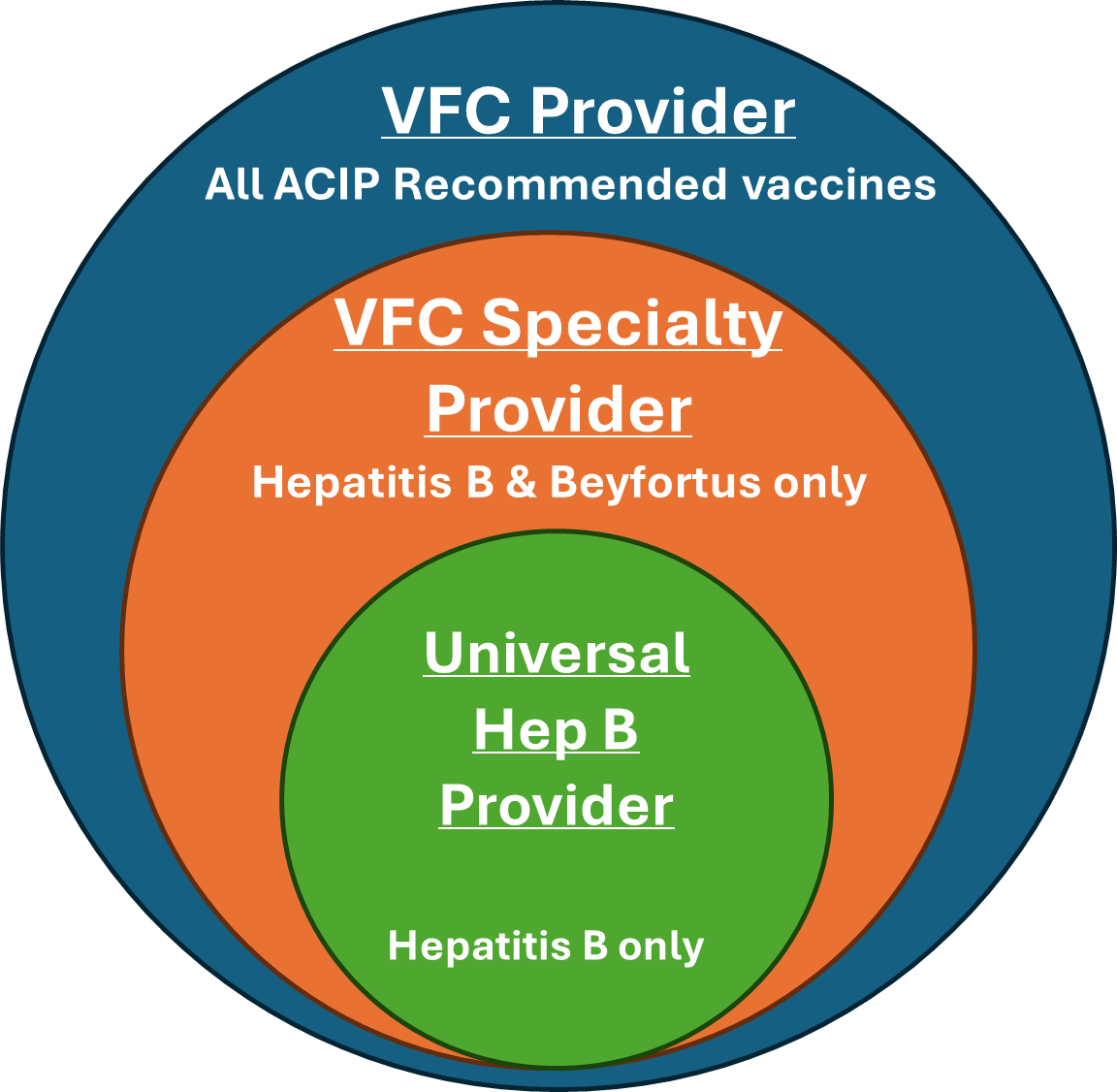
Birthing hospitals must become a VFC enrolled provider to order Beyfortus through the program. While there are three different types of VFC participation, only two allow for administration of Beyfortus:

  1. VFC Provider (providing all ACIP recommended vaccines)
  2. VFC Specialty Provider (providing Hepatitis B & Beyfortus only)

The Michigan Department of Health and Human Services (MDHHS) and the Centers for Disease Control are encouraging all birthing hospitals to become a VFC Specialty Provider to protect Michigan infants against Hepatitis B and RSV. The process to become a VFC Specialty Provider differs slightly, depending on if a hospital is participating with the VFC as a Universal Hepatitis B Provider or not at all.

The steps in the graphic below outline how birthing hospitals can become a VFC Specialty Provider:

1 – MDHHS has created a Beyfortus Eligibility Tool to help birthing facilities with this process. Use of the tool is optional, however if it is used, it should be noted in the Eligibility Screening Plan in step two.
2 – Facilities should complete the Eligibility Screening Plan and submit it to the local health department.

Members with questions may contact Kelsey Ostergren at the MHA. Questions related to VFC program enrollment can be directed to the MDHHS Division of Immunizations.

MHA Keystone Center Offers Infection Control & Prevention Online Courses

The MHA Keystone Center partnered with the Michigan Department of Health and Human Services (MDHHS) to create a series of online learning modules for infection control and prevention education. The modules cater to the needs of healthcare systems in Michigan and are available at no cost.

The central objective of the six-part course is to provide healthcare workers with the vital knowledge and competencies required to engage in critical thinking about infection control via the Centers for Disease Control and Prevention’s (CDC) Project Firstline initiative. This goal is achieved by integrating adult learning principles, educational best practices, CDC recommendations and the foundational scientific principles that underpin effective infection control strategies.

For more information about Project Firstline, please visit the CDC and MDHHS Project Firstline webpages.

Members with questions about the online courses should contact Josh Suire at the MHA Keystone Center.

National Blood Collection and Utilization Survey: Response Requested

The CDC issued a National Blood Collection and Utilization Survey (NBCUS) invitation to all U.S. blood collection centers and acute care hospitals that perform a minimum of 100 inpatient surgical procedures annually.

The survey aims to enhance federal agencies’ understanding of blood supply and demand, providing a reliable foundation for regulatory measurers and strategic planning. Survey outcomes will enable the federal government to track blood availability trends to ensure maintenance of an adequate supply of safe blood.

Facilities that meet the minimum annual surgical threshold should have received an email invitation from NBCUS. Eligible members are encouraged to complete the survey no later than April 26, 2024.

Members with questions may contact Kelsey Ostergren at the MHA.

Reporting AUR Module Data Session Available

Effective in 2024, eligible hospitals and critical access hospitals are required to report Antimicrobial Use and Resistance (AUR) data to the National Healthcare Safety Network (NHSN) as part of the Public Health and Clinical Data Exchange objective of the Centers for Medicare & Medicaid Services Promoting Interoperability Program.

NHSN is hosting an Office Hours session March 7 at 3 p.m., which will include a brief presentation and time for Q+A. Registration for this session is required.

Members can find more resources on reporting AUR data on the CDC website.

Members with questions can contact Kelsey Ostergren at the MHA.

MHA CEO Report — Vaccinations & Respiratory Illness Season

MHA Rounds image of Brian Peters

“An ounce of practice is worth more than tons of preaching.” Mahatma Gandhi

The last four years have generated tremendous awareness about vaccines, but also a large public health challenge as disinformation has exploded and anti-vaccine sentiment has emerged from the fringes to become widely embraced. This likely isn’t news to any of you, but the issue is once again top of mind because this time of year is respiratory illness season, whether it be the flu, RSV and now COVID. Thankfully, we have vaccines available to blunt the severe impacts of these illnesses, but it falls on both healthcare providers and public health professionals to appropriately communicate the benefits of vaccines to our patients and the public.

The recent reports from the Centers for Disease Control and Prevention (CDC) are concerning, as they are warning providers about the low vaccination rates for each of these diseases. Flu vaccination rates are down across all age groups compared to last year, while COVID vaccine uptake is the same as last year at just 17% of adults; similarly, only 17% of adults 60 years of age and older have received an RSV vaccine.

Due to these low vaccine rates, the CDC reported Dec. 14 that over the past four weeks, hospitalizations across the country increased 200% for the flu, 51% for COVID and 60% for RSV. In Michigan, we need look no further than last year to see how a surge of RSV illness can dramatically challenge the statewide capacity of our children’s hospitals. We know more can be done and it isn’t too late for people to receive their vaccines that are proven to reduce the risk of severe illness and hospitalization.

The MHA has a long history of support for vaccinations, as we continue to work with the Alliance for Immunizations in Michigan, the Parent Information Network, I Vaccinate and others to measure, educate and promote appropriate vaccinations for all Michigan residents. I Vaccinate specifically has been a terrific statewide public awareness campaign to connect with parents on the value of making sure you keep your children up to date on their vaccinations as they grow up. The bottom line is that the safety and efficacy of numerous vaccines has been supported and documented by not only the CDC, but the World Health Organization, and many other academic and clinical organizations.

We also know healthcare personnel play a key role in limiting the spread of illness during these months. For some time, we have collaborated with the Michigan Department of Health and Human Services to encourage vaccination policies for healthcare personnel against preventable diseases, such as the flu and pertussis.

Healthcare personnel are also important messengers when it comes to vaccines. We highly encourage all patients with questions about vaccines to contact their healthcare provider. These are important decisions and healthcare providers are uniquely qualified to provide accurate information about the benefits and any potential risks associated with any treatment. They also do so with care and respect for their patients. The MHA provides additional vaccine resources to healthcare leaders on our MHA vaccinations webpage.

Since the pandemic, the MHA has engaged in numerous ways on healthcare supply chain issues. On that note, another key challenge has been the available supply of Beyfortus, the monoclonal antibody for infants to prevent severe RSV illness. The MHA has been actively collaborating with stakeholders to navigate these supply concerns, as well as to provide reimbursement clarity. The good news is we have plenty of patients wishing to have their infants immunized, but due to manufacturing and distribution issues, there simply is not enough supply for all these young children. Thankfully the Biden administration recently announced 230,000 additional doses of RSV immunizations for infants will be available this month.

Realistically, we know we won’t change declining vaccination trends overnight, in a society that is as polarized as ever. Yet, I’m hopeful that over time we will be able to turn the tides, much as healthcare providers have for over a hundred years in using this valuable tool to eradicate harmful illnesses. It all starts with individual conversations from trusted messengers, but at the end of the day, we need to practice what we preach.

As always, I welcome your thoughts.