Michigan Senate Hears MHA Testimony on ED Boarding Challenges, MHA Opposes Introduced MCPA Bill

The MHA provided testimony May 7 to the Senate Health Policy Committee on certain challenges related to hospital emergency department boarding for behavioral health patients.

The Senate Health Policy Committee heard about patients facing behavioral health crises and their experiences with emergency department boarding based on insurance status. Lauren LaPine, senior director, legislative & public policy, MHA  discussed how the association collected data, starting in 2023, from hospital emergency departments on length of stay for patients with a behavioral health diagnosis. Initial findings within this data showed there were over 150 patients with a behavioral health diagnosis waiting in a hospital emergency department daily. Furthermore, behavioral health-related patients with Medicaid coverage spent longer time in hospital emergency departments than their counterparts with commercial insurance and one of every three patients with Medicaid spent more than 48 hours in a hospital emergency department waiting to be accepted for inpatient hospitalization or discharged.
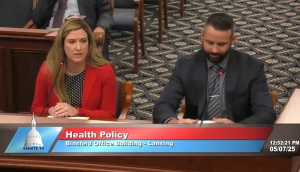
Lauren LaPine, senior director, legislative & public policy, MHA and Kyle Hoffmaster, director, patient access, Pine Rest Christian Mental Health Services provided testimony May 7 on patients facing behavioral health crises and their experiences with emergency department boarding based on insurance status.

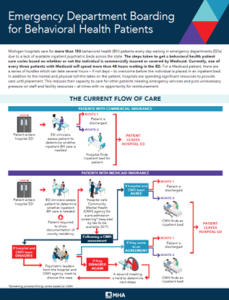
LaPine explained the process of the pre-admission screening assessment completed by providers for these patients with a behavioral health diagnosis and illustrated for the committee how the process is unnecessarily complicated for those with Medicaid coverage.

Kyle Hoffmaster, director, patient access, Pine Rest Christian Mental Health Services also provided testimony on the challenges faced by their organization in helping serve behavioral health patients seeking care. He shared how waiting for another provider from the community mental health (CMH) organizations to complete a pre-admission assessment for patients covered by Medicaid can cause significant delays in these patients receiving the care they need. Patients covered through Medicaid are forced to go to a hospital emergency department per guidelines from the CMHs to receive the assessment in that specific setting, causing more unnecessary stress and costs for families and providers alike. Sharing personal experiences from Pine Rest Christian Mental Health Services illuminated the need for serious change on this issue. The MHA will continue to educate lawmakers on this challenge and work to expand the assessment responsibility to improve the delivery of care for behavioral health patients in Michigan.

In addition, the Senate Finance, Insurance and Consumer Protection Committee took testimony on Senate Bill (SB) 134, sponsored by Sen. Sam Singh (D-East Lansing), which repeals the regulatory compliance exemption under the Michigan Consumer Protection Act (MCPA). If signed into law, this legislation would significantly increase the potential for class-action lawsuits under the MCPA purview against the hospital industry in the state without protecting consumers. The MHA, along with several other businesses and industries stands opposes to this harmful legislation.

Members with additional questions should contact Elizabeth Kutter at the MHA.

Addressing Hurdles for Behavioral Health Patients Seeking Care in the ED

The MHA released a new episode of the MiCare Champion Cast exploring the need to expand the pre-admission screening assessment for behavioral health providers.

Lauren LaPine, senior director of legislative & public policy, MHA, joined to provide insight on how Michigan continues to experience issues with timely access to behavioral health services. More specifically, LaPine shared how and why Medicaid patients experiencing a behavioral health crisis are often stuck in emergency departments (EDs) longer than those who are commercially insured.

Infographic illustrating the differing processes that commercially insured patients go through to be assessed for a behavioral health need compared to a Medicaid beneficiary.
Infographic illustrating the differing processes that a Medicaid beneficiary goes through to be assessed for a behavioral health need compared to a commercially insured patient.

Under the current guidelines, LaPine explained, there are a series of arduous steps needed in order to get patients with Medicaid coverage inpatient behavioral healthcare. One of the biggest hurdles is that following an assessment by ED clinicians, a patient with Medicaid must receive a secondary pre-admission screening from a community mental health (CMH) agency.

This process can take hours – if not days – to complete. Meanwhile, a patient needing the same level of care who is commercially insured is not required to have the pre-admission screening by a CMH.

Last year, there were more than 1.2 million emergency room visits where behavioral health was one of the reasons for care. LaPine noted that pediatric and geriatric patients board for the longest periods of time.

One proposed solution to alleviate the process is to expand the three-hour assessment responsibility to allow clinically qualified staff to conduct pre-admission screenings in order to improve the delivery of care for behavioral health patients in Michigan hospital EDs.

“Emergency departments across the state are well-equipped to complete the pre-admission screening to determine if someone needs inpatient psychiatric care,” said LaPine. “Implementing this change will really help us to expand the number of available healthcare personnel that are able and available to conduct that pre-admission screening…it also allows Medicaid patients to be assessed in a similar manner as patients that have commercial insurance.”

According to recent survey data, there are more than 155 patients waiting in a hospital emergency department for access to behavioral health services; Whether that is an assessment through a CMH agency, an inpatient bed or a transfer to a short-term, residential setting.

The episode is available to stream on Apple Podcasts, Spotify, SoundCloud and YouTube.

RFP Available for Hospital-Based Peer Recovery Coach Services

The MHA is issuing a request for proposal (RFP) for a $2.5 million competitive grant program for Michigan healthcare entities to expand access to hospital-based peer recovery coach (PRC) services. The funding was appropriated by the Michigan Legislature as part of the state fiscal year 2025 budget to prepare hospitals for implementation of PRC billing to Medicaid in FY 2026.

The grant program will award funds to entities across the state of Michigan who wish to develop, or expand, hospital-based peer recovery coach programs. All facilities are eligible to apply, regardless of whether they currently employ peer recovery coaches or not.

Further information about the RFP application process, as well as templates, are available on the MHA Behavioral Health webpage.

The MHA will accept online applications through May 9, 2025. All applications will be blindly reviewed and scored to determine funding allocations. No email or hard copy applications will be accepted.

Members with questions may contact Kelsey Ostergren at the MHA.

New Resources for Patient Rights in Psychiatric Hospitals

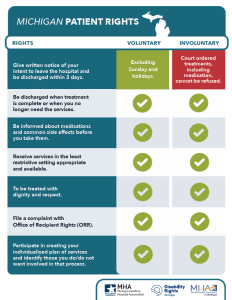
The MHA recently collaborated with the Mental Health Association of Michigan and Disability Rights Michigan to develop resources outlining patient rights in psychiatric hospitals across Michigan, Indiana, Wisconsin and Ohio. These assets are modeled after Disability Rights Ohio’s voluntary and involuntary patient rights materials in psychiatric hospitals.

The MHA’s continued dedication to expanding access to behavioral health services and its commitment to the full care continuum involves addressing challenges such as finding appropriate placement for individuals requiring inpatient hospitalization. The MHA is aware of instances where patients are transferred out of state for inpatient psychiatric care due to diagnosis or acuity level.

This underscores the importance of ensuring patients and families have clear, accessible information about their rights, especially when care extends across state lines.

These resources aim to help individuals, families and advocates understand key rights, including access to treatment, communication and safety. Whether an individual is a patient, caregiver or community advocate, these documents are designed to inform and empower.

Available in accessible formats such as PDF, Word and Large Print, these quick guides ensure equal access to critical rights information for people with disabilities, including those using screen readers or requiring larger text in psychiatric hospitals.

Members are encouraged to share these resources with other colleagues and contacts. Indiana and Wisconsin’s resources can also be found on the MHA behavioral health webpage.

Members with questions can contact Kelsey Ostergren at the MHA.

LaPine Appears on MIRS Monday Podcast Discussing Behavioral Health

Lauren LaPine

Lauren LaPineLauren LaPine, senior director, legislative and public policy, MHA, appeared on the MIRS Monday podcast published March 24 to discuss the state behavioral health system.

LaPine spoke about the challenges associated with patients boarding in the emergency department (ED) while they await placement for behavioral health services and the impact it has on all patients. She also discussed the current need for specialty psychiatric placements and the need to increase capacity for these beds in the state.

“When we have patients coming to the emergency department that are in a behavioral health crisis, that can cause a backlog and [increased] wait times for critical care,” said LaPine. “We learned that at any one point in time, there are 177 patients stuck in the emergency department waiting for either a behavioral health assessment to determine what kind of care they need, or they’re stuck in the ED waiting for an inpatient bed.”

The episode was hosted by Samantha Shriber from MIRS and joining LaPine during the interview was Constance O’Malley, RN, MSA, FACHE, regional chief operating officer, UM Health Regional Network; and Rep. Greg VanWoerkom (R-Norton Shores), chair of the House’s Medicaid and Behavioral Health appropriations subcommittee.

Members with any questions regarding media requests should contact John Karasinski at the MHA.

Behavioral Health Internship Stipend Program Application Released

The Michigan Department of Health and Human Services (MDHHS) is offering the Behavioral Health Internship Stipend Program, a key initiative aimed at increasing Michigan’s behavioral health workforce. Now in its second year, the program provides up to $15,000 per student to cover costs such as tuition, fees, books and living expenses, helping address the growing need for mental health services across the state.

Eligible students must be enrolled in accredited bachelor’s or master’s degree programs that prepare them for behavioral health professions, such as:

  • Marriage or family therapy
  • Behavioral analysis
  • Social Work
  • Professional counseling
  • Psychology

MDHHS allocated $1 million for the program, which is expected to benefit approximately 100 interns, depending on individual funding needs.

Eligibility Requirements

To qualify for the stipend, applicants must:

  • Be enrolled in an accredited behavioral health degree program within the United States.
  • Have an approved unpaid internship in Michigan that meets the programs requirements.
  • Participate in program surveys and evaluation activities.
  • Commit to seeking employment in Michigan’s behavioral health sector after graduation (encouraged but not required).

Stipend Distribution

The stipend is a one-time award distributed in two payments, based on the total hours required by the internship site. Only hours accrued on or after Oct. 1, 2024 are eligible for stipend calculation. The tiered scale is as follows:

  • 80-200 Hours: $5,000
  • 201-400 Hours: $10,000
  • 401-600 Hours: $15,000

Applications must be completed by 11:59 p.m. Jan. 22, 2025. Students should fill out the online application form and submit all required documentation to MDHHS. Applicants will be notified of their acceptance status within three weeks of the application deadline.

Members with questions may contact Lauren LaPine at the MHA.

LaPine Discusses the Role of Hospitals in Crisis Care

Lauren LaPine

Lauren LaPineSecond Wave Michigan published a story Jan. 7 on how state officials, healthcare providers and community organizations are focusing on expanding the continuum of care for people experiencing a mental health crisis.

Lauren LaPine, senior director of legislative and public policy at the MHA, was interviewed in the story to share the role hospitals place in crisis care. She mentioned the high utilization of hospital emergency departments for people in a behavioral health crisis and the long wait times involved in finding the appropriate placement for the patient. LaPine also mentioned how the MHA is advocating for more resources that can support crisis intervention before hospitalization becomes necessary.

“We are working to build partnerships that can offer more specialized crisis care options,” said LaPine. “Similar to community paramedics initiatives, MDHHS [Michigan Department of Health and Human Services] has been committed to expanding access to mobile crisis units so when an individual is in some type of behavioral health crisis, there are mobile crisis units you can call through local community mental health agencies.”

Members with any questions regarding media requests should contact John Karasinski at the MHA.

MHA Monday Report Oct. 7, 2024

MHA Participates in Southwest Michigan Behavioral Health Healthcare Policy Forum

Southwest Michigan Behavioral Health hosted Oct. 4 the ninth annual regional healthcare policy forum in Kalamazoo. Moderated by Dr. Colleen Allen, CEO, Autism Alliance of Michigan, the forum focused on the theme of “Working Together” …


MHA Webinar Explores How Boards and Leaders Can Deploy AI Responsibly and Ethically
The MHA is hosting the webinar How Boards and Leaders Can Deploy AI Responsibly and Ethically, scheduled 4:30 – 6 p.m. ET Dec. 3 which features respected healthcare leaders in artificial intelligence (AI), healthcare operations …


Fall MI AIM Regional Training Events

The Michigan Alliance for Innovation on Maternal Health (MI AIM) is offering training events across Michigan for inpatient maternal healthcare providers. The events, scheduled from late October to November, will focus on using quality improvement …


MDHHS Releases Medicaid Doula Services Proposed Policy

The Michigan Department of Health and Human Services (MDHHS) recently released a proposed policy updating Medicaid coverage for doula services, effective Oct. 1, 2024. Key updates include increasing the number of covered doula visits to …


MHA Highlights Behavioral Health Priorities at Michigan Children and Families Summit

Lauren LaPine, senior director, legislative and public policy, MHA, participated in a discussion Oct. 3 in Grand Rapids during the Michigan Children and Families Summit hosted by the Steelcase Foundation. The summit explored the results …


MHA Race of the Week – U.S. Senate

The MHA’s Race of the Week series highlights the most pivotal statewide races for the 2024 General Election. The series will provide hospitals and healthcare advocates with the resources they …


MHA Rounds graphic of Brian PetersMHA CEO Report — Protecting Access to Care Through 340B

Protecting access to high quality, affordable healthcare for all Michiganders is a key tenet of the MHA. Stated simply, the 340B drug pricing program, created by Congress in 1992, is absolutely crucial to our member …


Keckley Report

Tax Exemptions for Not-for-Profit Hospitals: Are they Worth it?

It’s a question lots of folks inside and outside of healthcare are asking these days. …

The JAMA study did not focus on a ratio; instead, it focused on quantifying the amount of state and local exemptions that should be considered by policymakers in addition to their federal exemptions.  Notably, this study quantifies wide variation in which hospitals benefit most when local, state and federal exemptions are included and proposes that policies around NFP hospital tax exemptions be delegated in part to state and local determinations (as is already the case in at least 3 states). …

The Boards and leaders in each not-for-profit hospitals must account for the tax exemptions they currently enjoy and anticipate changes that limit them in the future. These studies point clearly to that inevitability. And each must answer this question for their organization objectively: are our tax exemptions truly worth it to the communities we serve, or simply a financial maneuver to use our money elsewhere?

Paul Keckley, Sept. 30, 2024


News to Know

Members looking to support hospitals impacted by Hurricane Helene can contribute to relief efforts through the North Carolina Disaster Relief Fund and the Tennessee Hospital Association Disaster Relief Fund.

MHA Participates in Southwest Michigan Behavioral Health Healthcare Policy Forum

Laura Appel, executive vice president of government relations and public policy, MHA (middle), is pictured during a panel discussion at the SWBH 9th annual regional healthcare policy forum.

Southwest Michigan Behavioral Health (SWMBH) hosted Oct. 4 the ninth annual regional healthcare policy forum in Kalamazoo. Moderated by Dr. Colleen Allen, CEO, Autism Alliance of Michigan, the forum focused on the theme of “Working Together” to discuss the future landscape of Michigan healthcare.

The event convened association leaders, policymakers and behavioral health professionals to focus on fostering collaboration, addressing the needs of mutually served populations and advancing whole person care.

Laura Appel, executive vice president of government relations and public policy, MHA, joined a panel discussion alongside Meghan Groen, senior deputy director, Behavioral and Physical Health Services, Michigan Department of Health and Human Services; Dominick Pallone, executive director, Michigan Association of Health Plans; Phillip Bergquist, chief executive officer, Michigan Primary Care Association; State Representative Julie Rogers, chair, House Health Policy; and Alan Bolter, associate director, Community Mental Health Association of Michigan to discuss Psychiatric Residential Treatment Facilities, opioid settlement dollars and treatment for substance use disorders.

SWMBH is the Prepaid Inpatient Health Plan for eight Michigan counties and is in partnership with the Community Mental Health (CMH) agencies of these counties. SWMBH, in partnership with the CMH’s and local providers, provides mental health services to adults with severe and persistent mental illness, children with severe emotional disturbance, individuals with intellectual/developmental disabilities and individuals with substance use disorders.

The event also held an awards presentation which honored Gov. Gretchen Whitmer and Van Buren County Commissioner Richard Godfrey.

Members with questions about the event or SMBH are encouraged to contact Lauren LaPine at the MHA.

MHA Highlights Behavioral Health Priorities at Michigan Children and Families Summit

Lauren LaPine, senior director, legislative and public policy, MHA (middle) pictured during Michigan Children and Families Summit.

Lauren LaPine, senior director, legislative and public policy, MHA, participated in a discussion Oct. 3 in Grand Rapids during the Michigan Children and Families Summit hosted by the Steelcase Foundation. The summit explored the results of a Harvard study on the impact of loneliness in Michigan families that the foundation supported with the national nonpartisan think tank Capita.

The summit was a continuation of a collaborative roundtable held in May, where participants explored the growing epidemic of loneliness affecting families across America, with a particular focus on its impact in Michigan.

The event brought together a diverse group of stakeholders, including representatives from government, associations and nonprofit organizations, all deeply engaged in addressing the rising levels of loneliness among Michigan families and identifying the key factors contributing to this concerning trend.

LaPine discussed the state of behavioral health and its contribution to the topic. The conversation also delved into the critical challenges confronting Michigan hospitals, with a focus on the behavioral health priorities the MHA is leading to address these issues within the state.

The event was led by Daniel Williams, president, Steelcase Foundation, and Tracie Coffman, program officer, W.K. Kellog Foundation. Other speakers during the event included Joe Waters, founder and CEO, Capita; Elliot Haspel, senior fellow, Capita; State Senate Majority Leader Winnie Brinks; U.S. Representative Hillary Scholten; Kent County Commissioner and Chair Stan Stek; Dr. Kim Carter, Battle Creek Public Schools and Jacob Maas, West MiWorks!.

Members with questions about the event or behavioral health are encouraged to contact Lauren LaPine at the MHA.