MHA CEO Report — A Program Year in Review

MHA Rounds graphic of Brian Peters

“Winning is not a sometime thing, it is an all the time thing. You don’t do things right once in a while…you do them right all the time.”  — Vince Lombardi

MHA Rounds image of Brian PetersI am pleased to share we just completed a successful MHA Annual Meeting, continuing a long-standing June tradition whereby we celebrate the conclusion of one MHA program year, and prepare for the next. Each program year is unique with the different challenges it presents. At this point five years ago, no one could have predicted how the emergence of COVID-19 would flip healthcare on its head and drastically alter the tactical objectives of our association. However, there is a constant: the MHA continues to rise to any challenge presented to us and we deliver results for our membership to improve the health and wellness of individuals and communities.

The 2023-2024 program year focused intensely on workforce, viability and behavioral health, while addressing the various “wildcard” issues that always come up. We were led with great wisdom and compassion by Shannon Striebich, president and CEO, Trinity Health Michigan, as our board chair. Due to Shannon’s commitment and leadership, the MHA accomplished numerous highly successful and impactful outcomes on behalf of our members.

One of the most significant challenges in this past year was the threat posed by government-mandated nurse staffing ratio legislation. This proposed policy had the potential to dramatically reduce access to care for individuals throughout the state. Our advocacy on the issue lasted throughout the entire year but was highlighted by an Advocacy Day we hosted in September that featured more than 150 hospital representatives, primarily consisting of nurse leaders, who came to the Capitol and conducted 118 meetings with lawmakers that day. Later in the year, the MHA successfully advocated our position at a committee hearing, where more than 60 supporters attended on very short notice to push back on false narratives and to support alternative nurse staffing solutions. As a result of our efforts, no committee votes have been scheduled, and momentum on this harmful legislation has been effectively stalled.

While we had to play defense against this harmful proposed legislation, the MHA spent the program year actively engaged in workforce development and efforts to grow the healthcare talent pipeline. The MHA worked with stakeholders to implement new funding designed to expand access to Bachelor of Science in Nursing degrees through partnerships between community colleges and four-year universities, while also engaged in partnerships with other organizations to promote healthcare careers, increase clinical faculty and nurse preceptors, address high turnover rates in rural areas and promote healthcare career options. We continued our award-winning healthcare career marketing campaign designed to attract future workers and also redeployed our annual hospital workforce survey that shows the efforts of Michigan hospitals to recruit, retain and train healthcare workers is making a real difference. Finally, we hired our first-ever chief nursing officer at the MHA, which is already strengthening our ties to the nursing community throughout the state.

The viability of hospitals was another key focus and was largely supported through our legislative advocacy work. MHA funding priorities continued to be protected in the state budget, which includes $163 million for graduate medical education, $45 million for traditional disproportionate share hospitals, $15 million through the rural access pool and an additional $8 million for the obstetrical stabilization fund. The fiscal year 2024 budget also included $60 million annually to support hospitals with Level I and II trauma centers and $34 million annually to support hospitals that provide inpatient psychiatric care. Besides state funding, the MHA protected Medicaid funding, medical liability, the 340B drug pricing program and certificate of need.

The MHA is also intricately involved in in addressing the behavioral health crisis plaguing our state and country. Expanding access to care is a key focus, which included the MHA administrating a $50 million grant program to expand access to pediatric inpatient behavioral health services. The Michigan Department of Health and Human Services (MDHHS) is a close partner in this work and the MHA participated in the MDHHS Advisory Committee on the creation of a psychiatric bed registry. The MHA launched a new member ED boarding survey to quantify the number of patients struggling with behavioral health access in the emergency department and the MHA is using this data when engaging with lawmakers, stakeholders and the public to explain the scope of the program. These learnings informed the creation of a four-bill package of legislation to address board-identified issues in the behavioral and mental health system, such as coverage parity and community mental health shortcomings.

Much of the work in the past year has focused on maternal and infant health and improving maternal health and birth outcomes. And I am pleased to share that our MHA Board of Trustees just approved the full slate of recommendations emanating from the MHA Community Access to Health Task Force, giving us the support to continue this important journey together.

And as usual, we effectively dealt with a long list of “wildcard” issues that emerged during the program year, including drug shortages, guardianship, infection control, patient transport, population growth and safety and quality. We also continued to strengthen our efforts related to the growing cybersecurity threat. Indeed, the Change Healthcare cyberattack was one of the largest and most impactful attacks ever seen and served as a clear reminder of the importance of our work in this space.

At our Annual Meeting, I spoke to our attendees about “the power of zero.” In the 2023-2024 program year, the following were true:

  • The number of Michigan acute care community hospitals and health systems that are not members of our association is zero. We have everyone at the table, which allows us to speak with one powerful, united voice.
  • We passed 39 MHA-supported bills through the state legislature that were enacted into law, with five more on their way to the governor for her signature. The number of MHA-opposed bills that made their way to the finish line was zero.
  • The MHA now has a full-time chief medical officer and a full-time chief nursing officer (as noted above). How many other state hospital associations can say this? Zero.
  • And most importantly, how many other associations – in any sector – are as relevant, as impactful, as mission-driven and successful as the MHA? I believe that number is zero.

I would like to recognize and thank our outstanding MHA Board of Trustees, our members, sponsors and business partners, but most of all, our incredible MHA staff for coming together to achieve such tremendous results for the patients and communities we collectively serve. I hope you will take the opportunity to celebrate these results with us.

As always, I welcome your thoughts.

Michigan Hospitals Fill 61,000 Jobs in 2023

Healthcare Remains the Largest
Private-Sector Employer in Michigan

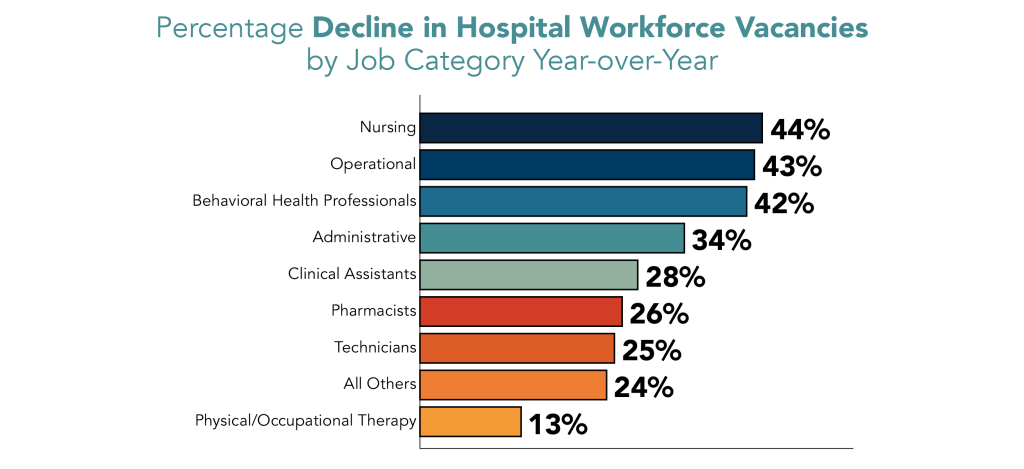
The Michigan Health & Hospital Association (MHA) published results from their second annual Michigan hospital workforce survey that shows hospital recruitment, retention and training efforts in 2023 helped fill 61,000 total positions in 2023, reducing job vacancies by 29% to a total of 19,000 statewide. More than 13,000 nurses were hired during that time, decreasing the number of nursing vacancies by 44%. The survey includes responses from more than 95% of all Michigan acute-care inpatient hospitals.

Nearly all job categories in the survey experienced double-digit percentage decreases in vacancies year-over-year. Hospitals successfully reduced vacancies in the following job categories:

  • Nursing – 44% decrease
  • Operations – 43% decrease
  • Behavioral health – 42% decrease
  • Administration – 34% decrease
  • Clinical assistants – 28% decrease
  • Pharmacists – 26% decrease
  • Technicians – 25% decrease

Bar graph of decline in hospital job vacancy by category.

Amidst a national nursing shortage, the results show Michigan hospitals are outperforming national nurse retention rates. The registered nurse (RN) turnover rate for Michigan hospitals is 3.7 percentage points lower than the national average of 18.4%. Examples of how Michigan hospitals are retaining and recruiting nurses include offering better and faster pay, improved benefits and employee support, and expanding educational opportunities for students to consider a nursing career. State funding obtained through Public Act 9 of 2022 and Public Act 5 of 2023 contributed to these efforts and have directly benefitted at least 69,000 healthcare workers.

To complement the efforts of individual hospitals, the MHA launched the statewide MI Hospital Careers public awareness campaign in 2023 targeting students and professionals considering a career change to express the value of healthcare careers. The MHA also engaged in efforts that ultimately led to four-year Bachelor of Science in Nursing programs at community colleges, expansion of the Michigan Reconnect program to allow funds to support Michiganders accessing healthcare credentials for technician and nursing careers, and new state law that increases the penalties for individuals who commit acts of violence against healthcare workers.

Michigan hospitals remain focused on solutions that build the healthcare workforce that patients need now, and in the future, to fill the remaining 19,000 open hospital positions, including 4,700 in nursing.

These efforts will strengthen healthcare in Michigan, which remains the state’s largest employer of direct, private-sector jobs according to 2024 Economic Impact of Healthcare in Michigan data. More than one million jobs in Michigan were directly or indirectly related to or induced by healthcare in fiscal year 2022, the most recent data available. Hospitals collectively employ 217,000 full- and part-time employees, remaining one of the largest employers in many Michigan communities. In addition, direct healthcare workers in Michigan earned nearly $47 billion in wages, salaries and benefits.

“Retaining and growing the workforce is a top priority shared by hospitals throughout the state,” said Michigan Health & Hospital Association CEO Brian Peters. “We’re extremely encouraged by the data demonstrating the success of hospitals over the past year in increasing the talent pipeline to care for patients and strengthening the healthcare workforce. Hospitals provide Michigan communities with good jobs that help drive our state’s economy and keep residents healthy.”

The 19th edition of The Economic Impact of Healthcare in Michigan was compiled using IMPLAN® cloud software to quantify healthcare’s significant economic impact in the state. The data represents direct, indirect[1] and induced[2] healthcare jobs; taxes paid by those workers and their employers; and salaries, wages and benefits earned. The report is an online, interactive tool that allows users to examine these economic impacts from a statewide perspective and by region, county or congressional district. It is available at www.economicimpact.org.

[1] Indirect jobs are those created to support a larger employer or industry (for example, a laundry that cleans linens for a hospital).

[2] Induced jobs are those created by the spending of people who work in the indirect jobs (for example, a restaurant waiter who serves the laundry workers).

MHA CEO Report — Prioritizing our Workforce

MHA Rounds image of Brian Peters

“When people are financially invested, they want a return. When people are emotionally invested, they want to contribute.” – Simon Sinek 

Workforce Support and Innovation is the top priority for the MHA this program year, as identified by our board of trustees and echoed by every member hospital and health system throughout the state. This should come as no surprise, as few sectors of our Michigan economy have been more challenged in this regard. I am proud to say the MHA has tackled this challenge head-on, using every tool in our increasingly diverse association toolbox.

For our members, we know delivering exceptional care begins with hiring, developing and retaining quality talent. We also know that the demographic realities of an aging population and the associated retirements, rising stress and burnout, and increased rates of violence against healthcare workers are all contributing to retention challenges and staffing shortages. Finally, as with any daunting issue, we know the best way for us to be helpful to our members is to first tap their expertise, letting them share the details of their day-to-day experience so we can identify the most impactful solutions both inside and outside of the public policy domain. In short, we listen.

Through our MHA Human Resources & Workforce Council, we convene our HR professionals to discuss issues such as workforce development, the education and training pipeline, diversity, equity and inclusion efforts, workplace safety, and emerging technologies that can aid in the completion of clinical and non-clinical tasks. The council generates robust information sharing on best practices, as well as discussion on HR-related legislative and regulatory proposals at the state and federal level.

Our work with this council does not occur in a vacuum but is instead complemented by our continual engagement with MHA committees, councils and task forces that include chief medical officers, chief nursing officers, hospital and health system attorneys and government affairs leaders. So, what have we accomplished to date? The list is long and impressive. Just a few examples:

  • Over the past two state budget cycles, we secured $300 million in new funding for our member hospitals for the specific purpose of workforce recruitment and retention.
  • We launched the new MI Hospital Careers campaign, which has helped to shine a light on hospitals and healthcare as a viable career path for Michiganders. We also continue to partner with state universities and community colleges to ramp up health-related training programs.
  • We successfully advocated for Public Acts 271 and 272 of 2023, recently signed by Gov. Whitmer, which increase the penalties for violence committed towards healthcare workers or volunteers.
  • Our MHA Keystone Center launched the Well-B workforce well-being initiative, which has now reached thousands of hospital workers and is contributing to enhanced resiliency of our front-line caregivers.
  • Our MHA Graphic Services division designed and produced workplace safety posters, which are now prominently displayed in hospitals throughout Michigan.
  • The MHA is hosting our annual Human Resources Conference this month, which brings together chief human resource officers and leaders to collaborate, strategize and network. The conference is headlined by Kerry Ebersole Singh, the chief talent solutions & engagement officer at the Michigan Economic Development Corporation. Her presence confirms the MEDC’s recognition of the significant role healthcare plays in our state’s labor force and economic success – a fact we annually lift up in our Economic Impact of Healthcare report.
  • The MHA Service Corporation (MHASC) plays a vital role in this realm. Our HR Conference is sponsored by MHA Endorsed Business Partners AMN Healthcare and Salary.com (as well as MHA members Executive Core and HPS, and event sponsor Vault Verify), who are all involved in the workforce solutions space. The MHASC is working with partners who assist hospitals with de-escalation training and staff safety, virtual nursing programs and other emerging technologies, and more.
  • The MHASC is crucial to our work here in yet another way. The MHA Unemployment Compensation Program has a decades-long track record of success, saving millions of dollars every year for their more than 700 clients.

Everything listed is an example of proactive, positive activity. In other words, “playing offense.” Of course, one of our most significant activities in the workforce realm is an example of “playing defense” by ensuring government mandated nurse staffing ratio legislation that would significantly jeopardize patient access to care is not advanced by the state legislature. As discussed at length in a recent CEO Report, the MHA has worked very effectively to explain the complexity associated with hospital staffing and the tangible solutions that will actually address workforce shortages.

There is no silver bullet to solving healthcare’s workforce challenges. Michigan’s population is not growing and there are many market forces at play unique to healthcare. However, I’m extremely pleased by the work our own MHA staff has put forth to best position our members to achieve our workforce goals. And it couldn’t be done without the engagement from our colleagues in hospitals throughout the state who are doing all they can to ensure access to high quality care 24/7/365. Collectively, these are people who are clearly emotionally invested and making significant contributions to this worthy cause.

As always, I welcome your thoughts.

MHA CEO Report — The State of Healthcare

MHA Rounds image of Brian Peters

“Mankind’s greatest achievements have come about by talking, and its greatest failures by not talking. It doesn’t have to be like this. Our greatest hopes could become reality in the future. With the technology at our disposal, the possibilities are unbounded. All we need to do is make sure we keep talking.”
Stephen Hawking

The new year always brings two traditional speeches from lawmakers: Gov. Whitmer just recently delivered her annual State of the State address, while President Biden will share the annual State of the Union address on March 7. While the economy, housing, education, border security, climate change and other important issues are featured in these speeches, the reality is that healthcare remains a top concern for millions of Americans, and therefore will continue to be front and center for elected officials and candidates at the state and federal level throughout this election year.

The bottom line is that the fragility of the healthcare continuum was exposed during the pandemic and four years later, the aftershocks can still be felt. Let’s touch on just a few issues that dictate the state of healthcare in 2024:

Healthcare Workforce

Michigan hospitals employ roughly 219,000 people and are desperately trying to hire thousands more in every corner of the state. A survey we conducted last year showed there were over 27,000 job openings in Michigan hospitals. Hospitals are often the largest employer in their respective communities and serve as critical economic engines. It takes longer to deliver care when hospitals don’t have enough staff, impacting the experience of patients and families.

Much like other industries in Michigan, healthcare has a supply and demand issue, but we feel it in a uniquely acute manner: the aging population not only contributes to an exodus of talent from the field, but it increases demand for healthcare services at the same time. And because we are classic “price-takers” when it comes to a huge share of our business (i.e. Medicare and Medicaid tell us what they are going to pay), our ability to pass rising labor (and supply chain) costs along to consumers is extraordinarily limited. The financial performance of hospitals across the state and country has been negatively impacted as a direct result, and it fuels our advocacy efforts related to our ongoing viability.

Healthcare needs to continue to refill the talent pipeline and we’re making progress on these efforts. From the MI Hospital Careers campaign to the individual partnerships created between health system and secondary-education institutions, the effort is being made to increase the supply of future professionals. I’m encouraged to hear Gov. Whitmer’s proposal for tuition-free community college for all Michiganders who graduate from a Michigan high school. We have been active in advocating for such a policy to improve the number of students pursuing these pathways to address the nursing shortage.

Behavioral Health

Behavioral healthcare in Michigan continues to be in crisis. We need to fund, support and reform our systems to better meet the behavioral healthcare needs of our communities.  Responding to MHA advocacy, the Michigan Legislature provided $50 million in grant funding last year to increase access to pediatric inpatient behavioral health services. We are encouraged by what our member hospitals have planned to improve access, but more needs to be done. This will be a focus area for us in Lansing through the rest of the year, specifically looking at solutions that include continuing to expand care locations, clarifying insurance coverage policies and increasing the number of providers.

Prescription Drug Affordability

Increasing prescription drug costs are a key driver of escalating healthcare costs. These increased costs are not just experienced by patients at their local pharmacies, but hospitals are also large purchasers of prescription drugs and are experiencing the same costs, threatening their viability. Data shows drug costs rose by 36.9% from 2019 to 2021 and currently account for the largest portion of healthcare insurance premiums, costing 22.2 cents for every dollar.

With these dramatic cost increases, the 340B drug pricing program has never been more important. This critical program allows safety net hospitals and other community care organizations to access certain outpatient prescription drugs at discounted prices. It does not require any state taxpayer dollars and has contributed to supporting access to care to Michigan’s most vulnerable patients for more than 30 years. We’re hopeful to see legislation passed to protect these hospitals and the benefits they provide, such as supporting OB services, financial assistance programs for low-income patients or lowering the cost of prescription drugs.

Emerging Technology and AI

Technology continues to provide many opportunities and growth for healthcare. It can serve as a “force-multiplier” that allows our staff to work smarter, extending their impact. If used correctly, technology can improve the patient experience, care delivery, worker satisfaction and more. We’re already seeing it with the dramatic growth in the utilization of telehealth and the emergence of artificial intelligence (AI) applications throughout healthcare. Technology can help expand access to care for many of our rural or disadvantaged residents who are confronted with a variety of social barriers.

We’re seeing great innovation when it comes to technology and I expect even more in the years ahead. The “disruptors,” that is to say, the large, global companies known for their technological innovation (and deep financial resources) are increasingly turning their attention toward the $4 trillion American healthcare market. These entities could be viewed as a potential threat to traditional healthcare providers, payors and others in the health ecosystem – but could also be viewed as potential collaborators and strategic partners. Without a doubt, the future delivery and financing model will be shaped in some way by this development.

At the same time, the rise of sophisticated technology and the inter-connectedness between healthcare entities, their patients and the rest of the world gives rise to the specter of cybercrime. This topic is worthy of its own special focus (stay tuned for more on that in the months ahead), but for now, let me just point to the fact that the MHA was proud to be ahead of the game in this regard, helping to launch our own healthcare-focused cybersecurity operations center right here in Michigan with MHA Endorsed Business Partner CyberForceQ.

These are just a few of the countless, complex issues that will impact Michigan healthcare in the year ahead. Plenty to be concerned about, for sure. But I remain fundamentally optimistic and hopeful about the future. Our healthcare workers are committed and resilient. And our policymakers continue to acknowledge the dependent relationship their communities have with healthcare. While I know better than to predict much of anything in an election year, I feel confident in predicting healthcare will continue to help make Michigan a better place, no matter what the political winds bring our way. All we need to do is continue our most human connection – let’s keep talking with each other and craft a positive future together.

As always, I welcome your thoughts.