Virtual Maternal Health Quality Improvement Courses Available

The Michigan Alliance for Innovation on Maternal Health (MI AIM) is offering virtual modules to support maternal health quality improvement efforts. All obstetric team members at MI AIM participating birthing hospitals are encouraged to complete the courses.

This approximately three-hour series consists of the following three modules:

MI AIM Collaborative Orientation

Focuses on criteria for each program year by highlighting requirements for birthing hospital participation, data collection and reporting, and quality improvement implementation.

MI AIM Data Overview

Walks through the KeyMetrics system, learning how to navigate the pages within the dashboard, filter between hospital, region and state data, and interpret data and graphs.

Fundamentals of Quality Improvement

Provides an exploration of the Quality Improvement Model, the Plan, Do, Study, Act cycle, instructions on conducting a GAP analysis and for crafting SMART goals.

Members with questions may visit the KeyLearnings FAQ page, or contact the MHA Keystone Center.

*Please note: Continuing education credits are not currently available. Participants requiring a certificate of completion should contact the MHA Keystone Center.

Registration Now Open for MHA Annual Membership Meeting

Registration is now open for the MHA Annual Membership Meeting June 25 through 27 at the Grand Hotel on Mackinac Island.

The annual meeting will feature an outstanding lineup of speakers, including Geeta Nayyar, MD, MBA, a globally recognized chief medical officer, technologist and bestselling author. She will decode AI hype versus reality and provide examples of promising partnerships between healthcare and technology organizations. She will also expand on how AI can build patient engagement and trust in today’s misinformation society.

A panel will feature statewide leaders in maternal health, who will explore the treatment of maternal health risks that result in healthier moms and babies, and solutions within individual communities, led by local agencies that can provide social services and other support systems for women.

The MHA Annual Membership Meeting also includes the popular lawn party, with games and entertainment, an ice cream social and many more relationship-building opportunities. New this year is a Sip N’ Sail cruise, which underwrites the health improvement programs recognized by the MHA Health Foundation Ludwig Community Benefits Award.

Members are encouraged to register by May 23 to attend this memorable event. Opportunities for sponsorship of the annual meeting are available through May 5. Members with questions should contact the MHA Field Engagement team or call (517) 323-3443.

Fall MI AIM Regional Training Events

The Michigan Alliance for Innovation on Maternal Health (MI AIM) is offering training events across Michigan for inpatient maternal healthcare providers. The events, scheduled from late October to November, will focus on using quality improvement techniques for MI AIM safety bundle implementation.

The in-person events are free of charge, open to nurses, physicians and hospital maternal health teams. The trainings will run from 9 a.m. to 3 p.m. and include breakfast and lunch. Time for discussion and collaboration among regional hospital teams will be provided. An overview agenda is available for attendees to view prior to the event.

MI AIM Regional Training Dates

For questions, please reach out to Dominique Abram and Meagan Chuey from the Michigan Department of Health & Human Services Division of Maternal & Infant Health. Members may also reach out to the MHA Keystone Center for assistance.

Upcoming MDHHS Maternal Health Offerings

MDHHS to Host Statewide Maternal and Infant Health Data Meeting – Oct. 28

The Michigan Department of Health and Human Services (MDHHS) Division of Maternal and Infant Health is partnering with the Michigan Perinatal Quality Collaborative (MI PQC) to offer its Statewide Maternal and Infant Health Data Meeting from 4 to 6 p.m. on Oct. 28. The event will showcase maternal and infant health data across the state and regionally.

Members interested in attending the event can register online.

MDHHS Invites Community-Based Organizations to Apply for Maternal Mortality Surveillance Grant – Oct. 7 Deadline

The MDHHS is offering funding support to a select number of projects focused on improving maternal health, with an emphasis on pre-pregnancy, pregnancy and postpartum care. Community-based organizations are encouraged to apply for funding by Oct. 7.

Members interested in learning more about the funding opportunity can download the informational flyer or review the online application.

MHA CEO Report — A Program Year in Review

MHA Rounds graphic of Brian Peters

“Winning is not a sometime thing, it is an all the time thing. You don’t do things right once in a while…you do them right all the time.”  — Vince Lombardi

MHA Rounds image of Brian PetersI am pleased to share we just completed a successful MHA Annual Meeting, continuing a long-standing June tradition whereby we celebrate the conclusion of one MHA program year, and prepare for the next. Each program year is unique with the different challenges it presents. At this point five years ago, no one could have predicted how the emergence of COVID-19 would flip healthcare on its head and drastically alter the tactical objectives of our association. However, there is a constant: the MHA continues to rise to any challenge presented to us and we deliver results for our membership to improve the health and wellness of individuals and communities.

The 2023-2024 program year focused intensely on workforce, viability and behavioral health, while addressing the various “wildcard” issues that always come up. We were led with great wisdom and compassion by Shannon Striebich, president and CEO, Trinity Health Michigan, as our board chair. Due to Shannon’s commitment and leadership, the MHA accomplished numerous highly successful and impactful outcomes on behalf of our members.

One of the most significant challenges in this past year was the threat posed by government-mandated nurse staffing ratio legislation. This proposed policy had the potential to dramatically reduce access to care for individuals throughout the state. Our advocacy on the issue lasted throughout the entire year but was highlighted by an Advocacy Day we hosted in September that featured more than 150 hospital representatives, primarily consisting of nurse leaders, who came to the Capitol and conducted 118 meetings with lawmakers that day. Later in the year, the MHA successfully advocated our position at a committee hearing, where more than 60 supporters attended on very short notice to push back on false narratives and to support alternative nurse staffing solutions. As a result of our efforts, no committee votes have been scheduled, and momentum on this harmful legislation has been effectively stalled.

While we had to play defense against this harmful proposed legislation, the MHA spent the program year actively engaged in workforce development and efforts to grow the healthcare talent pipeline. The MHA worked with stakeholders to implement new funding designed to expand access to Bachelor of Science in Nursing degrees through partnerships between community colleges and four-year universities, while also engaged in partnerships with other organizations to promote healthcare careers, increase clinical faculty and nurse preceptors, address high turnover rates in rural areas and promote healthcare career options. We continued our award-winning healthcare career marketing campaign designed to attract future workers and also redeployed our annual hospital workforce survey that shows the efforts of Michigan hospitals to recruit, retain and train healthcare workers is making a real difference. Finally, we hired our first-ever chief nursing officer at the MHA, which is already strengthening our ties to the nursing community throughout the state.

The viability of hospitals was another key focus and was largely supported through our legislative advocacy work. MHA funding priorities continued to be protected in the state budget, which includes $163 million for graduate medical education, $45 million for traditional disproportionate share hospitals, $15 million through the rural access pool and an additional $8 million for the obstetrical stabilization fund. The fiscal year 2024 budget also included $60 million annually to support hospitals with Level I and II trauma centers and $34 million annually to support hospitals that provide inpatient psychiatric care. Besides state funding, the MHA protected Medicaid funding, medical liability, the 340B drug pricing program and certificate of need.

The MHA is also intricately involved in in addressing the behavioral health crisis plaguing our state and country. Expanding access to care is a key focus, which included the MHA administrating a $50 million grant program to expand access to pediatric inpatient behavioral health services. The Michigan Department of Health and Human Services (MDHHS) is a close partner in this work and the MHA participated in the MDHHS Advisory Committee on the creation of a psychiatric bed registry. The MHA launched a new member ED boarding survey to quantify the number of patients struggling with behavioral health access in the emergency department and the MHA is using this data when engaging with lawmakers, stakeholders and the public to explain the scope of the program. These learnings informed the creation of a four-bill package of legislation to address board-identified issues in the behavioral and mental health system, such as coverage parity and community mental health shortcomings.

Much of the work in the past year has focused on maternal and infant health and improving maternal health and birth outcomes. And I am pleased to share that our MHA Board of Trustees just approved the full slate of recommendations emanating from the MHA Community Access to Health Task Force, giving us the support to continue this important journey together.

And as usual, we effectively dealt with a long list of “wildcard” issues that emerged during the program year, including drug shortages, guardianship, infection control, patient transport, population growth and safety and quality. We also continued to strengthen our efforts related to the growing cybersecurity threat. Indeed, the Change Healthcare cyberattack was one of the largest and most impactful attacks ever seen and served as a clear reminder of the importance of our work in this space.

At our Annual Meeting, I spoke to our attendees about “the power of zero.” In the 2023-2024 program year, the following were true:

  • The number of Michigan acute care community hospitals and health systems that are not members of our association is zero. We have everyone at the table, which allows us to speak with one powerful, united voice.
  • We passed 39 MHA-supported bills through the state legislature that were enacted into law, with five more on their way to the governor for her signature. The number of MHA-opposed bills that made their way to the finish line was zero.
  • The MHA now has a full-time chief medical officer and a full-time chief nursing officer (as noted above). How many other state hospital associations can say this? Zero.
  • And most importantly, how many other associations – in any sector – are as relevant, as impactful, as mission-driven and successful as the MHA? I believe that number is zero.

I would like to recognize and thank our outstanding MHA Board of Trustees, our members, sponsors and business partners, but most of all, our incredible MHA staff for coming together to achieve such tremendous results for the patients and communities we collectively serve. I hope you will take the opportunity to celebrate these results with us.

As always, I welcome your thoughts.

Healthcare Advocates Honored with MHA Special Recognition Award

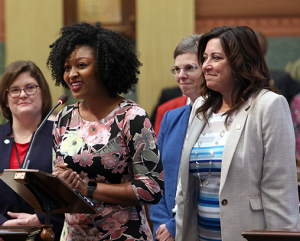
Sen. Anthony and Rep. Witwer

The MHA announced two winners of its Special Recognition Award during the Annual Membership Meeting June 27, recognizing them for extensive contributions to healthcare. Each of the winners has uniquely influenced healthcare in Michigan. The winners include Sen. Sarah Anthony (D-Lansing) and Rep. Angela Witwer (D-Delta Township).

The lawmakers each chair their chamber’s appropriations committee, with Anthony the first Black woman to ever chair the Senate Appropriations Committee. These committees are responsible for determining the annual state budget, covering important healthcare areas including Medicaid, the Healthy Michigan Plan, graduate medical education, the rural access pool and obstetrical stabilization fund, and critical access hospital reimbursement rates. Both lawmakers were strong supporters of Public Act 5 of 2023, sponsored by Witwer, which provided $75 million for hospital workforce recruitment, retention and training in the fiscal year 2023 state budget. In addition, they each fought to include enhanced funding for ongoing Level I and Level II trauma centers, inpatient psychiatric payment rates and maternal health in the fiscal year 2024 budget. Both Anthony and Witwer are strong supporters of funding Medicaid appropriately to ensure adequate reimbursement rates for providers and protect access to healthcare services.

Sen. Sarah Anthony (D-Lansing)

In addition to her committee role, Anthony prioritizes expanding access to healthcare. She sponsored Michigan’s first mental health parity law, signed into law May 21 by Gov. Whitmer. Public Act 41 of 2024 requires insurance coverage for mental health and substance use disorder treatments at the same level as physical health services. This new law eliminates existing disparities and ensure equal access to necessary care for all Michiganders. Anthony also co-sponsored key legislation last session to support the healthcare talent pipeline signed into law by Gov. Whitmer Dec. 22, 2022. Public Acts 251 and 252 of 2022 expanded the Michigan Reconnect program, allowing for several additional certifications to qualify for the post-secondary scholarship program including high-demand healthcare credentials. Other healthcare legislation Anthony sponsors includes Senate Bill 531, which is part of a package of bills supported by the MHA that would improve Michigan’s amended auto no-fault laws. The package would simplify and increase Medicare hospital reimbursements, clarify the definition of Medicare and create a new post-acute care provider fee schedule. The bills passed the Senate in a bipartisan vote and await consideration by the House.

Rep. Angela Witwer (D-Delta Township)

Witwer’s role as a healthcare champion is inspired by more than the 22 years she spent working in healthcare to begin her career. She first started as a clinician, working in University of Michigan Health – Sparrow Lansing’s burn unit and later as the manager of pediatric rehabilitation. She later became manager of the hospital’s community relations and marketing department, before leaving the organization to co-found her own public relations, marketing and advocacy firm. These life experiences inspired Witwer’s support for Public Acts 271 and 272 of 2023, which increase the penalties for assaulting a healthcare worker or volunteer by doubling the financial fines for those found guilty of such a crime.

New to Know – June 24, 2024

The MHA is hosting office hours virtually from 2 to 3 p.m. every Thursday through June 27 to assist hospitals in completing an application for The Joint Commission’s (TJC’s) Maternal Levels of Care (MLC) Verification. Registration is required and members are asked to register by end of business the Wednesday prior to a week’s session. These sessions provide an opportunity for hospitals to collaborate across the membership, as well as to address general MLC Verification application and program/process questions. Members with questions about the MLC Verification application process are encouraged to attend the sessions. Members with questions about office hours should contact Ewa Panetta.


MHA Endorsed Business Partner CorroHealth will host a free webinar for members on June 26. Master Revenue Integrity with VISION: Unveiling Advanced CDI Technology for Hospitals. VISION is a cutting-edge DRG revenue integrity technology developed by physicians with deep clinical knowledge, advanced data analytics, and the latest coding guidelines. VISION instantly scores and prioritizes clinical cases for review and optimization to maximize compliant revenue capture. Members with questions may contact Laura Penton at CorroHealth or Rob Wood at the MHA.

News to Know – May 13, 2024

  • MHA Endorsed Business Partner Managed Care Advisory Group, Inc. (MCAG) provided an update on the Visa Mastercard class action settlement. A $5.54 billion settlement has been reached for merchants to compensate for excessive interchange fees, with pre-populated claim forms sent to eligible class members by the settlement administrator in December 2023. The deadline for submitting a claim form is May 31, 2024. Eligible entities are advised to thoroughly review the form and information on the administrator’s portal to ensure expected compensation, with MCAG’s experts available to assist in reviewing figures and maximizing settlements. For more information or to sign up, visit MCAG’s website for MHA members, where their experienced team can guide members through the process. Members may contact Adam Schmidt, vice president of business development at MCAG, for further details on the settlement monitoring service.
  • The MHA Keystone Center is partnering with the Michigan Regional Perinatal Quality Collaborative (MI PQC) to offer an additional networking opportunity for members attending the Michigan Maternal & Infant Health Summit. The event will take place from 5 to 8:30 p.m. on Monday, June 17. Registration is required and separate from the Michigan Maternal & Infant Health Summit registration. Members with questions may contact Andrew Syrek at the MHA.
  • In partnership with the Michigan Department of Health and Human Services, the MHA Keystone Center developed a series of online learning modules for infection control and prevention education. The modules cater to the needs of healthcare systems in Michigan and are available at no cost. The central objective of the six-part course is to provide healthcare workers with the vital knowledge and competencies required to engage in critical thinking about infection control via the Centers for Disease Control and Prevention’s Project Firstline Members with questions may contact Josh Suire at the MHA.