
HRSA Announces 340B Rebate Pilot; President Trump Pens Letter on Most Favored Nation Pricing

The Health Resources and Services Administration (HRSA) issued guidance July 31 on a proposal to shift a portion of the 340B drug pricing program away from an upfront discount model to a rebate model. HRSA guidance indicates permission for certain drugmakers to participate in a rebate model for certain drugs starting January 1, 2026 and allowing the rebate pilot to run for at least one year.

The specific drugs selected for the pilot include those subject to negotiation under the Medicare Drug Price Negotiation for initial price applicability year 2026. The guidance issued outlines pilot program criteria including requirements that any plan submitted by a manufacturer include a platform for data submission paid for by drug manufacturers, and a specific prohibition on passing that cost on to covered entities; requiring 60 days notice to covered entities before implementation of a rebate model; allowance for covered entities to purchase pilot covered drugs through existing distribution mechanisms; requirements for technical assistance and good faith engagements and requirements on data security. Importantly, HRSA reiterates the requirement that manufacturers may not implement rebate plans without prior approval.

From a reporting perspective, the guidance indicates that any plan submitted limit data submission requirements from covered entities to several readily available fields and allows covered entities to submit and report data for up to 45 calendar days from date of dispense or potentially longer if extenuating circumstances arise. Finally, the guidance requires that manufacturers pay rebates, or alternatively deny them with documentation, within 10 calendar days of data submission.

The MHA remains concerned about the implications of significantly altering the foundation of the 340B program. Given the program’s intent to stretch scarce federal resources for safety net healthcare providers, the proposed pilot does not appear to align with Congressional intent at this time.

The MHA continues to review this guidance and encourages members to submit comments through the Federal eRulemaking Portal.

Also on July 31, President Trump sent letters to drug manufacturers reiterating his expectations that American families and patients see the impact of Most-Favored-Nation prescription drug pricing. In the letter, the President emphasized that within 60 days, manufacturers doing business in the United States should take several actions:

  • Extend Most-Favored-Nation pricing to Medicaid.
  • Guarantee Most-Favored-Nation pricing for newly launched drugs.
  • Return increased revenues abroad to American patients and taxpayers.
  • Provide for direct purchasing at most-favored-nation pricing.

As major purchasers and consumers of prescription drugs, hospitals and patients continue to seek relief from rising costs. The MHA will continue to monitor the president’s prioritization of lowering drug prices and its potential impact on healthcare affordability and access.

Members with additional questions should contact Elizabeth Kutter at the MHA.
MHA Monday Report Jan.13, 2025

103rd Legislature Begins With Introduction of Earned Sick Time Bills
The Michigan Legislature officially commenced their 103rd session on Wednesday, Jan. 8, including the introduction of legislation to amend Michigan’s Earned Sick Time Act . The session brings a new partisan divide with the Senate …


HHS Submits New HIPAA Security Proposed Rule
The U.S. Department of Health and Human Services (HHS) recently submitted a proposed rule to update the HIPAA Security Rule and enhance the protection of electronic protected health information. The changes aim to address the …


Healthcare Leadership Academy Enrollment Deadline Approaches

The enrollment deadline for the MHA Healthcare Leadership Academy is Feb. 3. The cohort meets Feb. 19 – 21 and April 10 and 11 at the MHA headquarters in Okemos. The Healthcare Leadership Academy, in partnership …


Applications Open for New Medicare Funded Rural Residency Slots

Qualifying rural hospitals may now apply for new residency positions created by Section 126 of the Consolidated Appropriations Act of 2021 and Section 4122 of the CAA of 2023, which allow hospitals to expand …


HRSA Announces Addiction Medicine Fellowship Program

The Health Resources and Services Administration (HRSA) recently announced the establishment of the Addiction Medicine Fellowship Program, which trains physicians to become addiction medicine specialists. The program aims to expand the number of fellows at …


Behavioral Health Internship Stipend Program Application Released

The Michigan Department of Health and Human Services is offering the Behavioral Health Internship Stipend Program, a key initiative aimed at increasing Michigan’s behavioral health workforce. Now in its second year, the program provides up …


Nominations Open for 2025 Hometown Health Hero Award

The Michigan Public Health Week Partnership is now accepting nominations for the 2025 Hometown Health Hero Award. This award recognizes individuals and organizations that made a meaningful impact on improving the health of their community.


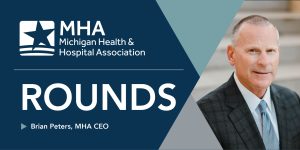
MHA Rounds image of Brian PetersMHA CEO Report — Impacting Communities

As we turn the page on 2024 (and celebrate our success in preventing harmful government-mandated nurse staffing ratio legislation, as well as harmful changes to our medical liability system, during the lame-duck session of the legislature), …


Keckley Report

The Two Events that Changed U.S. Healthcare for Everyone

In late 2025, two events reset the U.S. health system’s future at least through 2026 and possibly beyond…

Transforming the U.S. health system is a bodacious ambition for the incoming Trump team. Early wins will be key—like expanding price transparency in every healthcare sector, softening restrictions on private equity investments, targeted cuts in Medicaid and Medicare funding and annulment of the Inflation Reduction Act. In tandem, it has promised to cut Federal government spending by $2 trillion and lower prices on everything including housing and healthcare—the two spending categories of highest concern to the working class. Healthcare will figure prominently in Team Trump’s agenda for 2025 and posturing for its 2026 mid-term campaign. And equally important, healthcare costs also figure prominently in quarterly earnings reports for companies that provide employee health benefits forecast to be 8% higher this year following a 7% spike the year prior. Last year’s 23% S&P growth is not expected to repeat this year raising shareholder anxiety and the economy’s long-term resilience and the large roles housing and healthcare play in its performance.”

Paul Keckley, Jan. 6, 2025Lauren LaPine


MHA in the News

Second Wave Michigan published a story Jan. 7 on how state officials, healthcare providers and community organizations are focusing on expanding the continuum of care for people experiencing a mental health crisis. Lauren LaPine, senior …


HRSA Announces Addiction Medicine Fellowship Program

The Health Resources and Services Administration (HRSA) recently announced the establishment of the Addiction Medicine Fellowship Program, which trains physicians to become addiction medicine specialists.

The program aims to expand the number of fellows at accredited Addiction Medicine Fellowship (AMF) and Addiction Psychiatry Fellowship (APF) programs. Program participants will be trained to work in underserved, community-based settings that provide primary care services, along with mental health disorder and substance use disorder services.

$23 million will be awarded to 28 fellows over a five-year period through this program. Applicants must be based at an accredited AMF or APF program. The sponsoring institution must be accredited by the Accreditation Council of Graduate Medical Education.

For more information and to access the application, members are encouraged to visit the HRSA website.

Members with questions may contact Lauren LaPine at the MHA.

MHA CEO Report — Protecting Access to Care Through 340B

MHA Rounds image of Brian Peters

“I alone cannot change the world, but I can cast a stone across the water to create many ripples.” Mother Teresa

MHA Rounds image of Brian PetersProtecting access to high quality, affordable healthcare for all Michiganders is a key tenet of the MHA. Stated simply, the 340B drug pricing program, created by Congress in 1992, is absolutely crucial to our member hospitals’ ability to maintain this access. And remarkably, since its inception to the current day, it has never required any state or federal taxpayer dollars.

One of my favorite elements of my MHA job is the opportunity to travel around the state and visit with the executives, clinicians and other important employees of our Michigan hospitals. I always ask the question: “What are your highest priorities and how can we help?” One of the most consistent answers for years has been: “We need to protect 340B.” Erosion or elimination of the program would quite literally mean the closure of key service lines, or even the hospital itself, in some cases.

At a time when drug prices are the most rapidly growing expense for hospitals, the 340B program has never been more important. It acts as a force multiplier, allowing hospitals to stretch incredibly scarce resources to provide high quality care for more patients in their communities, including our most vulnerable residents. The savings created from the ability to purchase certain prescription drugs at a discount enables hospitals to keep care in the community in various ways. Examples include funding free or heavily discounted prescription drugs for patients, trauma care, care for people with HIV/AIDs, behavioral health services, oncology clinics, nursing homes and treatment for substance use disorder.

It allows qualifying hospitals, particularly rural hospitals and those serving low-income patients, to deliver care and programming based on the needs of their individual communities. Many larger 340B hospitals are academic medical centers that care for the sickest and most complex patients. They establish arrangements with pharmacies outside of their immediate geographic area so patients who travel long distances to the hospital for specialized care can still access needed drugs at pharmacies near the patient’s home.

Unfortunately, prescription drug manufacturers are working to put arbitrary limits on the 340B program at the state and federal level and Michigan hospitals are at risk of losing their ability to provide affordable, accessible care to those in need. This comes at the same time when costs for new drugs launched by pharmaceutical companies rose by 35% from 2022 to 2023 and for the first time in history, the median price of a new drug is $300,000 – more than four times the median annual household income in the U.S. These attacks will make it more difficult to administer the 340B program and unnecessarily cut needed savings that could be invested in the community. These restrictions threaten access to care by risking the closure of birthing units, nursing homes and even critical access hospitals.

The MHA and Michigan hospitals are currently advocating for the passage of House Bill 5350 to counteract these attacks. The proposed legislation would help protect the 340B drug pricing program at the state level and the healthcare cost-savings generated for hospitals and the communities they serve. We highly encourage you to use our action alert to express the importance of the program to your lawmakers as the bill currently awaits passage out of the House Insurance and Financial Services committee.

Other harmful actions by manufacturers include Johnson & Johnson’s recent attempt to institute an unapproved rebate requirement for two drugs. The MHA opposed that proposal and we’re pleased to see that our advocacy with the Health Resources and Services Administration (HRSA) and our Congressional delegation, along with other hospitals and state hospital associations from across the country, influenced Johnson &  Johnson into discontinuing their pursuit of this unauthorized plan, after multiple HRSA notices of opposition.

This specific work is just the latest example of the MHA’s long-time strident advocacy at the state and federal level related to 340B. We have engaged in the state legislature, Congress, the courts and with our MHA Service Corporation Endorsed Business Partners, demonstrating just how impactful we know this program is.

The 340B program has helped to improve the health and wellness of individuals and communities for 30 years. It operates without any taxpayer-funded support and has positively impacted millions of lives. Attempts at eroding the program would not only harm hospitals, but more importantly patients and communities. As I have often said, the healthcare ecosystem is incredibly complex and there is rarely if ever a single silver bullet solution to any aspect of our challenges. But there is no doubt that the 340B program is one of those critically important stones that creates many positive ripples.

As always, I welcome your thoughts.

National Rural Health Association Funding Opportunities Available

The National Rural Health Association (NRHA) recently announced two new funding opportunities to support initiatives that will improve healthcare access in rural communities.

The Rural Utilities Service, a Rural Development agency of the United States Department of Agriculture (USDA), will accept applications for the USDA Rural eConnectivty Program starting March 22 until April 22. This program offers loans and grants to support the construction, improvement or acquisition of facilities and equipment that are necessary to expand broadband internet service in rural areas. Funding opportunities for eligible applicants will vary based on the needs of each Proposed Funded Service Area.

Additionally, the HRSA Rural Communities Opioid Response (RCORP) Funding Program is currently accepting applications through May 6 to expand access to treatment for substance use disorder (SUD) in rural communities. Throughout this four-year project, grantees are eligible to receive up to $750,000 per year. Funding is intended to support the establishment or expansion of the SUD workforce, collaboration with social services for long term recovery support, and sustainability of programming beyond the grant period. Public, private, non-profit, for-profit groups, tribal government, educational institutions and faith-based organizations are encouraged to apply. Applicants must be a part of a network involving at least four entities, with at least two located in HRSA-designated rural service areas.

Eligible MHA members are encouraged to consider applying for these funding opportunities to expand and enhance healthcare services in rural communities.

Members with questions may contact Lauren LaPine at the MHA.