The following statement can be attributed to Brian Peters, CEO of the Michigan Health & Hospital Association.
On behalf of the Michigan Health & Hospital Association, I want to extend my sincere condolences to Governor Whitmer and her family on the passing of her father, Mr. Whitmer.
Mr. Whitmer was a respected leader and trusted partner in the Michigan healthcare community. As the CEO of Blue Cross Blue Shield of Michigan, he worked with providers to tackle the state’s most complex healthcare challenges, always emphasizing collaboration and innovation. His commitment to improving care has left a lasting impact that will inspire healthcare leaders for years to come.
The Michigan Legislature’s newly passed state budget, which protects all existing healthcare funding, was signed into law Oct. 7 by Gov. Whitmer.
Public Act 22 of 2025, sponsored by Rep. Ann Bollin (R-Brighton), includes the following:
Full funding for Medicaid and the Healthy Michigan Plan.
Complete recognition of hospital provider taxes and the ability to access those funds without additional legislative action or red tape.
Restoration of Specialty Network Access Fee (SNAF) funding.
Continued support for the rural and obstetric (OB) stabilization pools.
Preserved funding to support Maternal Levels of Care verification.
Restoration of funding for the Michigan Clinical Consultation and Care (MC3) program.
This funding reinforces support for Michigan hospitals, healthcare workers and patients. Full funding for Medicaid means maintained access to healthcare for all patients across communities, especially in rural and underserved areas. Furthermore, SNAF supports physician reimbursements for those providing care in vulnerable communities, while rural and OB stabilization pools ensure funding for rural areas and for labor and delivery services. Lastly, Maternal Levels of Care and MC3 funding were both sustained, safeguarding hospitals’ ability to collaborate among facilities and providers to guarantee women receive risk-appropriate maternal care as well as provide access to important pediatric behavioral health services in Michigan.
The MHA worked diligently with legislators over the last several weeks on the budget and applauds the efforts of Gov. Whitmer, Senate Majority Leader Winnie Brinks and Speaker of the House Matt Hall to pass a bipartisan budget that preserves healthcare funding for hospitals, providers and patients.
Legislation that would implement 340B program protections advanced in the Senate Oversight Committee and Gov. Whitmer delivered her seventh annual State of the State address to the Michigan Legislature during the week of Feb. 24.
Deidra Wilson, senior vice president, government relations and public policy, McLaren Health Care; and Ben Frederick, associate vice president of advocacy and government relations, Memorial Healthcare testified Feb. 27 in the Senate Oversight Committee on legislation regarding 340B Protections.
Senate Bill (SB) 94, sponsored by Sen. Sam Singh (D-East Lansing), and SB 95, sponsored by Sen. Jonathan Lindsey (R-Allen), saw extensive action in the Senate Oversight Committee Feb. 27. SB 94 protects the 340B program in Michigan and is paired with SB 95, which requires hospital compliance with federal transparency laws. Two MHA members provided testimony during the committee in support:Deidra Wilson, senior vice president, government relations and public policy, McLaren Health Care; and Ben Frederick, associate vice president of advocacy and government relations, Memorial Healthcare.
SB 94 safeguards the 340B program, ensuring cost savings and preserves access to affordable healthcare services in both urban and rural Michigan communities. Further, this legislation adds first of its kind drug manufacturer transparency requirements, making Michigan’s legislation the strongest in the nation.
During testimony, Wilson first thanked the committee for their swift action on reintroduction of the bills and the importance of expediting this legislation to support communities. She discussed services for cancer patients across the state, such as covering copays, rural OB services and other vital services for vulnerable populations that are impacted when pharmaceutical manufacturers create restrictions around the 340B program. Wilson concluded her testimony by stating that hospitals prioritize the needs of patients and communities over the profits of drug manufacturers. Frederick emphasized the impact the 340B program has in rural communities, especially for independent and community hospitals, and shared how these rural areas can provide essential OB, cancer and family medicine services to preserve and improve access for patients. Following a successful hearing, the Senate Oversight Committee voted 5-0 to report SB 94 and SB 95 to the full Senate. The bills now await a full vote in the Senate before it can be sent to the House of Representatives.
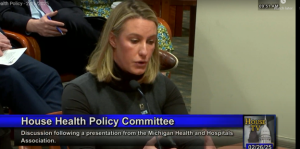
Elizabeth Kutter, senior director, government and political affairs, MHA testimony provided an overview of the 340B program in the House Health Policy Committee Feb. 26.
The House Health Policy Committee also heard testimony on the importance of the 340B program in the state Feb. 26.Elizabeth Kutter, senior director, government and political affairs, MHA, provided an overview of the program, including examples of how the program benefits patients and communities across the state. Wilson and Frederick also testified, sharing how the program works for their hospital systems. The educational hearing enabled House Health Policy members to ask questions and engage in a constructive dialogue around the topic. The MHA continues to advocate for the 340B program and support Michigan hospitals’ efforts to expand access to quality, community-based care. Members are encouraged to use the MHA 340B Action Alert to contact their lawmakers in support of this legislation.
Lastly, Gov. Whitmer outlined her upcoming priorities to a joint convention of the Michigan Legislature in her State of the State address Feb. 26. One key highlight in her address included reducing medical debt for Michiganders. While no specific policies were discussed, she cited 700,000 Michiganders currently have medical debt and that legislators should work to find solutions for this issue going forward. In addition to this, the governor discussed working in a bipartisan fashion on issues like road funding, building affordable housing and lowering costs in the state.
A variety of bills impacting hospitals were introduced and discussed in the state legislature during the week of Oct. 7.
Gov. Whitmer signed Public Act (PA) 132 of 2024, which updates statutory framework for the rural and obstetrical access pools funded in the fiscal year 2025 state budget. The MHA supports PA 132, introduced by Sen. Singh (D-East Lansing), as an additional statutory clarification to highlight the importance of funding for rural providers.
The Senate Health Policy Committee took testimony on Senate Bills (SB) 916 – 918, led by Sen. Hertel (D-Saint Clair Shores). The bills would expand the availability of Assisted Outpatient Treatment (AOT) in Michigan. AOT has been proven to decrease the number of individuals involved in the criminal justice system with behavioral health needs and can decrease the pressure on emergency departments for issues related to behavioral health. The bills expand the healthcare providers eligible to provide testimony for AOT and adds a new mechanism to divert individuals charged with misdemeanor offenses to AOT. The MHA supports the legislation as it awaits a vote of the full committee.
The Senate Finance, Insurance and Consumer Protection Committee took testimony on several sets of bills that impact hospitals this week. SBs 888–892, sponsored by Sen. Bayer (D-Keego Harbor), make alterations to the Identity Theft Protection Act and corresponding acts, to require certain security measures and protocols with regard to the protection of personal information from cyberattacks. The MHA worked closely with Sen. Bayer and Attorney General Dana Nessel on the ways to ensure healthcare providers and hospitals can protect patient information, while also allowing alignment with existing reporting and regulatory structures. The MHA continues to work with the sponsor and the attorney general on this legislation, and on other opportunities to support hospitals as victims of cybercrime.
The Committee also heard from proponents of SBs 1021 and 1022, which aim to expand the purview of the current Michigan Consumer Protection Act (MCPA). The MCPA provides a broad exemption for regulated and licensed professional entities, such as healthcare professionals and hospitals. This exemption acknowledges that these highly regulated fields already have proper channels for citizens to seek remedies, when needed. SB 1021 would alter that exemption and subject otherwise regulated and licensed spaces to new lawsuits and challenges. The MHA is opposed to this legislation.
Members with questions can reach out to Elizabeth Kutter at the MHA.


 The following statement can be attributed to Brian Peters, CEO of the Michigan Health & Hospital Association.