State Senate Advances Healthcare Legislation

Several bills impacting healthcare and hospitals were advanced through committees in the state Senate during the week of Oct. 14.

Senate Housing and Human Services voted out a package of legislation referred to as the ‘Momnibus.’ Sen. Erika Geiss (D-Taylor) and colleagues Sens. Stephanie Chang (D-Detroit), Sarah Anthony (D-Lansing), Mary Cavanagh (D-Redford Twp.) and Mai Xiong (D-Warren) introduced Senate Bills (SBs) 818, 819, 820, 821, 822, 823 and 825, as well as House Bill (HB) 5826, make alterations to state law to improve outcomes in maternal care. Specifically, these bills increase opportunities for addressing bias in patient care, prohibit discrimination based on pregnancy or lactation status, allow for appropriate information sharing with the Department of Health and Human Services, allow for loan repayment for certified nurse midwives and create the doula scholarship fund. The MHA secured amendments to the bills in committee to ensure that hospitals are trusted partners in this work and recognize hospitals’ commitment to addressing maternal health disparities. The bills were voted out of committee, with the MHA supporting SBs 818, 819, 820, 825 and HB 5826.

Additionally, the Senate Appropriations Committee voted out House Bill (HB) 4361 (Brabec), which creates a one-time individual income tax credit for organ donors. The $10,000 one-time credit can be used to cover expenses incurred from the live organ donation. Specifically, those expenses need to be non-reimbursed expenses that are directly related to the act of living organ donation including things like travel, lodging, lost wages or childcare. The MHA is supportive of HB 4361, which recognizes the costs incurred by organ donors.

Rep. Stephanie Young (D-Detroit) introduced HB 6025, the most recent legislation introduced among a series of bills highlighting the need to review the state’s guardianship system. HB 6025 alters the definition of “relative” for purposes of guardianship of a minor. This change could potentially increase opportunities for relatives, close kin, foster parents or those who are identified as having a special relationship with the minor to be selected as the guardian. Further, the legislation modifies when a minor’s guardian may request financial assistance. If enacted, a minor would have to reside with a relative guardian or foster parent for at least six months before an application for financial assistance. The guardianship process is complex and can be difficult to navigate. For those reasons the MHA has put together the Guide for Michigan’s Adult Guardianship Process to help all those who interact with the system find more success.

Members with questions on state legislation can contact Elizabeth Kutter at the MHA.

Healthcare Advocates Honored with MHA Special Recognition Award

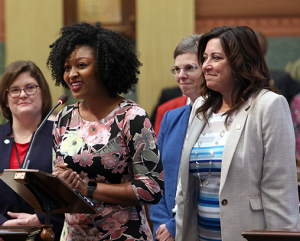
Sen. Anthony and Rep. Witwer

The MHA announced two winners of its Special Recognition Award during the Annual Membership Meeting June 27, recognizing them for extensive contributions to healthcare. Each of the winners has uniquely influenced healthcare in Michigan. The winners include Sen. Sarah Anthony (D-Lansing) and Rep. Angela Witwer (D-Delta Township).

The lawmakers each chair their chamber’s appropriations committee, with Anthony the first Black woman to ever chair the Senate Appropriations Committee. These committees are responsible for determining the annual state budget, covering important healthcare areas including Medicaid, the Healthy Michigan Plan, graduate medical education, the rural access pool and obstetrical stabilization fund, and critical access hospital reimbursement rates. Both lawmakers were strong supporters of Public Act 5 of 2023, sponsored by Witwer, which provided $75 million for hospital workforce recruitment, retention and training in the fiscal year 2023 state budget. In addition, they each fought to include enhanced funding for ongoing Level I and Level II trauma centers, inpatient psychiatric payment rates and maternal health in the fiscal year 2024 budget. Both Anthony and Witwer are strong supporters of funding Medicaid appropriately to ensure adequate reimbursement rates for providers and protect access to healthcare services.

Sen. Sarah Anthony (D-Lansing)

In addition to her committee role, Anthony prioritizes expanding access to healthcare. She sponsored Michigan’s first mental health parity law, signed into law May 21 by Gov. Whitmer. Public Act 41 of 2024 requires insurance coverage for mental health and substance use disorder treatments at the same level as physical health services. This new law eliminates existing disparities and ensure equal access to necessary care for all Michiganders. Anthony also co-sponsored key legislation last session to support the healthcare talent pipeline signed into law by Gov. Whitmer Dec. 22, 2022. Public Acts 251 and 252 of 2022 expanded the Michigan Reconnect program, allowing for several additional certifications to qualify for the post-secondary scholarship program including high-demand healthcare credentials. Other healthcare legislation Anthony sponsors includes Senate Bill 531, which is part of a package of bills supported by the MHA that would improve Michigan’s amended auto no-fault laws. The package would simplify and increase Medicare hospital reimbursements, clarify the definition of Medicare and create a new post-acute care provider fee schedule. The bills passed the Senate in a bipartisan vote and await consideration by the House.

Rep. Angela Witwer (D-Delta Township)

Witwer’s role as a healthcare champion is inspired by more than the 22 years she spent working in healthcare to begin her career. She first started as a clinician, working in University of Michigan Health – Sparrow Lansing’s burn unit and later as the manager of pediatric rehabilitation. She later became manager of the hospital’s community relations and marketing department, before leaving the organization to co-found her own public relations, marketing and advocacy firm. These life experiences inspired Witwer’s support for Public Acts 271 and 272 of 2023, which increase the penalties for assaulting a healthcare worker or volunteer by doubling the financial fines for those found guilty of such a crime.

Governor Signs Mental Health Parity Law and Other Legislative Updates

Gov. Whitmer signed Michigan’s first mental health parity law May 21. The bipartisan legislation requires insurance coverage for mental health and substance use disorder treatments at the same level as physical health services. Senate Bill (SB) 27, sponsored by Sen. Sarah Anthony (D-Lansing), will eliminate existing disparities and ensure equal access to necessary care for all Michiganders.

The signing of SB 27 reflects ongoing efforts to address behavioral health access concerns in Michigan. Gov. Whitmer announced during her 2022 State of the State Address her intention that the legislature focus on policies to expand access to mental health services and expand the state’s mental health workforce. By strengthening mental health parity through recognition in state law, patients will have increased access to services.

The House Health Policy Committee also voted May 22 to advance legislation that aligns the Mental Health Code with the Public Health Code when defining scope for recognized clinical providers. House Bill (HB) 5114, sponsored by Rep. Carrie Rheingans (D-Ann Arbor), adds certified nurse practitioners, clinical nurse specialists-certified and physician assistants to the Mental Health Code, where they are not currently recognized. This lack of inclusion results in care gaps and confusion regarding the scope of those professionals, depending on the patient they may be serving or the location within a hospital they may be working. The state continues to struggle with healthcare workforce shortages, particularly in the behavioral health space. Alignment throughout Michigan’s compiled laws allow for certified nurse practitioners, clinical nurse specialists-certified and physician assistants to provide care to the fullest extent possible. Without this definitional change, those providers will continue to be precluded from fully participating in the behavioral healthcare continuum. The MHA supports this legislation and it now moves to the full House for consideration.

The House Insurance Committee voted on legislation that would cap insulin co-pays and co-insurance in the state to $35 for each 30-day supply. HB 4015, sponsored by Rep. Jennifer Conlin (D-Ann Arbor), prohibits an insurer in the state that provides coverage for insulin to charge a patient more than the $35 cap on selected insulin products. An insurer would be required to select at least one insulin product of each rapid-acting, short-acting, intermediate-acting, long-acting, ultra-long-acting and premixed to include under the cap. As the cost of drugs continues to skyrocket, the MHA supports this legislation as well as other opportunities to positively impact patient access and affordability.

In addition, the House gave final approval to HBs 413142134579 and 4580, which provide payment parity for telehealth services and protections for telemedicine access. The bills support a provider’s ability to serve patients and protect in-person visits that are vital to health outcomes. The MHA supported bills are now headed to the governor’s desk to be signed into law.

Members with questions may contact Lauren LaPine or Elizabeth Kutter at the MHA.