Report: Michigan Hospital Programming, Investments Improve Health and Well-being of Residents

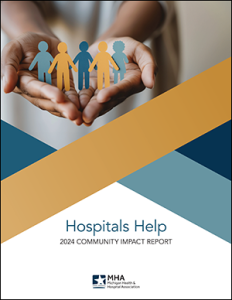
2024 MHA Community Impact Report

The Michigan Health & Hospital Association (MHA) released the 2024 Community Impact Report highlighting how Michigan hospitals are strengthening the healthcare workforce, enhancing access to care and building community health and wellness. This report shares 15 hospital-led community impact programs from nearly every region of the state.2024 MHA Community Impact Report

Michigan hospitals are advancing the health of patients and communities beyond the traditional healthcare setting with a variety of community-focused programs. These efforts are a result of strategic community benefit investments, in addition to local partnerships and support from state and federal healthcare champions.

“The MHA Community Impact Report demonstrates a long-standing commitment by Michigan hospitals to advance the well-being of patients and communities beyond the traditional four walls of the hospital,” said MHA CEO Brian Peters. “It also showcases the strong, lasting impact of investments in health education, community outreach services, clinical research and workforce development.”

Examples of stories include Corewell Health William Beaumont University Hospital’s Street Medicine Oakland program that provides free medical care to patients experiencing homelessness; MyMichigan Health’s Grow Our Own initiative, which provides financial assistance to individuals who want to further their education in healthcare; and Schoolcraft Memorial Hospital’s Community Connect program that is reducing health disparities related to mental health, substance abuse and adverse childhood events.

The investments total more than $4.5 billion in community impact activities in fiscal year (FY) 2022, from education and prevention services to community outreach, research and workforce development.

“At ProMedica Health, we’re always looking for innovative ways to address the specific health needs of our patient population and reach communities where they are,” said MHA Board Chair Julie Yaroch, DO, president of ProMedica Charles and Virginia Hickman Hospital. “It’s inspiring to see the work of other hospitals featured in the report that are focused on bringing solutions to the table, especially when it comes to closing gaps in public health and enhancing access to care in rural communities.”

The full report and community impact stories from hospitals across the state can be accessed on the MHA website.
MHA CEO Report — Impacting Communities

MHA Rounds image of Brian Peters

“People will forget what you said, people will forget what you did, but people will never forget how you made them feel.” Maya Angelou

MHA Rounds graphic of Brian PetersAs we turn the page on 2024 (and celebrate our success in preventing harmful government-mandated nurse staffing ratio legislation, as well as harmful changes to our medical liability system, during the lame-duck session of the legislature), it is appropriate to reflect on the fact that Michigan hospitals and health systems are there for our communities 24 hours a day, 365 days a year in ways that reach far beyond their four walls. What they do adheres to this simple theme: Hospitals help.

Hospitals help strengthen the healthcare workforce, enhance access to care, build healthier communities, serve as an economic driver and more. They provide essential resources and programming that help patients, hospital employees, community groups and local businesses thrive.

We highlight and summarize the impact of these activities annually. We will publish in the coming days the 2024 Community Impact Report, which reflects some of the outstanding ways Michigan hospitals are advancing the health and well-being of patients, our healthcare workforce and communities across nearly every region of the state.

These efforts are made possible through strategic investments, innovative programming, local partnerships and support from state and federal healthcare champions. The stories featured in the report paint a picture of the impact hospitals have on our everyday lives beyond traditional patient care. While there are many other efforts underway, we’re honored to uplift a handful of strong examples in this publication.

Visit our MiCareMatters website to read stories that showcase how Michigan hospitals positively impact their communities every day. And as we look forward to the new year, I invite everyone to join us and consider how you can support these vital organizations and the amazing people who work there. I promise that no matter how you engage with hospitals, it feels good to help.

As always, I welcome your thoughts.

MHA Monday Report Sept. 16, 2024

Leaders Convene for Crucial Healthcare Workforce Discussion
The MHA hosted nearly 150 thought leaders from healthcare, post-secondary education and workforce talent development Sept. 11 in Lansing for a discussion to help strengthen connections across the sectors focused on building the pipeline for …


MDHHS Issues Final Maternal Infant Health Services Policy

The Michigan Department of Health and Human Services (MDHHS) issued a final Medicaid Policy Bulletin Sept. 9 to expand coverage for Maternal Infant Health Program services. ​​ The final policy was issued in response …


2024 Election Materials Available for Michigan Hospitals

The MHA is offering election communication materials geared toward hospital staff, volunteers, patients and visitors to encourage voter participation in the 2024 general election. Additionally, the MHA elections webpage will be updated regularly with relevant …


Michigan Doula Advisory Council Membership Application Opens

The Michigan Doula Advisory Council (DAC) invites doulas across the state to apply for membership as its first council term ends in Dec. 2024. The DAC works to improve doula services in Michigan, particularly with …


What’s Ahead in Healthcare? Insights from the American Hospital Association

The MHA released a new episode of the MiCare Champion Cast featuring Rick Pollack, president and CEO of the American Hospital Association. Pollack joined MHA CEO Brian Peters to discuss a variety of topics …


Keckley Report

The Presidential Debate will Frustrate Healthcare Voters

“The healthcare system per se is not a major concern to voters this year, but its affordability is. Out-of-pocket costs for prescription drugs, insurance premiums and co-pays and deductibles for hospitals and physician services are considered unreasonable and inexplicably high. They contribute to public anxiety about their financial security alongside housing and food costs. And majorities think the government should do more by imposing price controls and limiting corporate consolidation. …

Misinformation, disinformation and AI derived social media messaging are standard fare in winner-take-all politics. When used in addressing health issues and policies, they’re effective because the public’s basic level of understanding of the health system is embarrassingly low: studies show 4 in 5 American’s confess to confusion citing the system’s complexity and, regrettably, the inadequacy of efforts to mitigate their ignorance is widely acknowledged. Thus, terms like affordability, value, quality, not-for-profit healthcare and many others can be used liberally by politicians, trade groups and journalists without fear of challenge since they’re defined differently by every user. …

Long-term, the system will proceed incrementally. Bigger players will fare OK and others will fail. I remain hopeful thoughtful leaders will address the near and long-term future with equal energy and attention. Regrettably, the tyranny of the urgent owns the U.S. health system’s attention these days: its long-term destination is out-of-sight, out-of-mind to most. And the complexity of its short-term issues lend to magnification of misinformation, disinformation and public ignorance.

That’s why this debate will frustrate healthcare voters.”

Paul Keckley, Sept. 9, 2024


MHA in the News

WWMT-TV Newschannel 3 aired a story Sept. 9 on the radiology workforce shortage in hospitals, including a shortage of radiologists and radiology technicians. MHA Executive Vice President Laura Appel was interviewed for the story, explaining …