MHA Monday Report Oct. 21, 2024

State Senate Advances Healthcare Legislation

Several bills impacting healthcare and hospitals were advanced through committees in the state Senate during the week of Oct. 14. Senate Housing and Human Services voted out a package of legislation referred to as the …


MHA Continues to Monitor Baxter IV Solutions Shortage

The MHA continues to support Michigan hospitals in response to the Baxter IV solutions shortage that began the week of Sept. 29. Baxter International Inc. temporarily closed its North Cove manufacturing plant in Marion, N.C., …


LARA to Evaluate Non-Long Term Care Provider Licensures

The Department of Licensing and Regulatory Affairs (LARA) is required by MCL 333.20155 to make at least one visit to each licensed Non-Long Term Care provider every three years to evaluate licensure. LARA may waive …


MHA Webinar Explores Leadership Strategic Planning for AI

The MHA will host the webinar How Boards and Leaders Can Deploy AI Responsibly and Ethically, scheduled 4:30 – 6 p.m. ET, Dec. 3. The webinar will cover a framework to govern the approach, policies …


CMS Finalizes Medicare Appeals Process for Beneficiary Status Change

The Centers for Medicare & Medicaid Services (CMS) and the United States Department of Health and Human Services recently released a final rule, effective Oct. 11, 2024, implementing a federal district court order that …


Rural Health Research Gateway Releases Report on the First Year of REHs

The Rural Health Research Gateway recently published a report on Rural Emergency Hospitals (REHs) highlighting data from the first year of the designation. Under the Consolidated Appropriations Act of 2021, the Rural Emergency Hospital provider type …


MHA Race of the Week – Michigan Supreme Court

The MHA’s Race of the Week series highlights the most pivotal statewide races for the 2024 General Election. The series will provide hospitals and healthcare advocates with the resources they …


Three Key Takeaways from the MHA Webinar Featuring Health Equity Regulatory Requirements

Earlier this month, the MHA, in partnership with the MHA Keystone Center, hosted a member webinar highlighting the current and future state of health equity priorities and requirements from the Centers for Medicare & Medicaid Services and The Joint Commission that impact …


Keckley Report

Do Healthcare Prices Matter?

“With the election 22 days away and inflation the key issue for voters, the latest Consumer Price Index report from the Bureau of Labor Statistics is especially important. Released last Tuesday, it shows: …

Healthcare prices account for 10.2% of the CPI but attention to these is decidedly less than food, energy, housing and other categories. For consumers, that neglect is harmful’ for industry insiders, it’s a pressure point that’s been avoided. Price estimators, posted chargemasters, open-panel benefits design, website queries and other tactics work OK for now. So…

Do Healthcare Prices Matter? Not much today. But they’re mission critical in healthcare tomorrow.”

Paul Keckley, Oct. 14, 2024


News to Know

The United States Departments of Labor, Health and Human Services and the Treasury issued Sept. 9 a set of final rules on the Mental Health Parity and Addiction Equity Act of 2008.


Laura Appel speaks with NBC25 about the Baxter IV solutions shortage.

MHA in the News

The MHA continued to engage with media requests on the Baxter IV solutions shortage during the week of Oct. 14. NBC25/Fox66 in Flint aired a story Oct. 16 on the shortage, which includes an interview …

MHA Monday Report Oct. 14, 2024

Legislation Impacting Hospitals Advances in State Legislature

A variety of bills impacting hospitals were introduced and discussed in the state legislature during the week of Oct. 7. Gov. Whitmer signed Public Act 132 of 2024, which updates statutory framework for the …


Baxter IV Solutions Shortage Updates

The MHA continues to support Michigan hospitals in response to the Baxter IV solutions shortage that began the week of Sept. 29. Baxter International Inc. temporarily closed its North Cove manufacturing plant in Marion, N.C., …


Reimbursement for Age-Friendly Quality Data Included in FY 2025 Hospital IPPS Final Rule

Included in the Centers for Medicare & Medicaid Services’ Medicare fee-for-service hospital inpatient prospective payment system (IPPS) fiscal year (FY) 2025 final rule is a reimbursement model for hospitals submitting age-friendly quality data. Hospitals …


Healthcare Leaders Discuss Regional Care at Lansing Economic Club
The Lansing Regional Chamber hosted its annual Future of Healthcare in the Lansing Region luncheon Oct. 10 as part of its monthly series of Lansing Economic Club events. This event featured a panel discussion moderated …


New Hospital Reporting Requirements for Respiratory Illness and Bed Capacity
The Centers for Medicare & Medicaid Services recently announced new respiratory disease reporting requirements for hospitals through the National Healthcare Safety Network effective Nov. 1. These requirements replace the previous “Hospital COVID-19 Data” reporting requirements …


MHA Webinar Outlines Strategies to Strengthen Healthcare Worker Well-being

The MHA and the MHA Keystone Center will host the MHA Health Foundation webinar Implementing Evidence-Informed Strategies to Normalize Help-Seeking and Strengthen Wellbeing from 4:30 to 5:30 p.m. Dec 4. This webinar is dedicated to …


MHA Race of the Week – Michigan Supreme Court

The MHA’s Race of the Week series highlights the most pivotal statewide races for the 2024 General Election. The series will provide hospitals and healthcare advocates with the resources they …


MHA Podcast Explores Why Voting Matters to Healthcare in Michigan

The MHA released a new episode of the MiCare Champion Cast featuring Laura Appel, executive vice president of government relations & public policy, MHA, exploring why voting in the 2024 General Election is critical to …


Keckley Report

What is the Medicare Advantage?

“On October 15, the open enrollment period for Medicare begins running through December 7 for coverage starting in January 2025. In this period, 67 million Medicare eligible seniors can review features of Medicare plans offered in their area, switch from traditional Medicare to a Medicare Advantage (MA) plan (or vice versa), change their MA selection and add/change their Medicare Part D prescription drug plans.

In 2024, Medicare Advantage plans enrolled 33 million seniors and Medicare paid private insurers $462 billion to pay for their care. But conditions for Medicare Advantage have changed in recent years prompting many to ask ‘what is the Medicare Advantage?’ …

Its funding comes from payroll taxes paid by employers and their employees, and those who are self-employed PLUS income taxes paid on Social Security benefits, interest earned on the Medicare trust fund’s investments and Part A premiums from people who aren’t eligible for premium-free Part A. …”

Paul Keckley, Oct. 7, 2024


Laura AppelMHA in the News

The MHA received media coverage the week of Oct. 7 that includes coverage on a potential national shortage of IV solutions products, physician retention and rural hospital funding. The closure of a Baxter manufacturing facility …

MHA Race of the Week – Michigan Supreme Court

MHA RACE OF THE WEEK

The MHA’s Race of the Week series highlights the most pivotal statewide races for the 2024 General Election. The series will provide hospitals and healthcare advocates with the resources they need to make informed decisions on Election Day, including candidates’ views and background.

There will be two races for Michigan Supreme Court on the 2024 General Election ballot: One partial and one full-term seat. This Race of the Week highlights partial term candidates only. Once elected, this individual will take office in January 2025 and fill the remainder of a term that is already underway. From there, the elected full-term candidate will take office at the start of the new term and serve for a full eight years.

CANDIDATES FOR MICHIGAN SUPREME COURT (PARTIAL TERM)

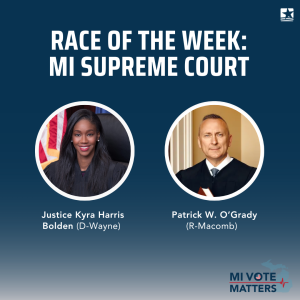
Justice Kyra Harris Bolden (D-Wayne) is an incumbent candidate serving her second year on the Michigan Supreme Court since being appointed in January 2023. A graduate of Southfield Public Schools, Justice Bolden received her bachelor’s degree from Grand Valley State University and went on to attend the University of Detroit Mercy School of Law. After receiving her Juris Doctorate, Justice Bolden became a criminal defense attorney and later a civil litigation attorney. She then served in the Michigan House of Representatives for two terms where she sat on the Judiciary Committee.

In her time, Justice Bolden has successfully passed pieces of critical bipartisan legislation into law, including the “Medically Frail” Prison Reform package, the revision of the Wrongful Imprisonment Compensation Act and the “Address Confidentiality for Survivors of Domestic Violence” package. For more information, visit www.boldenforjustice.com.

Patrick W. O’Grady (R-Macomb) previously served as the chief judge for the 15th Circuit Court and the Probate Court in Branch County. Over his 15-year tenure, O’Grady navigated diverse legal landscapes, from overseeing high-stakes criminal jury trials involving offenses such as murder, robbery, kidnapping, criminal sexual conduct, domestic violence, and child abuse, to adjudicating matters in civil law encompassing labor disputes, contractual intricacies, property rights, family law issues, auto negligence and medical malpractice.

Prior to his time as a circuit judge, O’Grady served in the Army Reserve, worked as a Michigan State Trooper and later as an assistant prosecuting attorney. He holds a law degree from Wayne State University. To learn more, visit www.judgeogrady4supremecourt.com.

WHY IT MATTERS

The Michigan Supreme Court is the cornerstone of Michigan’s legal system and responsible for the general administrative supervision of all courts in the state. Those elected must set important legal precedents, ensure that laws and policies align with constitutional principles and maintain the checks and balances of the judicial system. Supreme Court officials play a critical role in healthcare policy and often have the final say when it comes to things like healthcare provider liability, public health policy, Medicaid expansion and insurance regulation. The decisions made by these elected officials have a direct impact on access to care for Michigan patients and communities.

For more information or to request 2024 Election materials, visit the MHA Election webpage or contact the MHA.

MHA Monday Report Oct. 7, 2024

MHA Participates in Southwest Michigan Behavioral Health Healthcare Policy Forum

Southwest Michigan Behavioral Health hosted Oct. 4 the ninth annual regional healthcare policy forum in Kalamazoo. Moderated by Dr. Colleen Allen, CEO, Autism Alliance of Michigan, the forum focused on the theme of “Working Together” …


MHA Webinar Explores How Boards and Leaders Can Deploy AI Responsibly and Ethically

The MHA is hosting the webinar How Boards and Leaders Can Deploy AI Responsibly and Ethically, scheduled 4:30 – 6 p.m. ET Dec. 3 which features respected healthcare leaders in artificial intelligence (AI), healthcare operations …


Fall MI AIM Regional Training Events

The Michigan Alliance for Innovation on Maternal Health (MI AIM) is offering training events across Michigan for inpatient maternal healthcare providers. The events, scheduled from late October to November, will focus on using quality improvement …


MDHHS Releases Medicaid Doula Services Proposed Policy

The Michigan Department of Health and Human Services (MDHHS) recently released a proposed policy updating Medicaid coverage for doula services, effective Oct. 1, 2024. Key updates include increasing the number of covered doula visits to …


MHA Highlights Behavioral Health Priorities at Michigan Children and Families Summit

Lauren LaPine, senior director, legislative and public policy, MHA, participated in a discussion Oct. 3 in Grand Rapids during the Michigan Children and Families Summit hosted by the Steelcase Foundation. The summit explored the results …


MHA Race of the Week – U.S. Senate

The MHA’s Race of the Week series highlights the most pivotal statewide races for the 2024 General Election. The series will provide hospitals and healthcare advocates with the resources they …


MHA Rounds graphic of Brian PetersMHA CEO Report — Protecting Access to Care Through 340B
Protecting access to high quality, affordable healthcare for all Michiganders is a key tenet of the MHA. Stated simply, the 340B drug pricing program, created by Congress in 1992, is absolutely crucial to our member …


Keckley Report

Tax Exemptions for Not-for-Profit Hospitals: Are they Worth it?

It’s a question lots of folks inside and outside of healthcare are asking these days. …

The JAMA study did not focus on a ratio; instead, it focused on quantifying the amount of state and local exemptions that should be considered by policymakers in addition to their federal exemptions.  Notably, this study quantifies wide variation in which hospitals benefit most when local, state and federal exemptions are included and proposes that policies around NFP hospital tax exemptions be delegated in part to state and local determinations (as is already the case in at least 3 states). …

The Boards and leaders in each not-for-profit hospitals must account for the tax exemptions they currently enjoy and anticipate changes that limit them in the future. These studies point clearly to that inevitability. And each must answer this question for their organization objectively: are our tax exemptions truly worth it to the communities we serve, or simply a financial maneuver to use our money elsewhere?

Paul Keckley, Sept. 30, 2024


News to Know

Members looking to support hospitals impacted by Hurricane Helene can contribute to relief efforts through the North Carolina Disaster Relief Fund and the Tennessee Hospital Association Disaster Relief Fund.

MHA Race of the Week – U.S. Senate

MHA RACE OF THE WEEK

The MHA’s Race of the Week series highlights the most pivotal statewide races for the 2024 General Election. The series will provide hospitals and healthcare advocates with the resources they need to make informed decisions on Election Day, including candidates’ views and background.

MICHIGAN CANDIDATES FOR U.S. SENATE

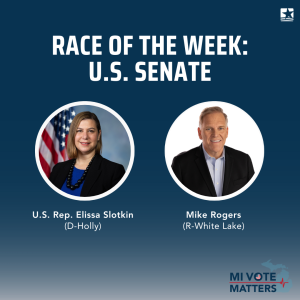
U.S. Rep. Elissa Slotkin (D-Holly) is a former national security official currently serving Michigan’s 7th Congressional District, which includes all of Ingham, Livingston, Shiawassee and Clinton counties, as well as parts of Eaton, Genesee and Oakland counties.

Like many Americans, healthcare is a deeply personal issue for Rep. Slotkin. In Congress, she worked across the aisle to help pass legislation to make prescription drug prices more transparent and fought to pass laws that capped the cost of insulin for seniors and allowed Medicare to negotiate for lower drug prices. Slotkin also worked closely with the MHA and the hospitals in her district during the COVID-19 pandemic.

Slotkin is a third-generation Michigander who believes government works best when there are two healthy parties that debate the big issues facing Americans. For more information, visit elissaslotkin.org.

Mike Rogers (R-White Lake) is a former state senator and member of the U.S. House of Representatives for Michigan’s 8th congressional district. Prior to his time in the legislature, Rogers worked as a lieutenant in the U.S. Army and a special agent with the Federal Bureau of Investigation.

Rogers, also a Michigan native, is known for his work on Michigan’s 529 College Savings Program and efforts passing legislation to help low-income families receive healthcare. Additionally, Rogers served as Chairman of the House Intelligence Committee and was a part of the House Energy and Commerce Committee.

Rogers entered the private sector in 2015 to champion small businesses before announcing in August 2023 his candidacy for the U.S. Senate. To learn more, visit rogersforsenate.com.

WHY IT MATTERS

Congress is responsible for lawmaking and budgetary decisions critical to Michigan’s healthcare community and residents. In addition to setting the course on federal funding that impacts Michigan’s Medicare and Medicaid populations, among other issues, Congress is responsible for making policy decisions that can vastly impact the delivery and access to healthcare in the state, as well as confirmation of Supreme Court nominees. Due to the major financial and policy decisions made in Washington, DC, Michigan relies on its federal officials to advocate and protect the needs of state residents, which is why electing healthcare champions to federal offices is so important.

For more information or to request 2024 Election materials, visit the MHA Election webpage or contact the MHA.