
MHA Monday Report May 26, 2025

MHA Testifies in House Oversight Subcommittee, IMLC and AOT Legislation Passes Senate

The MHA provided testimony May 21 to the House Oversight Subcommittee on Public Health & Food Security on certain challenges related to behavioral health patients and the need for inpatient psychiatric beds across the state. …


Medical Residents Highlight Workforce Needs During 2025 GME Capitol Day

The MHA Graduate Medical Education (GME) Capitol Day welcomed more than 40 physician residents from a dozen member hospitals to the MHA Capitol Advocacy Center offices May 21 for a day of meetings with members …


MHA Keystone Center PSO to Hosts Two Safe Tables in June

The MHA Keystone Center Patient Safety Organization (PSO) will host two upcoming safe table events in June focused on cybersecurity risk management and regulatory inspections. These events offer healthcare leaders an opportunity to engage in …


Federal Agencies Pause Enforcement of 2024 Mental Health Parity Rule
The Department of Labor, Health and Human Services, and the Treasury recently announced that the 2024 final rule on the Mental Health Parity and Addiction Equity Act will not be enforced, following a legal …


MHA and DataGen to Host Upcoming Medicare Quality-Based Program Webinars

The MHA has partnered with DataGen to host two upcoming webinars focused on the Medicare fee-for-service (FFS) quality-based programs which can reduce hospital inpatient FFS payments by up to 6% based on performance. The webinars …


Today’s Students Are Tomorrow’s Workforce

The healthcare workforce has been a top priority for MHA’s members, an active pillar in the annual strategic action plan for several years. The healthcare profession is arguably one of the most rewarding career fields, leaving lasting impacts on communities. …


Keckley Report

The Winners and Losers in One Big Beautiful Bill

“This week, Republicans in the House will pass “One Big Beautiful Bill” they can forward to the Senate ahead of their self-imposed Memorial Day deadline. Its fate in the GOP controlled Senate is likely to be less partisan with a similar outcome: in some form, it will pass setting the stage for Campaign 2026 partisan posturing and continued chaos for most industries especially healthcare.  …

What’s clear is this: healthcare is suspected of widespread waste, poor performance and putting profits above patient care by lawmakers in DC, state capitals, non-healthcare business leaders and the majority of the public who think a shake-up is needed. Each organization in healthcare believes it operates for the greater good and delivers optimal value for funds received. The budgeting process prompts questions about who’s right.”

Paul Keckley, May 19, 2025


New to KnowNews to Know

  • MHA offices will be closed and no formal meetings will be scheduled May 26 in honor of Memorial Day.
  • The MHA is seeking dedicated leaders to serve on its committees, councils and task forces, with the call for participation open through June 2, 2025.

Lauren LaPineMHA in the News

The MHA received news coverage during the week of May 19 highlighted by stories related to Mental Health Awareness Month and the need to expand state psychiatric bed capacity. Lauren LaPine, senior director, legislative and …
News to Know – Oct. 21, 2024

New to Know

The United States Departments of Labor, Health and Human Services and the Treasury issued Sept. 9 a set of final rules on the Mental Health Parity and Addiction Equity Act (MHPAEA) of 2008. As an update, the regulations clarify that disorders, such as eating disorders, autism spectrum disorder and gender dysphoria, are considered mental health conditions under the current standards and are protected under the new rule. Telehealth benefits must also be included when assessing MHPAEA compliance.

Members with questions may contact Lauren LaPine at the MHA.

Healthcare Advocates Honored with MHA Special Recognition Award

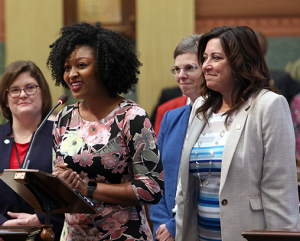
Sen. Anthony and Rep. Witwer

The MHA announced two winners of its Special Recognition Award during the Annual Membership Meeting June 27, recognizing them for extensive contributions to healthcare. Each of the winners has uniquely influenced healthcare in Michigan. The winners include Sen. Sarah Anthony (D-Lansing) and Rep. Angela Witwer (D-Delta Township).

The lawmakers each chair their chamber’s appropriations committee, with Anthony the first Black woman to ever chair the Senate Appropriations Committee. These committees are responsible for determining the annual state budget, covering important healthcare areas including Medicaid, the Healthy Michigan Plan, graduate medical education, the rural access pool and obstetrical stabilization fund, and critical access hospital reimbursement rates. Both lawmakers were strong supporters of Public Act 5 of 2023, sponsored by Witwer, which provided $75 million for hospital workforce recruitment, retention and training in the fiscal year 2023 state budget. In addition, they each fought to include enhanced funding for ongoing Level I and Level II trauma centers, inpatient psychiatric payment rates and maternal health in the fiscal year 2024 budget. Both Anthony and Witwer are strong supporters of funding Medicaid appropriately to ensure adequate reimbursement rates for providers and protect access to healthcare services.

Sen. Sarah Anthony (D-Lansing)

In addition to her committee role, Anthony prioritizes expanding access to healthcare. She sponsored Michigan’s first mental health parity law, signed into law May 21 by Gov. Whitmer. Public Act 41 of 2024 requires insurance coverage for mental health and substance use disorder treatments at the same level as physical health services. This new law eliminates existing disparities and ensure equal access to necessary care for all Michiganders. Anthony also co-sponsored key legislation last session to support the healthcare talent pipeline signed into law by Gov. Whitmer Dec. 22, 2022. Public Acts 251 and 252 of 2022 expanded the Michigan Reconnect program, allowing for several additional certifications to qualify for the post-secondary scholarship program including high-demand healthcare credentials. Other healthcare legislation Anthony sponsors includes Senate Bill 531, which is part of a package of bills supported by the MHA that would improve Michigan’s amended auto no-fault laws. The package would simplify and increase Medicare hospital reimbursements, clarify the definition of Medicare and create a new post-acute care provider fee schedule. The bills passed the Senate in a bipartisan vote and await consideration by the House.

Rep. Angela Witwer (D-Delta Township)

Witwer’s role as a healthcare champion is inspired by more than the 22 years she spent working in healthcare to begin her career. She first started as a clinician, working in University of Michigan Health – Sparrow Lansing’s burn unit and later as the manager of pediatric rehabilitation. She later became manager of the hospital’s community relations and marketing department, before leaving the organization to co-found her own public relations, marketing and advocacy firm. These life experiences inspired Witwer’s support for Public Acts 271 and 272 of 2023, which increase the penalties for assaulting a healthcare worker or volunteer by doubling the financial fines for those found guilty of such a crime.

Governor Signs Mental Health Parity Law and Other Legislative Updates

Gov. Whitmer signed Michigan’s first mental health parity law May 21. The bipartisan legislation requires insurance coverage for mental health and substance use disorder treatments at the same level as physical health services. Senate Bill (SB) 27, sponsored by Sen. Sarah Anthony (D-Lansing), will eliminate existing disparities and ensure equal access to necessary care for all Michiganders.

The signing of SB 27 reflects ongoing efforts to address behavioral health access concerns in Michigan. Gov. Whitmer announced during her 2022 State of the State Address her intention that the legislature focus on policies to expand access to mental health services and expand the state’s mental health workforce. By strengthening mental health parity through recognition in state law, patients will have increased access to services.

The House Health Policy Committee also voted May 22 to advance legislation that aligns the Mental Health Code with the Public Health Code when defining scope for recognized clinical providers. House Bill (HB) 5114, sponsored by Rep. Carrie Rheingans (D-Ann Arbor), adds certified nurse practitioners, clinical nurse specialists-certified and physician assistants to the Mental Health Code, where they are not currently recognized. This lack of inclusion results in care gaps and confusion regarding the scope of those professionals, depending on the patient they may be serving or the location within a hospital they may be working. The state continues to struggle with healthcare workforce shortages, particularly in the behavioral health space. Alignment throughout Michigan’s compiled laws allow for certified nurse practitioners, clinical nurse specialists-certified and physician assistants to provide care to the fullest extent possible. Without this definitional change, those providers will continue to be precluded from fully participating in the behavioral healthcare continuum. The MHA supports this legislation and it now moves to the full House for consideration.

The House Insurance Committee voted on legislation that would cap insulin co-pays and co-insurance in the state to $35 for each 30-day supply. HB 4015, sponsored by Rep. Jennifer Conlin (D-Ann Arbor), prohibits an insurer in the state that provides coverage for insulin to charge a patient more than the $35 cap on selected insulin products. An insurer would be required to select at least one insulin product of each rapid-acting, short-acting, intermediate-acting, long-acting, ultra-long-acting and premixed to include under the cap. As the cost of drugs continues to skyrocket, the MHA supports this legislation as well as other opportunities to positively impact patient access and affordability.

In addition, the House gave final approval to HBs 413142134579 and 4580, which provide payment parity for telehealth services and protections for telemedicine access. The bills support a provider’s ability to serve patients and protect in-person visits that are vital to health outcomes. The MHA supported bills are now headed to the governor’s desk to be signed into law.

Members with questions may contact Lauren LaPine or Elizabeth Kutter at the MHA.