
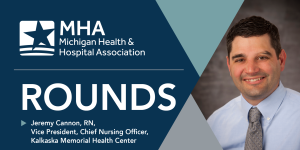
Jeremy Cannon, RN, vice president, chief nursing officer, Kalkaska Memorial Health Center
In my years at the bedside and now as a nurse leader in Northern Michigan, I’ve witnessed healthcare at its most complex and its most human.
I’ve worked across rural communities where healthcare access isn’t a given. Where patients travel long distances for routine care. Where my neighbors might delay or skip that care entirely — not because they want to, but because systemic barriers gave them no other choice. Seeing this reality first-hand has shaped my purpose and what I believe healthcare must be: accessible, compassionate and rooted in a commitment to whole-person care.
At its core, this philosophy means recognizing that health doesn’t begin or end within the four walls of a hospital. Our health is defined by various life circumstances: housing and food security, transportation, education, community and patient-provider trust, to name a few.
Changing the way we think about care delivery isn’t just a strategic priority, it’s deeply personal. I think any fellow nurse would agree that treating a diagnosis is only one piece of the puzzle. We must also look at underlying health drivers, which demands that we listen, advocate and build partnerships that reach beyond the clinical setting.
Our teams at Kalkaska Memorial Health Center take this to heart. One of the initiatives I’m most proud of is our Community Paramedic program, which supports patients during and after discharge to address social determinants and prevent avoidable emergency department visits. We’re not just delivering care and sending patients on their way — we’re asking questions, investigating resources and following up.
This is about more than access, it’s building trust. Now more than ever, our communities need to know that their healthcare team sees them, hears them and respects their unique needs.
This level of intentionality makes a tangible difference. In addition to improving health outcomes and lowering costly readmission rates, our commitment to community health also leads to better patient and staff satisfaction. Those of us who choose to become caregivers often find purpose in helping others, so seeing the difference we’re making beyond patient rooms is uniquely rewarding.
At the end of the day, we must evolve with the needs of our communities. The future of population health, especially in rural settings, depends on our willingness to embrace models of care that are proactive and deeply connected to those we serve.
This approach isn’t possible without support from state and federal policy leaders. My colleague and our chief executive officer, Andrew Raymond, recently joined the MHA Center of Rural Excellence board to elevate rural‑specific perspectives and ensure the needs of our communities, both inside and outside of the hospital, are not overlooked.
The work of our teams may not always make headlines, but we’re changing lives every day. When we reinvest in our communities, we don’t just improve health. We build resilience and create a system that serves everyone.
That is the future I’m committed to and the one I know we can achieve together.

