News to Know – Nov. 18, 2024

  • The Centers for Medicare & Medicaid Services (CMS) recently announced the 2025 Medicare Part A and B Premiums and Deductibles, with details available in the CMS Fact Sheet. The Medicare Part A inpatient hospital deductible will increase to $1,676, up $44 from the current $1,632. Members with questions may contact the Health Finance team at the MHA.
  • The Michigan Department of Health and Human Services has increased reimbursement rates for Behavioral Health Treatment (BHT) – Applied Behavior Analysis (ABA) services to improve autism treatment access for Medicaid beneficiaries. Effective Nov. 1, 2024, Prepaid Inpatient Health Plans (PIHPs) must reimburse providers for BHT-ABA services at a minimum rate of $16.50 per unit, or $66.00 per hour. This policy is funded by the state general fund, with additional federal matching funds passed to PIHPs through adjusted capitation payments. Members with questions may contact Lauren LaPine at the MHA.

MHA Monday Report Nov. 11, 2024

Hearings Held on State Legislation Impacting Hospitals

Several bills impacting hospitals were discussed in state committee hearings during the week of Nov. 4. The Michigan House Health Policy Behavioral Health subcommittee advanced several pieces of legislation to the full Health Policy Committee …


2024 General Election: What’s Ahead in Michigan

Below is a summary of the projected results for Michigan’s top races that will influence healthcare following the 2024 General Election. Official state and local outcomes will be available in the coming days on the …


CMS Releases Medicare 2025 Outpatient Prospective Payment System Final Rule

The Centers for Medicare & Medicaid Services (CMS) recently released a final rule to update the Medicare fee-for-service outpatient prospective payment system effective Jan. 1,  2025. The final rule: Provides a net 2% increase …


endorsed business partnerLongtime Associate Member Alliance-HNI Becomes an Endorsed Business Partner

The MHA recently endorsed Alliance-HNI, a longtime MHA associate member, as an Endorsed Business Partner. Alliance-HNI delivers a full continuum of services, including mobile, fixed-site, comprehensive service line management and joint venture partnerships. …


2025 Medicare Fee-for-Service Home Health Final Rule Released

The Centers for Medicare & Medicaid Services (CMS) recently released a final rule for the home health prospective payment system  for calendar year 2025. The rule includes updates to the Medicare fee-for-service …


Webinar Focuses on Strengthening Healthcare Worker Well-being

The MHA Health Foundation will host the webinar Implementing Evidence-Informed Strategies to Normalize Help-Seeking and Strengthen Wellbeing from 4:30 to 5:30 p.m. Dec 4 to offer strategies for supporting the mental well-being of healthcare professionals. The webinar offers …


Keckley Report

In Healthcare, Near-Sightedness is “Normalcy”

““Normalcy” in our political system means willful acceptance that our society is hopelessly divided by income, education, ethnic and political views. It’s benign acceptance of a 2-party system, 3-branches of government (Executive, Legislative, Judicial) and federalism that imposes limits on federal power vis a vis the Constitution. …

A process for defining of the future of the U.S. health system and a bipartisan commitment by hospitals, physicians, drug companies, insurers and employers to its implementation are needed–that’s the point. Near-sightedness in our political system and in our health, system is harmful to the greater good of our society and to the voters, citizens, patients, and beneficiaries all pledge to serve.

As respected healthcare marketer David Jarrard wrote in his blog post yesterday “As the aggravated disunity of this political season rises and falls, healthcare can be a unique convener that embraces people across the political divides, real or imagined. Invite good-minded people to the common ground of healthcare to work together for the common good that healthcare must be.”

Thinking and planning for healthcare’s long-term future is not a luxury: it’s an urgent necessity. It’s also not “normal” in our political and healthcare systems.”

Paul Keckley, Nov. 4, 2024


News to Know

MHA offices will be closed and no formal meetings will be scheduled Nov. 11 in honor of Veterans Day.

2025 Medicare Fee-for-Service Home Health Final Rule Released

The Centers for Medicare & Medicaid Services (CMS) recently released a final rule for the home health (HH) prospective payment system (PPS) for calendar year (CY) 2025. The rule includes updates to the Medicare fee-for-service (FFS) HH PPS payment rates based on changes by the CMS and those previously adopted by the U.S. Congress.

Highlights of the final rule, which takes effect Jan. 1, 2025, include:

  • A negative 2% adjustment to base payment rates to achieve budget neutrality following the transition to the Patient-driven Groupings Model (PDGM).
  • A 30-day standard payment rate of $2,057.35, up 0.9% from the current $2,038.13, for HHs that submit the required quality data.
  • Updating core-based statistical areas for wage index purposes, consistent with recent fiscal year 2025 final rules.
  • Recalibrating the PDGM case-mix weights, low utilization payment adjustment thresholds, functional levels and comorbidity adjustment subgroups.
  • Revising the fixed dollar loss ratio from 0.27 to 0.35, reducing outlier payments.
  • Requiring HH agencies to report four new patient assessment items in the HH agency Outcome and Assessment Information Set under the social determinants of health category beginning with CY 2027.
  • Adding a new standard within the Medicare Conditions of Participation requiring HH agencies to develop, implement and maintain a patient acceptance to service policy that is applied consistently to each prospective patient referred for HH care.
  • Requiring long-term care facilities to electronically report information about COVID-19, influenza and respiratory syncytial virus in a standardized format weekly through National Healthcare Safety Network beginning Jan. 1, 2025. The CMS notes that the Secretary will have the discretion to revise the reporting frequency based on changing needs for data collection.

The MHA will provide an updated impact analysis in the near future. Members with questions should contact Vickie Kunz at the MHA.

MHA Monday Report Nov. 4, 2024

Behavioral Health Bills Advance, Other Bills Discussed in State Legislature

Several bills impacting healthcare and hospitals were advanced through committees in the state Senate during the week of Oct. 28. The Senate Health Policy Committee unanimously approved Senate Bills (SB) 916 – 918, led by Sen. …


First Legislative Policy Panel Meeting of New Program Year

The MHA Legislative Policy Panel held their first meeting of the MHA program year at the MHA Capital Advocacy Center Oct. 30 to develop recommendations on legislative issues impacting Michigan hospitals. Chad Tuttle, SVP, clinical …


Strategic Planning Session Update with MHA Service Corporation Board

The MHA Service Corporation (MHASC) board met Oct. 24 to discuss healthcare market strategies to identify, diversify and grow solutions for MHA members and clients. The board retreat focused on how the MHASC can support …


Webinar Recap: Special Pathogen Response Systems of Care

The MHA hosted a webinar Oct. 23 overviewing the National Special Pathogen System (NSPS) of care. The NSPS is a tiered system with four facility levels that have increasing capabilities to care for suspected …


MHA Shares September Medicare and Medicaid Enrollment Analysis

The MHA updated its analysis of Medicaid and Medicare enrollment based on September 2024 data. The analysis includes program enrollment as a percentage of each county’s total population and the split between fee-for-service and …


Webinar Explores AI Policy and Strategy for Boards and Leaders

The MHA will host the webinar How Boards and Leaders Can Deploy AI Responsibly and Ethically, scheduled 4:30 – 6 p.m. ET, Dec. 3. The webinar will cover a framework to govern the approach, policies and procedures …


Keckley Report

Looking to 2025: The Stop-Gap Actions likely on Healthcare’s 8 Most Urgent Issues

“Last week, I wrote about three predictions for healthcare regardless of next week’s the election results:

  1. States will be the epicenter for healthcare legislation and regulation; federal initiatives will be substantially fewer.
  2. Large employers will take direct action to control their health costs.
  3. Private equity and strategic investors will capitalize on healthcare market conditions.

As these play out, eight major issues will get attention vis a vis stop-gap measures reflecting regulator and elected officials’ responsiveness to industry pressure and voter sentiment …

These issues are not new to healthcare: they’ve prompted endless symposia, sponsored white papers and discussion by trade associations, special interests and think tanks offering solutions beneficial to preserving their view of what’s needed. What’s new is the public’s distaste for the status quo in healthcare: in every major poll conducted since the pandemic, trust and confidence in the health system has been low and majorities have said the status quo is unsatisfactory.

Thus, stop-gap measures serve two purposes: they enable elected officials and government agency personnel to demonstrate responsiveness to important issues and they provide foundations for additional rules, laws and actions downstream. They’re a start.”

Paul Keckley, Oct. 28, 2024


News to Know

The general election is Tuesday, Nov. 5. Polls open at 7 a.m. and close at 8 p.m. Voters in line at 8 p.m. can still cast ballots. The MHA strongly encourages voter participation, knowing those …


MHA CEO Brian Peters

MHA in the News

Becker’s Hospital Review published an article Oct. 31 that includes responses from MHA CEO Brian Peters and other MHA members. Becker’s asked C-suite executives from hospitals and health systems across the U.S. to share their …

MHA Shares September Medicare and Medicaid Enrollment Analysis

The MHA updated its analysis of Medicaid and Medicare enrollment based on September 2024 data. The analysis includes program enrollment as a percentage of each county’s total population and the split between fee-for-service (FFS) and managed care organization (MCO). Just over 26% of Michigan’s total population is enrolled in Medicaid and 22% is enrolled in Medicare.

The Michigan Department of Health and Human Services completed the Medicaid redetermination process as required by the Consolidated Appropriations Act. September 2024 enrollment, including the Healthy Michigan Plan, is just over 2.6 million, which is down approximately 617,000 since July 2023. 67% of Medicaid beneficiaries are enrolled in one of nine managed care plans.

The impact on hospitals is unknown since many enrollees had other coverage and their services were not billed to Medicaid. Many individuals who lost coverage subsequently reenrolled in the program, have other third-party coverage or sought coverage on the federal marketplace.

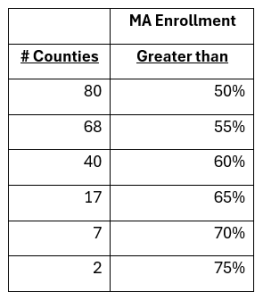
Total Medicare enrollment is 2.24 million, with 62% of beneficiaries enrolled in a Medicaid Advantage (MA) plan and only three counties having less than 50% of total Medicare enrollment in MA plans. MA enrollment by county ranges from 45% to 77%, with 68 counties having 55% or more of their Medicare population enrolled in an MA plan, as highlighted below.

September enrollment is spread across 47 MA plans, with up to 30 plans covering beneficiaries in several Michigan counties and a minimum of four plans available in each county.

Members with enrollment questions should contact the Health Finance team at the MHA.

June Medicaid and Medicare Enrollment in Michigan

The MHA updated its analysis of Medicaid and Medicare enrollment to reflect June 2024 data. The analysis now includes program enrollment as a percentage of each county’s total population and the split between fee-for-service and managed care organization. Nearly 27% of Michigan’s total population are enrolled in Medicaid and 22% are enrolled in Medicare.

The Michigan Department of Health and Human Services completed the Medicaid redetermination process, as required by the Consolidated Appropriations Act.  June 2024 enrollment, including the Healthy Michigan Plan, is at nearly 2.7 million, which is down approximately 603,000 since July 2023. 67% of Medicaid beneficiaries are enrolled in one of nine managed care plans.

The impact on hospitals is unknown since many enrollees had other coverage and their services were not billed to Medicaid. Many individuals who lost coverage have subsequently reenrolled in the program, have other third-party coverage or have sought coverage on the federal marketplace.

Total Medicare enrollment is 2.26 million, with 62% of beneficiaries enrolled in a Medicaid Advantage (MA) plan and only two counties having less than 50% of total Medicare enrollment in MA plans. MA enrollment by county varies from 45% to 77%, with most counties having 55% or more of their Medicare population enrolled in an MA plan, as highlighted below.

June enrollment is spread across 48 MA plans, with up to 28 plans covering beneficiaries in several Michigan counties.

Members with enrollment questions should contact the Health Finance team at the MHA.

CMS Releases 2025 Physician Fee Schedule Proposed Rule

The Centers for Medicare & Medicaid Services (CMS) recently released a proposed rule to update the physician fee schedule (PFS) payment system effective Jan. 1, 2025.

The proposal would:

  • Reduce the PFS conversion factor by a net 2.8% from the current $33.29 to $32.36 after expiration of the 2.93% statutory payment increase for 2024 and a 0% conversion factor update.
  • Refine guidance regarding the complexity add-on code (G2211) for payment of evaluation and management visits.

Extend certain telehealth waivers through 2025 including:

  • Allowing providers to report enrolled practice addresses instead of home addresses when services are performed from their home.
  • Defining direct supervision to include virtual presence via audio/video real-time communications technology.
  • Revise the data reporting period and phase-in of payment reductions for clinical laboratory tests under the clinical laboratory fee schedule by updating the data reporting period to Jan. 1 – March 31, 2025.
  • Extending the phase-in of payment reductions by an additional year meaning that 2024 payments cannot be reduced below 2023 amounts and 2025-2027 payments cannot be reduced more than 15% compared to the previous year.
  • Delay implementation of the CMS’ rebased and revised Medicare economic index until future rulemaking.
  • Codify policies established in revised guidance for Medicare Part B and Part D drug inflation rebate programs and propose new and revised policies for these programs.
  • Exclude suspected anomalous spending from financial calculation for the Medicare Shared Savings Program (MSSP).
  • Add six new measures to the MSSP measure set and streamline reporting options
  • Add six new optional merit-based incentive payment system value pathways for 2025.

The MHA encourages members to contact Vickie Kunz by Aug. 30, regarding issues identified. Hospitals are encouraged to review the proposed rule and submit comments to the CMS by Sept. 9.  The CMS is expected to release a final rule around Nov. 1, for the Jan. 1, 2025, effective date.  Members with questions may contact Vickie Kunz at the MHA.

CMS Releases Medicare 2025 Outpatient Prospective Payment System Proposed Rule

The Centers for Medicare & Medicaid Services (CMS) recently released a proposed rule to update the Medicare fee-for-service outpatient prospective payment system (OPPS) effective Jan. 1,  2025.

The proposed rule:

  • Provides a net 2.3% increase to the OPPS conversion factor from $87.38 to $89.38 for hospitals that report quality measure data.
  • Increases the outlier fixed-dollar threshold by 3.2% from the current $7,750 to $8,000.
  • Modifies the timeframe for standard review of prior authorization requests for hospital outpatient department services from 10 business days to seven calendar days.
  • Uses 2023 claims data and the most updated cost report data from the healthcare cost report information system, primarily from 2022, to set payment rates.
  • Adds three services (CPT codes 0894T, 0895T and 0896T) for liver allograft-related procedures to the 2025 Inpatient-Only List.
  • Updates the core based statistical areas used to determine a hospital’s wage index, consistent with other 2025 proposed rules.
  • Adds two new status indicators (H1 and K1) to identify healthcare common procedure coding system/current procedural terminology (HCPCS/CPT) codes representing separately payable, non-opioid post-surgical pain management products as authorized by the Consolidated Appropriations Act of 2023.
  • Establishes separate payment for diagnostic radiopharmaceuticals with a per-day cost exceeding $630.
  • Excludes qualifying cell and gene therapies from comprehensive ambulatory payment classification packaging.
  • Adopts three measures related to health equity for the Outpatient, ambulatory surgical center (ASC) and rural emergency hospital quality reporting programs, and extending voluntary data reporting for two hybrid measures in the inpatient quality reporting program.
  • Establishes new conditions of participation for hospitals and critical access hospitals focused on obstetrical services and maternal care.
  • Extends the virtual direct supervision of therapeutic and diagnostic services under the physician fee schedule (PFS) through Dec. 31, 2025. The CMS also proposes to extend virtual direct supervision under the OPPS through Dec. 31, 2025, to maintain alignment between the PFS and OPPS.
  • Adds 20 medical and dental procedures to the ASC covered procedures list.
  • Updates the hospital outpatient quality reporting program requirements.
  • Updates requirements for the rural emergency hospital quality reporting program.

The MHA will provide a hospital-specific impact analysis within the next few weeks and encourages members contact Vickie Kunz by Aug. 30 regarding issues identified. Hospitals are encouraged to review the proposed rule and its impact on operations and submit comments to the CMS by Sept. 9.  The CMS is expected to release a final rule around Nov. 1 for the Jan. 1, 2025, effective date.

Members with questions may contact Vickie Kunz at the MHA.

2025 Medicare Fee-for-Service Home Health Proposed Rule Released

The Centers for Medicare & Medicaid Services (CMS) recently released a proposed rule to update the home health (HH) prospective payment system (PPS) for calendar year (CY) 2025. The rule includes updates to the Medicare fee-for-service HH PPS payment rates based on changes by the CMS and those previously adopted by Congress.

Highlights of the proposed rule, which takes effect Jan. 1, 2025, include:

  • A negative 4% adjustment to base payment rates to achieve budget neutrality following the transition to the Patient-driven Groupings Model (PDGM).
  • A 30-day standard payment rate of $2,008.12 ,down 1.5% from the current $2,038.13, for HH agencies that submit the required quality data.
  • Updating core-based statistical areas for wage index purposes, consistent with recent fiscal year 2025 proposed rules.
  • Recalibrating the PDGM case-mix weights, low utilization payment adjustment thresholds, functional levels and comorbidity adjustment subgroups.
  • Revising the fixed dollar loss ratio from 0.27 to 0.38, reducing outlier payments.
  • Requiring HH agencies to report four new patient assessment items in the HH agency Outcome and Assessment Information Set under the social determinants of health category, beginning CY 2027.
  • Adding a new standard within the Medicare Conditions of Participation requiring HH agencies to develop, implement and maintain a patient acceptance to service policy that is applied consistently to each prospective patient referred for HH care.
  • Requiring long-term care facilities to report respiratory illness data as part of their infection prevention and control programs. The CMS proposes that facilities would electronically report weekly data on COVID-19, influenza and RSV in a standardized format through the National Healthcare Safety Network.
  • Requesting information on:
    • HH quality reporting program measure concepts under consideration for future years.
    • Future performance measure concepts for the expanded HH value-based purchasing model.
    • Rehabilitative therapists conducting the initial and comprehensive assessment.
    • Plan of care development and scope of services HH patient receive.

Members are encouraged to review the proposed rule and contact Vickie Kunz by Aug. 19 regarding issues. Comments are due to the CMS Aug. 26, 2024, and can be submitted electronically. The MHA will provide an estimated impact analysis in the near future.

Members with questions should contact Vickie Kunz at the MHA.

MHA Monday Report April 26, 2024

MHA Member Testifies on Healthcare Legislation, Staffing Agency Bill Introduced

Hills and Dales Hospital President and CEO Andrew Daniels testified April 25 in the House Health Policy Committee on legislation removing timelines on disposal of sharps containers. Senate Bill 482, which was initiated by …


MDHHS Announces $10 Million Maternal Health Reimbursement Opportunity

The Michigan Department of Health and Human Services (MDHHS) announced April 22 its intention to reimburse Michigan birthing hospitals for committing to participate in The Joint Commission Maternal Levels of Care Verification Program and …


CMS Seeks Comments on Proposed Transforming Episode Accountability Model

The Centers for Medicare & Medicaid Services (CMS) included a proposal to create a new mandatory alternative payment model, the Transforming Episode Accountability Model, in the fiscal year 2025 hospital inpatient prospective payment system …


LEO Launches Second Round of Going Pro Talent Fund Grants

The Michigan Department of Labor and Economic Opportunities (LEO) recently opened the second round of Going Pro Talent Fund grants, which will distribute a portion of the $11 million remaining from the first round of …


MHA EventsFinal Reminder: Register Now for the 2024 Communications Retreat

It is not too late to register for the 2024 MHA Communications Retreat, scheduled from 8:30 a.m. to 4 p.m. May 7 at the Henry Center for Executive Development in Lansing. Members are encouraged to …


Requests for Information Required for SLCGP Grant

The Michigan Cybersecurity Planning Committee is requesting additional information from applicants who previously expressed an interest in participating in the Fiscal Year 2022 State and Local Cybersecurity Grant Program Funds (SLCGP). This program aims to …


CMS Releases FY 2025 LTCH PPS Proposed Rule

The Centers for Medicare & Medicaid Services (CMS) recently released a proposed rule to update the Medicare fee-for-service long-term care hospital (LTCH) prospective payment system (PPS) for fiscal year 2025. Specifically, the rule proposes: …


The Keckley Report

Hospitals declare War on Corporate Insurance: Handicapping the Players

“At the Annual Meeting of the American Hospital Association in DC last week, its all-out attack on “corporate insurance” was a prominent theme. In the meeting recap, AHA CEO Rick Pollack made the influential organization’s case:

“This year, there was special focus on educating policymakers that our health care system is suffering from multiple chronic conditions. These include continued government underpayment, cyberattacks, workforce shortages, broken supply chains, access to behavioral health, and irresponsible behavior by corporate commercial health insurance companies, among others — that put access to services in serious jeopardy.” …

This war has been simmering. It’s now a blaze. The outcome is uncertain despite the considerable resources both will spend to win.”

Paul Keckley, April 22, 2024


News to Know

MHA Endorsed Business Partner Medical Solutions is hosting a free webinar Empowering Rural Care: Dynamic Staffing Solutions and Retention Methods from noon – 1 p.m. ET May 8 with special guest, Patti Artley, chief nursing officer at Medical Solutions.