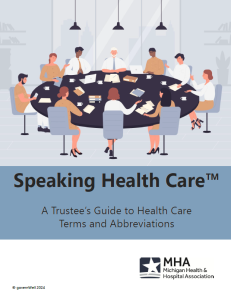
Speaking Health Care™: A Guide to Understanding Healthcare Language

Orienting new trustees extends far beyond a single session. New members usually require months to get fully up-to-speed on strategic priorities and the basic expectations for trustees. A daunting challenge is interpreting language about operations, clinical care, insurance and regulation.

The MHA, other state hospital associations and governWell™ collaborated to create Speaking Health Care™, a guide designed to help hospital and health system trustees better understand the complex and often confusing language used in healthcare. The glossary includes over 1,000 words with acronyms that are often used in briefings, documents and discussions in the boardroom.

The MHA encourages members to share this guide with governing board members, new employees and others who could benefit.

Questions about the guide can be directed to Erin Steward at the MHA.

AHA Releases 2025 National Governance Report

The American Hospital Association (AHA) has released its 2025 National Governance Report. The report, based on data collected from August to December 2024, continues to develop a comprehensive picture of the state of healthcare governance structures and practices across the country in areas including composition, performance oversight and selection. The report also includes commentary from several governance experts following each section, offering valuable interpretations of the data and trends identified in the report.

For information about MHA trustee resources or webinars, contact Erin Steward at the MHA.

News to Know – Nov. 24, 2025

New to Know
  • New to KnowThe Centers for Medicare & Medicaid Services recently announced 2026 premiums, deductibles and coinsurance amounts for Medicare Parts A and B. Members with questions may contact Vickie Kunz at the MHA.
  • The MHA offices will be closed and no formal meetings will be scheduled Nov. 27 and 28 in honor of Thanksgiving.
  • Due to the holiday, Monday Report will not be published Dec. 1 and will resume its regular schedule Dec. 8. Member alerts and MHA newsroom articles will continue to be published during that time to provide relevant updates to the MHA membership, as necessary.
  • The American Hospital Association (AHA) released the first three chapters of its 2025 National Governance Report. The report, based on data collected from August to December 2024, outlines a comprehensive picture of healthcare governance structures and practices across the country in areas including composition, performance oversight and selection. The report includes commentary from governance experts to provide valuable insights into the data and trends presented. Questions about the AHA National Governance Report or governance can be directed to Erin Steward at the MHA.

AHA Trustee Insights Highlights Aging Population and Cybersecurity Oversight

The October edition of Trustee Insights, the monthly digital package from the American Hospital Association, highlights podcasts, videos, webinars and other resources on today’s most pressing issues. The issue examines the nation’s aging population and how health care delivery must adapt to increased clinical complexity, workforce shortages and margin pressures. Trustees can access a board checklist that outlines aging as an enterprise strategy, performance metrics and key red flags. The edition also explores board oversight of cyber threats, including IT investment awareness, continuity processes and decision-making protocols, and emphasizes the board’s role as a steadying force during response and recovery periods.

For information about MHA trustee resources or webinars, contact Erin Steward at the MHA.

Latest AHA Trustee Insights Examines the Role of Boards in Workforce Strategy

The August edition of Trustee Insights, the American Hospital Association’s (AHA) monthly digital package, highlights podcasts, videos, webinars and other resources on today’s most pressing issues. The issue includes a special-edition paper on trends shaping care and board actions to leverage data to meet market pressures and community needs; develop “care anywhere” delivery models; elevate patient experience and personalized care; and rethink talent acquisition, development and retention. It also features a podcast with a board chair discussing the health system’s preparation for and response to cyber incidents.

Members with questions about MHA trustee resources or webinars may contact Erin Steward at the MHA.

Latest AHA Trustee Insights Examines The Boards Role in Workforce Strategy

The July edition of Trustee Insights, the monthly digital package from the American Hospital Association (AHA), highlights board-level strategies for advancing leadership development, governance structure, care transformation and the use of AI in healthcare data analysis.

A featured article examines the consequences of overlooking leadership development as the healthcare landscape becomes more complex. It also explores the board’s role in workforce strategy as a long-term priority and includes questions boards can use to evaluate management’s efforts to find, retain, engage and develop staff.

This edition also features resources on the emerging role of a chief governance officer, including key responsibilities, common challenges and best practices for implementing the position in hospital and health system leadership.

For information about MHA trustee resources or webinars, contact Erin Steward at the MHA.

Latest AHA Trustee Insights Examines How Boards are Reimagining Workforce

The June edition of Trustee Insights, a monthly digital publication from the American Hospital Association, highlights how board members can support workforce planning and leverage innovation to strengthen healthcare delivery.

One article outlines key questions trustees should ask to ensure workforce priorities are embedded in enterprise planning, resourcing decisions and performance oversight. It also encourages boards to examine how work is structured to support updated roles and more efficient processes.

A second article explores how embracing “ecosystem-ness” and leveraging artificial intelligence can help create stronger networks that promote accessibility, cost effectiveness and collaborative care. It identifies four actions boards can take to shift from inward-focused system strategies to a broader, interconnected approach.

Members with questions about MHA trustee resources or webinars may contact Erin Steward at the MHA

MHA Monday Report May 19, 2025

Healthcare Legislation Advances in House, Senate

Numerous healthcare bills including the Nurse Licensure Compact, Interstate Medical Licensure Compact and the Michigan Department of Health & Human Services (MDHHS) budget advanced in the Michigan Legislature during the week of May 12. …


Legislative Policy Panel Acts on Advocacy Priorities for Michigan Hospitals

The MHA Legislative Policy Panel met May 14 at the MHA Capital Advocacy Center to develop recommendations for the MHA Board of Trustees on legislative initiatives impacting Michigan hospitals. MHA Capitol Advocacy Center staff provided …


Healthcare Makes $100+ Billion Impact to Michigan’s Economy

The MHA published results from the 2025 Economic Impact of Healthcare in Michigan report as part of National Hospital Week (May 11-17), demonstrating a $106 billion total economic impact healthcare had in fiscal year 2023, the most recent data available. …


Deadline Approaching to Register for MHA Annual Membership Meeting

The deadline to register for the 2025 MHA Annual Membership Meeting is Friday, May 23. The event will be held June 25 through 27 at the Grand Hotel on Mackinac Island. The annual meeting offers …


LARA Finalizes Osteopathic Licensing and Practice Rules

The Department of Licensing and Regulatory Affairs (LARA) recently finalized administrative rules that update licensing and practice standards for osteopathic medicine and surgery in Michigan, effective May 8, 2025. The revised rules, issued through the …


Members Discuss Cyberattack Preparedness in MHA Virtual Forum

More than 80 information systems, clinical and administrative leaders joined the MHA’s virtual member forum May 9 to discuss strategies for preparing for and responding to cyberattacks. Leaders shared insights and lessons learned from real-world …


MDHHS Updates MMR Vaccine Guidance Amid Measles Outbreaks

The Michigan Department of Health and Human Services (MDHHS) updated guidance May 9 on the administration and reimbursement of the Measles, Mumps and Rubella (MMR) vaccine. The bulletin outlines how providers may administer and receive …


Latest AHA Trustee Insights Outlines Fundraising as a Growth Strategy

The May edition of Trustee Insights, a monthly digital publication from the American Hospital Association, explores how fundraising can serve as a low-risk growth strategy for hospitals and health systems. One article focuses on the …


Nurses Share Insights on Balance, Technology and the Future of the Profession in New Survey

The MHA has endorsed AMN Healthcare as a national leader in workforce solutions. AMN Healthcare’s 2025 Survey of Registered Nurses measures the insights and direction of the nursing profession using responses from more than 12,000 nurses. MHA …


The Reality for Medicaid Patients Entering the ED With a Behavioral Health Crisis

Imagine this: You enter a hospital emergency department for chest pain. The clinicians onsite confirm you’re having a heart attack, but before can receive lifesaving care, you must wait for a second pre-admission screening from an agency outside of the hospital. …


Keckley Report

The Value-based Care Agenda in Trump 2.0 Healthcare

“Central to both efforts is the administration’s mandate to reduce federal spending which it deems achievable, in part, by replacing fee for services with value-based payments to providers from the government’s Medicare and Medicaid programs. The CMS Center for Medicare and Medicaid Innovation (CMMI) is the government’s primary vehicle to test and implement alternative payment programs that reduce federal spending and improve the quality and effectiveness of services simultaneously. ….

Recent efforts by the Trump Healthcare 2.0 team and its leadership appointments in CMS and CMMI point to a value-agenda will change significantly. Alternative payment models will be fewer and participation by provider groups will be mandated for several. Measures of quality and savings will be fewer, more easily measured and and standardized across more episodes of care. Financial risks and shared savings will be higher and regulatory compliance will be simplified in tandem with restructuring in HHS, CMS and CMMI to improve responsiveness and consistency across federal agencies and programs. …

Trump Healthcare 2.0 value-based care is a take-no prisoners strategy in which private insurers in Medicare Advantage have a seat at their table alongside hospitals that sponsor ACOs and distribute the majority of shared savings to the practicing physicians. But the agenda will be set, and re-set by the administration and link-minded physician organizations like America’s Physician Groups and others that welcome financial risk-sharing with Medicare and beyond.”

Paul Keckley, May 12, 2025


New to KnowNews to Know

MHA Endorsed Business Partner Medical Solutions, will host the free webinar Workforce Wellness: Effective Approaches to Foster Well-being and Retention in Healthcare from 1 to 2 p.m. ET May 19.


MHA in the News

Laura Appel

The MHA received news coverage during the week of May 12 related to federal Medicaid funding cuts and the release of the hospital economic and workforce impact data. …

Latest AHA Trustee Insights Outlines Fundraising as a Growth Strategy

The May edition of Trustee Insights, a monthly digital publication from the American Hospital Association, explores how fundraising can serve as a low-risk growth strategy for hospitals and health systems.

One article focuses on the financial and strategic value of philanthropy, describing how reinvestment through well-planned campaigns can deliver meaningful returns. It includes guiding questions for boards on how to evaluate and strengthen their organization’s fundraising approach.

Another article examines how organizational culture influences compliance effectiveness. It introduces the concept of the “say-do” ratio, highlighting gaps between what leaders say and what they do, and explores how leadership behavior, accountability and incentives contribute to a strong compliance program.

For information about MHA trustee resources or webinars, contact Erin Steward at the MHA.

Members Discuss Cyberattack Preparedness in MHA Virtual Forum

More than 80 information systems, clinical and administrative leaders joined the MHA’s virtual member forum May 9 to discuss strategies for preparing for and responding to cyberattacks.

Leaders shared insights and lessons learned from real-world incidents. Speakers included:

  • Brian Brown, MBA, senior vice president, Marketing, McLaren Health Care
  • Mark Geary, APR, senior director, Communications/External Affairs, Corewell Health East
  • Ash Goel, MD, MBA, senior vice president, Information Technology, and chief information officer, Bronson Healthcare
  • Jack Kufahl, chief information security officer, Michigan Medicine
  • Geoff Patterson, CHCIO, CDH-E, PMP, vice president and chief information officer, Henry Ford Health
  • Chuck Sherwin, FACHE, president, MyMichigan Medical Center Midland
  • J. Joshua Wilda, MPA, CHCIO, CDH-E, regional chief digital and information officer, University of Michigan Health – Regional Network

Discussions focused on ensuring continuity of care during a cyberattack, strengthening organizational resilience, prioritizing internal and external communications, and training staff for effective incident response.

Strengthening cybercrime and cybersecurity policy remains a key priority of the MHA Strategic Action Plan. The MHA continues to work with members, policymakers, payers and other stakeholders to secure resources, reduce disruption and support continuity of care.

Members with questions regarding member forums may contact Erin Steward at the MHA.