MHA CEO Brian Peters bylined an op-ed Feb. 16 in The Detroit News, highlighting Michigan hospitals’ understanding of the financial strain that rising healthcare costs are creating and reinforcing their commitment to being part of the solution.
Peters outlines how hospitals are confronting the same cost pressures affecting households and businesses, including workforce shortages, supply chain costs and increased cybersecurity demands. He emphasizes that amid these challenges, hospitals are committed to collaboration, working alongside policymakers, employers and community partners to advance solutions that improve affordability while protecting access to care for all Michiganders.
Lauren LaPine-Ray DrPH, MPH, vice president, policy and rural health, MHA, was quoted in a Feb. 17 Bride Magazine story expressing concern for emergency room (ER) capacity following Oakland Community Health Network’s recommendation to direct mental health patients to the ER amid paused operations at the county’s resource and crisis center.
Members with questions regarding media requests should contact Elise Gonzales at the MHA.
The MHA released a new episode of the MiCare Champion Cast exploring the need to expand the pre-admission screening assessment for behavioral health providers.
Lauren LaPine, senior director of legislative & public policy, MHA, joined to provide insight on how Michigan continues to experience issues with timely access to behavioral health services. More specifically, LaPine shared how and why Medicaid patients experiencing a behavioral health crisis are often stuck in emergency departments (EDs) longer than those who are commercially insured.
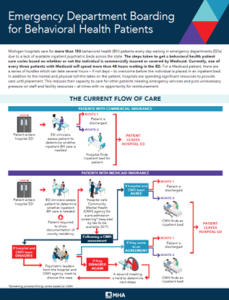
Infographic illustrating the differing processes that a Medicaid beneficiary goes through to be assessed for a behavioral health need compared to a commercially insured patient.
Under the current guidelines, LaPine explained, there are a series of arduous steps needed in order to get patients with Medicaid coverage inpatient behavioral healthcare. One of the biggest hurdles is that following an assessment by ED clinicians, a patient with Medicaid must receive a secondary pre-admission screening from a community mental health (CMH) agency.
This process can take hours – if not days – to complete. Meanwhile, a patient needing the same level of care who is commercially insured is not required to have the pre-admission screening by a CMH.
Last year, there were more than 1.2 million emergency room visits where behavioral health was one of the reasons for care. LaPine noted that pediatric and geriatric patients board for the longest periods of time.
One proposed solution to alleviate the process is to expand the three-hour assessment responsibility to allow clinically qualified staff to conduct pre-admission screenings in order to improve the delivery of care for behavioral health patients in Michigan hospital EDs.
“Emergency departments across the state are well-equipped to complete the pre-admission screening to determine if someone needs inpatient psychiatric care,” said LaPine. “Implementing this change will really help us to expand the number of available healthcare personnel that are able and available to conduct that pre-admission screening…it also allows Medicaid patients to be assessed in a similar manner as patients that have commercial insurance.”
According to recent survey data, there are more than 155 patients waiting in a hospital emergency department for access to behavioral health services; Whether that is an assessment through a CMH agency, an inpatient bed or a transfer to a short-term, residential setting.


 MHA CEO Brian Peters bylined an op-ed Feb. 16 in The Detroit News, highlighting Michigan hospitals’ understanding of the financial strain that rising healthcare costs are creating and reinforcing their commitment to being part of the solution.
 Lauren LaPine-Ray DrPH, MPH, vice president, policy and rural health, MHA, was quoted in a Feb. 17 Bride Magazine story expressing concern for emergency room (ER) capacity following Oakland Community Health Network’s recommendation to direct mental health patients to the ER amid paused operations at the county’s resource and crisis center.