
MHA Keystone Center Safety & Quality Symposium Approved for CE Credits

Registration is open for the highly anticipated MHA Keystone Center Safety & Quality Symposium, scheduled for April 28 & 29, 2025, at the Kellogg Conference Center & Hotel, East Lansing. The symposium, offering continuing education credits for physicians, nursing and social workers,* is designed for clinical teams across the continuum of care, quality, safety and risk professionals, person and family advocates and healthcare executives.

With premier speakers, interactive breakout sessions with a variety of topics and a registration fee half the price of most national patient safety conferences, the MHA Safety & Quality Symposium is an exceptional value. The content explores today’s most critical issues, like cyberattack downtime preparedness to decrease patient risk, creating a zero-harm environment, normalizing workforce members help-seeking and strengthening their wellbeing, and reducing health disparities. The online detailed agenda outlines the numerous learning opportunities.

A discounted overnight room rate is available through March 27 at the Kellogg Hotel & Conference Center and room reservations will be confirmed based on availability. Find the discount code for the hotel rooms in the “things to know” section of the event webpage.

For more information about the symposium, contact Erica Leyko at the MHA. Questions about event registration should be directed to Janice Jones at the MHA.

*For more details, please visit the online Continuing Education Accreditation Statement.

Regional Training April 23 for Maternal Health Providers on Hypertension Safety

The Michigan Alliance for Innovation on Maternal Health (MI AIM) is offering regional training sessions for inpatient maternal health providers focused on implementing the hypertension safety bundle and addressing common challenges with implementation.

The one-hour sessions will include time for discussion and collaboration among regional hospital teams following the presentation. Nurses, physicians and other maternal health inpatient clinicians are encouraged to attend and may choose from either a morning session from 8 to 9 a.m. or an evening session from 5 to 6 p.m. on April 23, 2025. There is no cost to participate, but registration is required with the links provided.

These sessions are funded by the HRSA AIM grant (A30MC49987) as a continuation of the regional trainings conducted in Fall 2024.

Members may contact the MHA Keystone Center for registration questions. Dominique Abram and Meagan Chuey at the Michigan Department of Health and Human Services are available for event related questions.

A Guide to Preparing, Preventing and Responding to Violence in a Healthcare Setting

The following article was written by MHA Endorsed Business Partner (EBP) Tarian (formerly HSS) and outlines essential strategies and best practices to create a safer environment for all.

Workplace violence in healthcare settings is an alarming reality that can jeopardize the safety of staff, patients and visitors. With the ongoing incidents of violence, all hospitals must be able to effectively prevent and respond to potential threats. Hospitals without onsite security teams must take extra steps to be proactive and ensure employees feel empowered and prepared.

Below is a brief guide for hospitals on how to prepare, prevent and respond to an act of violence.

Preparation: Developing a Comprehensive Plan

  • Risk Assessment
    Conduct a thorough risk assessment to identify potential vulnerabilities within the hospital. Analyze past incidents, evaluate patient demographics and assess environmental factors that may contribute to violence.
  • Policy Development
    Establish clear policies and procedures addressing workplace violence. Ensure all staff are familiar with these policies and understand the importance of reporting any incidents or suspicious behavior.
  • Training & Education
    Provide regular training for all employees, including clinical and non-clinical staff, on recognizing warning signs of potential violence, de-escalation techniques and emergency response protocols. Include role-playing scenarios to enhance skills and confidence.

Prevention: Creating a Safer Environment

  • Improve Environmental Design
    Optimize the physical environment to deter violence. This can include better lighting, clear signage and controlled access to sensitive areas. Consider implementing panic buttons or alarm systems that staff can easily access in emergencies.
  • Staff Engagement
    Foster a culture of safety by encouraging open communication among staff members. Implement regular safety meetings to discuss concerns, share experiences and brainstorm solutions to potential issues.
  • Patient Screening and Monitoring
    Screen patients for history of violence or substance abuse during intake assessments. Monitor patients exhibiting aggressive behavior closely and involve mental health professionals when necessary.

Response: Effective Action Plans

  • Emergency Response Team
    Establish a designated emergency response team composed of trained staff members who can act swiftly in the event of violent incidents. Ensure this team is familiar with the hospital layout, emergency protocols and communication channels.
  • Clear Communication Protocols
    Develop and disseminate clear communication protocols for reporting violent incidents. Staff should know who to contact and how to escalate situations quickly. Use walkie-talkies or mobile devices to maintain constant communication during emergencies.
  • Post-incident Support
    After any incident of workplace violence, provide immediate support to affected staff. This may include counseling services, debriefing sessions and follow-up care to address psychological impacts. Encourage a culture of support where staff feel comfortable discussing their experiences.

In a 2021 McKinsey & Co. workforce survey, over 60% of front line healthcare workers cited feeling unsafe as a major contributor to leaving or considering leaving their healthcare job. By implementing these strategies, hospitals, especially those without a security team, can greatly reduce violent incidents while helping the workforce feel more supported and prepared in the event of an incident.

The MHA Keystone Center has partnered with Tarian for several years to address violence in healthcare. Members who attend the MHA Safety & Quality Symposium on April 28-29, 2025 will have the opportunity to register to attend a pre-conference threat assessment workshop with Tarian for hands-on training.

Members may contact Seth Karnes, senior director of risk, consulting and training at Tarian to discuss risk assessments, staff training or policy review. Members with questions about the MHA Keystone Center and resources available may contact Adam Novak. Members with questions about the EBP program should visit the MHA’s Business Services page or contact Rob Wood at the MHA.

Corewell Health Trenton Hospital Nurse Honored with Q4 MHA Keystone Center Speak-up! Award

speak up
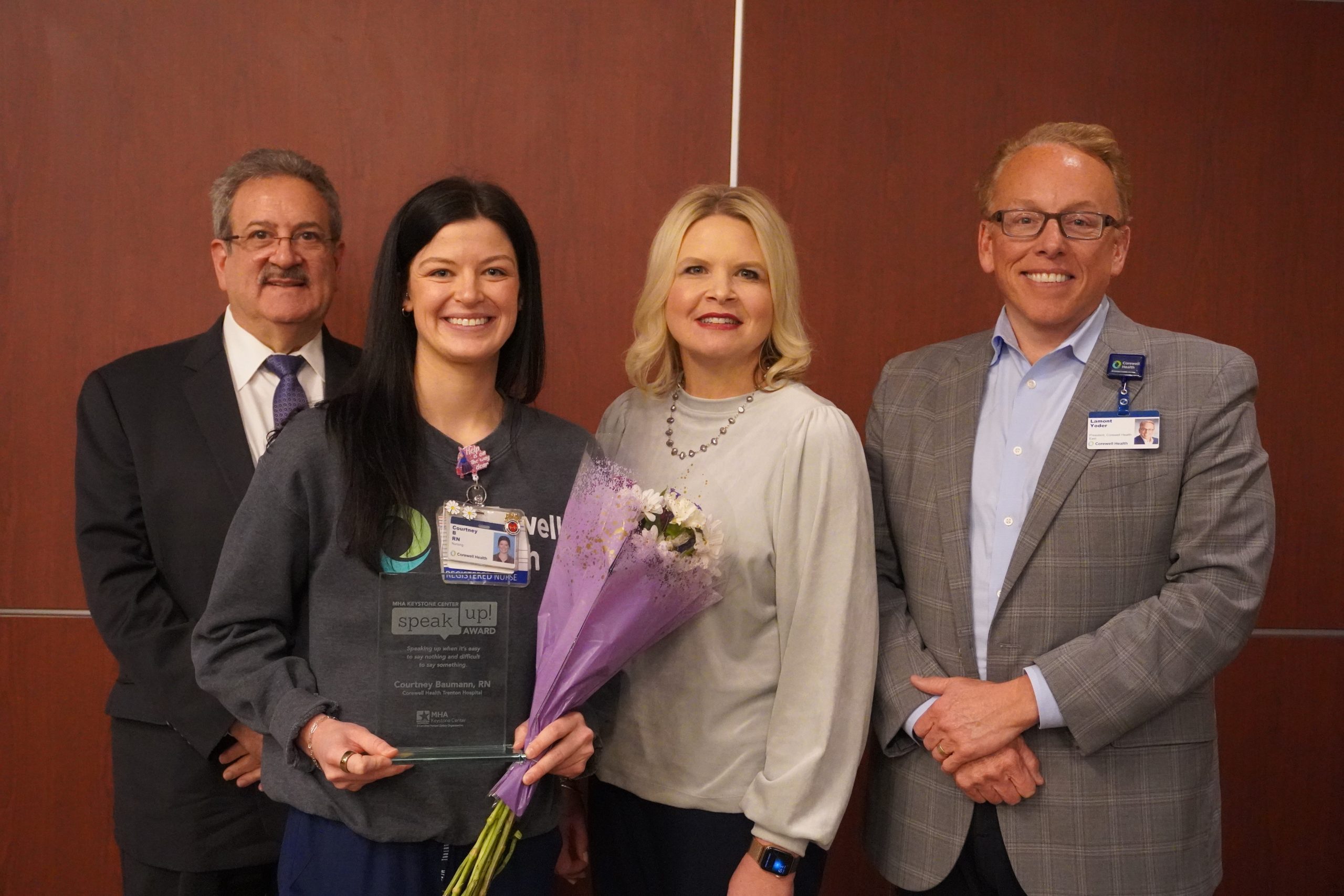
Q4 Speak-up! Award recipient Courtney Baumann, RN at Corewell Health Trenton Hospital pictured with Lamont Yoder, president, Corewell Health East, Amy Brown, chief nursing officer, MHA, and Gary L. Roth, DO, chief medical officer, MHA.

The Michigan Health & Hospital Association (MHA) Keystone Center celebrates Courtney Baumann, RN at Corewell Health Trenton Hospital, as its quarterly MHA Keystone Center Speak-up! Award recipient for February.

The Speak-up! Award celebrates individuals or teams in Michigan hospitals who demonstrate an exceptional commitment to preventing harm to patients or staff. Baumann was recognized for her commitment to patient safety by advocating for a patient whose discharge posed potential health risks.

“I’m honored to receive this recognition and to know this represents a positive outcome for one of my patients,” said Baumann. “We are empowered at Corewell Trenton to advocate for our patients, regardless of role. I’m grateful to be part of a team and organization that instills this confidence in all healthcare workers.”

Shortly before a patient was scheduled for discharge, Courtney identified concerning changes in the patient’s condition. Courtney’s intervention ensured the patient received the necessary care and reinforced the importance of speaking up in critical situations.

“Courtney’s dedication made all the difference and highlights the importance of speaking up for patient safety,” said Kristine Donahue, RN, president, Corewell Health Hospitals, Taylor, Trenton and Wayne. “Her ability to recognize a concern and take the necessary steps to address it embodies the strong patient-first culture we uphold at Corewell Health.”

Additional finalists for the fourth quarter of the 2024-25 program year included:

  • Spencer Smith, MyMichigan Medical Center Sault
  • Thomas Warner, McLaren Greater Lansing
  • Beronica Bahoura, Corewell Health Farmington Hills Hospital

“We are proud to recognize dedicated healthcare professionals like Courtney, whose advocacy and commitment to patient safety make a meaningful impact,” said MHA CEO Brian Peters. “Her quick thinking and willingness to speak up exemplify the highest standards of care and reflect Corewell Health’s dedication to fostering a strong culture of safety in Michigan hospitals.”

More information about the MHA Keystone Center Speak-up! Award, including criteria and a nomination form, are available online.

MHA Keystone Center Annual Report Features Hospital Quality and Safety Improvements

The MHA Keystone Center recently released its 2023-24 Annual Report, which demonstrates the organization’s commitment to advancing the safety and quality of care alongside Michigan hospitals. The report showcases MHA Keystone Center-led patient and workforce safety initiatives, including:

  • Resources created to support Michigan hospitals in their efforts to operationalize improved health outcomes for all.
  • Workforce safety offerings like active shooter trainings and physical security risk assessments provided via support from Blue Cross Blue Shield of Michigan and MHA Endorsed Business Partner Tarian.
  • Maternal health outcome improvements made across the state in partnership with the Michigan Alliance for Innovation on Maternal Health (MI AIM).

Printed copies are available upon request.

Members with questions about the report should contact the MHA Keystone Center.

University of Michigan Health-Sparrow Police Authority Officer Honored with Q3 MHA Keystone Center Speak-up! Award

speak up
Q3 Speak-up! Award recipient Ronald Patterson, a police authority officer at University of Michigan Health-Sparrow pictured with Kira Carter-Robertson, chief operating officer at UM Health-Sparrow Lansing and MHA CEO Brian Peters.

The Michigan Health & Hospital Association (MHA) Keystone Center has recognized Ronald Patterson, a police authority officer at University of Michigan Health-Sparrow, as its quarterly MHA Keystone Center Speak-up! Award recipient for December.

The Speak-up! Award celebrates individuals or teams in Michigan hospitals who demonstrate an exceptional commitment to preventing harm to patients or staff. Patterson was honored for his proactive advocacy on behalf of a patient requiring additional care after being discharged from the emergency department.

While responding to a call to escort the patient out, Patterson quickly identified impairments that could compromise the patient’s safety. Recognizing the potential risk, he took immediate action, alerting the care team. As a result, the patient was readmitted and received the necessary care to ensure their safety.

“It’s an honor to be recognized for something that is truly a part of my daily commitment to ensuring patient safety,” said Patterson. “In this instance, I was simply doing what I believe anyone in my position would do—advocating for a patient who needed additional help to remain safe.”

“Ronald’s actions exemplify our mission to provide exceptional care and foster a culture of safety,” said Kira Carter-Robertson, chief operating officer at UM Health-Sparrow Lansing. “His quick thinking and compassion ensured that this patient received the care they needed. We are proud to have team members like Ronald, who go above and beyond to make a difference.”

Additional finalists for the third quarter of the 2024-25 program year included:

  • Spencer Smith, MyMichigan Medical Center Sault
  • Thomas Warner, McLaren Greater Lansing
  • Beronica Bahoura, Corewell Health Farmington Hills

“Ronald’s actions serve as a powerful reminder that all healthcare workers share a responsibility for the safety and well-being of patients,” said MHA CEO Brian Peters. “We are pleased to celebrate his commitment to fostering a safe environment and applaud University of Michigan Health-Sparrow’s dedication to cultivating a just culture.”

More information about the MHA Keystone Center Speak-up! Award, including criteria and a nomination form, are available online.

Superior Health Quality Alliance Report Highlights Improvements in Care for Medicare Beneficiaries

The Superior Health Quality Alliance – a coalition of eight Midwest healthcare quality improvement organizations including the MHA Keystone Center – recently released a report detailing its work over the past five years as the Quality Innovation Network-Quality Improvement Organization (QIN-QIO) for Michigan, Minnesota and Wisconsin.

The report showcases several quality improvement initiatives spanning topics like chronic disease management, infection prevention and control and medication safety. The report highlights the organization’s success in reducing all-cause harm in rural, critical access and acute care hospitals serving vulnerable populations by:

  • Lowering opioid adverse drug events (ADE) by 9%.
  • Reducing anticoagulant-related and hypoglycemia-related ADEs by 46%.
  • Improving community-based care transitions, resulting in a 3% reduction of readmissions.

The organization’s efforts across all improvement areas and settings of care resulted in:

  • 268,656 harms avoided.
  • A $1.02 billion return on investment.
  • More than a 20% relative improvement rate in hospital readmissions.

Members with questions about the report or the Superior Health Quality Alliance should contact the MHA Keystone Center.

Reimbursement for Age-Friendly Quality Data Included in FY 2025 Hospital IPPS Final Rule

Included in the Centers for Medicare & Medicaid Services’ (CMS) Medicare fee-for-service hospital inpatient prospective payment system (IPPS) fiscal year (FY) 2025 final rule is a reimbursement model for hospitals submitting age-friendly quality data.

Hospitals will be asked to report on several measures to assess whether they are improving care for older patients in emergency departments, operating rooms and other settings.

Hospitals will need to report that they are:

  • Attesting annually to having procedures that enable patients’ healthcare goals, such as determining whether living wills and healthcare proxies are included in care plans.
  • Reviewing medication regimens and eliminating unnecessary prescriptions.
  • Implementing frailty screenings and interventions, such as for mobility or cognition.
  • Assessing social vulnerabilities, such as isolation or elder abuse.
  • Designating age-specialized leadership within hospitals.

The CMS will add the age-friendly structural measures to the FY 2025 inpatient quality reporting program reporting, which will impact Medicare payments in FY 2027.

The MHA Keystone Center has supported numerous age-friendly initiatives in recent years, including Age-Friendly Health Systems Action Communities, which implements the 4Ms framework (What Matters, Medication, Mentation and Mobility) – aligning with the proposed measures outlined by CMS.

Members seeking assistance implementing age-friendly policies and procedures should contact the MHA Keystone Center.

Members with questions about the IPPS final rule should contact Vickie Kunz at the MHA.

CE Credits Available for Health Equity Regulatory Requirements Webinar

The MHA and the MHA Keystone Center are hosting an educational webinar from 8:30 to 9:30 a.m. Oct. 10 about the current and future state of regulatory and accrediting health equity requirements from the Centers for Medicare & Medicaid (CMS) and The Joint Commission (TJC). 

Leading the discussion is Julia Finken, senior vice president for accreditation and regulatory compliance for Patton Healthcare Consulting and Barrins & Associates. With more than 25 years of healthcare expertise and nearly two decades at TJC, Finken will also walk members through the MHA Keystone Center’s Guide and Action Plan to Integrating CMS and TJC Health Equity and Health Disparities Requirements and its online learning module series. These resources were created to provide actionable strategies for implementing compliant health equity programming in an acute care setting.

At the conclusion of this activity, participants should be able to:

  • Explain priority areas across the CMS and TJC requirements.
  • Summarize compliance expectations for these new regulations.
  • Outline future health equity priorities and expectations from CMS and TJC.
  • Demonstrate how the MHA Keystone Center’s tools can assist hospitals and health systems with creating actionable strategies for advancing health equity that meet regulatory and accreditation requirements.

The webinar is eligible for nursing and social worker continuing education credits. 

Registration for the webinar is free of charge to MHA members thanks to the generosity of Alliance-HNI Health Care Services, an associate member of the MHA.

Members with questions about registration should contact the MHA Keystone Center.

Oct. 10 Webinar to Explore Health Equity Regulatory Requirements

The MHA and the MHA Keystone Center are hosting an educational webinar from 8:30 to 9:30 a.m. Oct. 10 about the current and future state of regulatory and accrediting health equity requirements from the Centers for Medicare & Medicaid (CMS) and The Joint Commission (TJC).

Leading the discussion is Julia Finken, senior vice president for accreditation and regulatory compliance for Patton Healthcare Consulting and Barrins & Associates. With more than 25 years of healthcare expertise and nearly two decades at TJC, Finken will also walk members through the MHA Keystone Center’s Guide and Action Plan to Integrating CMS and TJC Health Equity and Health Disparities Requirements and its online learning module series. These resources were created to provide actionable strategies for implementing compliant health equity programming in an acute care setting.

At the conclusion of this activity, participants should be able to:

  • Explain priority areas across the CMS and TJC requirements.
  • Summarize compliance expectations for these new regulations.
  • Outline future health equity priorities and expectations from CMS and TJC.
  • Demonstrate how the MHA Keystone Center’s tools can assist hospitals and health systems with creating actionable strategies for advancing health equity that meet regulatory and accreditation requirements.

This webinar is free of charge to MHA members thanks to the generosity of Alliance-HNI Health Care Services, an associate member of the MHA.

Members with questions about registration should contact the MHA Keystone Center.