The Senate Health Policy Committee held testimony on legislation related to treating patients with opioid use disorder during the week of June 16.
Collectively, Senate Bills (SB) 397–405make numerous changes to improve coverage and access for Michiganders to receive treatment for opioid use disorder. SBs 397, 400, 401, 402 and 403 specifically apply commercial insurer and Medicaid coverage modifications to reduce delays and remove additional barriers in prescribing opioid-related treatment and dosages.
SB 398 modifies opioid treatment program requirements under the Department of Licensing and Regulatory Affairs, while SBs 404–405 would require nurses to carry naloxone in select schools. Lastly, SB 399 amends the Public Health Code to specify that the term “drug paraphernalia” does not include testing products.
The MHA-supported bills now await a final vote in the Senate Health Policy Committee before moving to the full Senate chamber. The MHA Behavioral Health Integration Council reviewed and recommended changes for SBs 397, 398, 399, 400 and 402.
Members with additional questions should contact the MHA Advocacy Team.
The MHA provided testimony May 7 to the Senate Health Policy Committee on certain challenges related to hospital emergency department boarding for behavioral health patients.
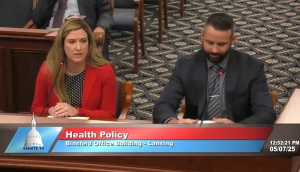
The Senate Health Policy Committee heard about patients facing behavioral health crises and their experiences with emergency department boarding based on insurance status. Lauren LaPine, senior director, legislative & public policy, MHA discussed how the association collected data, starting in 2023, from hospital emergency departments on length of stay for patients with a behavioral health diagnosis. Initial findings within this data showed there were over 150 patients with a behavioral health diagnosis waiting in a hospital emergency department daily. Furthermore, behavioral health-related patients with Medicaid coverage spent longer time in hospital emergency departments than their counterparts with commercial insurance and one of every three patients with Medicaid spent more than 48 hours in a hospital emergency department waiting to be accepted for inpatient hospitalization or discharged.
Lauren LaPine, senior director, legislative & public policy, MHA and Kyle Hoffmaster, director, patient access, Pine Rest Christian Mental Health Services provided testimony May 7 on patients facing behavioral health crises and their experiences with emergency department boarding based on insurance status.
LaPine explained the process of the pre-admission screening assessment completed by providers for these patients with a behavioral health diagnosis and illustrated for the committee how the process is unnecessarily complicated for those with Medicaid coverage.
Kyle Hoffmaster, director, patient access, Pine Rest Christian Mental Health Services also provided testimony on the challenges faced by their organization in helping serve behavioral health patients seeking care. He shared how waiting for another provider from the community mental health (CMH) organizations to complete a pre-admission assessment for patients covered by Medicaid can cause significant delays in these patients receiving the care they need. Patients covered through Medicaid are forced to go to a hospital emergency department per guidelines from the CMHs to receive the assessment in that specific setting, causing more unnecessary stress and costs for families and providers alike. Sharing personal experiences from Pine Rest Christian Mental Health Services illuminated the need for serious change on this issue. The MHA will continue to educate lawmakers on this challenge and work to expand the assessment responsibility to improve the delivery of care for behavioral health patients in Michigan.
In addition, the Senate Finance, Insurance and Consumer Protection Committee took testimony on Senate Bill (SB) 134, sponsored by Sen. Sam Singh (D-East Lansing), which repeals the regulatory compliance exemption under the Michigan Consumer Protection Act (MCPA). If signed into law, this legislation would significantly increase the potential for class-action lawsuits under the MCPA purview against the hospital industry in the state without protecting consumers. The MHA, along with several other businesses and industries stands opposes to this harmful legislation.
Members with additional questions should contact Elizabeth Kutter at the MHA.
The Michigan Senate unanimously passed several MHA-supported bills aimed at improving mental health treatment for individuals involved in the criminal justice system during the week of Dec. 2. Senate Bills (SB) 915 (Hertel-D), 916 (Santana-D), 917 (Irwin-D) and 918 (Wonjo-D) are designed to divert individuals with mental health issues from jail and into treatment programs.
SB 915 grants law enforcement officers the authority to take someone in for a psychiatric evaluation if they have “reasonable cause” to believe the person needs community mental health treatment. This change allows officers to act based on concerns from family members or treatment providers, rather than waiting for signs of uncontrolled mental illness. Supporters argue this will help individuals get treatment before symptoms escalate.
Similarly, SB 916 establishes a system where prosecuting attorneys, defendants or their counsel can request a mental health evaluation after misdemeanor charges are filed. If treatment is needed, the court can place the individual in an Assisted Outpatient Treatment program. Upon completion, the misdemeanor charges can be dismissed, offering an alternative to the criminal justice system. This bill aims to prioritize treatment over punishment and focuses on recovery without the pressure of legal consequences.
In addition, SB 802 (Wonjo-D) moved out of the Senate Health Policy Committee, following MHA-member testimony. This bill aims to enhance the transparency and accountability of Michigan’s behavioral health system by providing critical information on service availability and capacity.
Currently, there is no requirement for Community Mental Health (CMH) agencies to share data on treatment availability, leaving hospitals and policymakers without a clear understanding of what services are available statewide. This lack of data often leads to delays in care, especially for patients with behavioral health needs.
SB 802 addresses this concern by requiring CMH agencies to report real-time data on service capacity and availability. This will provide hospitals, healthcare providers and policymakers with better insight into service availability, helping patients access the care they need more quickly. The goal of SB 802 is to create a more transparent system, reduce wait times, improve patient outcomes, and inform decisions on expanding behavioral health services.
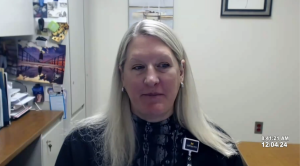
Kathy Dollard, Psy.D., L.P., director, behavioral health service line, MyMichigan Health, providing testimony via Zoom to the Senate Health Policy Committee in support of SB 802.
Two MHA members provided testimony to the Senate Health Policy Committee in support of SB 802; Kathy Dollard, Psy.D., L.P., director, behavioral health service line, MyMichigan Health and Bibhas Singla, MD, vice president & medicaid director of hospital & residential services, Pine Rest Christian Mental Health Services.
Dollard highlighted the lack of transparency in Michigan’s behavioral health system, particularly the absence of data-sharing requirements for CMH agencies regarding substance use disorder treatment options. She also addressed the issue of behavioral health boarding, where patients with behavioral health needs are often left waiting in emergency departments for extended periods due to a shortage of inpatient psychiatric beds or community-based services. MHA data shows that more than 150 patients experience this delay daily.
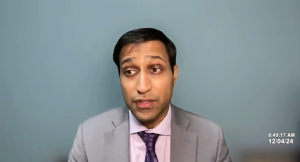
Bibhas Singla, MD, vice president & medicaid director of hospital & residential services, Pine Rest Christian Mental Health Services providing testimony via Zoom to the Senate Health Policy Committee in support of SB 802.
Dr. Singla highlighted the difficulty in transitioning patients from inpatient care to community-based services, particularly for Medicaid recipients. He shared the experience of a Medicaid patient in the addiction unit who struggled to find appropriate community-based care after discharge. Despite being motivated to seek help, the patient spent days calling programs across the state without success. The lack of available services and clear timelines for increasing capacity left the patient unable to access the care needed.
Dr. Singla explained that SB 802 would improve the system by requiring CMH agencies to report service availability in real-time, making it easier for healthcare providers and patients to access care. The bill was voted out of committee unanimously and will now move to the Senate floor.
Members with questions may contact Lauren LaPine at the MHA.
A variety of bills impacting hospitals were introduced and discussed in the state legislature during the week of Oct. 7.
Gov. Whitmer signed Public Act (PA) 132 of 2024, which updates statutory framework for the rural and obstetrical access pools funded in the fiscal year 2025 state budget. The MHA supports PA 132, introduced by Sen. Singh (D-East Lansing), as an additional statutory clarification to highlight the importance of funding for rural providers.
The Senate Health Policy Committee took testimony on Senate Bills (SB) 916 – 918, led by Sen. Hertel (D-Saint Clair Shores). The bills would expand the availability of Assisted Outpatient Treatment (AOT) in Michigan. AOT has been proven to decrease the number of individuals involved in the criminal justice system with behavioral health needs and can decrease the pressure on emergency departments for issues related to behavioral health. The bills expand the healthcare providers eligible to provide testimony for AOT and adds a new mechanism to divert individuals charged with misdemeanor offenses to AOT. The MHA supports the legislation as it awaits a vote of the full committee.
The Senate Finance, Insurance and Consumer Protection Committee took testimony on several sets of bills that impact hospitals this week. SBs 888–892, sponsored by Sen. Bayer (D-Keego Harbor), make alterations to the Identity Theft Protection Act and corresponding acts, to require certain security measures and protocols with regard to the protection of personal information from cyberattacks. The MHA worked closely with Sen. Bayer and Attorney General Dana Nessel on the ways to ensure healthcare providers and hospitals can protect patient information, while also allowing alignment with existing reporting and regulatory structures. The MHA continues to work with the sponsor and the attorney general on this legislation, and on other opportunities to support hospitals as victims of cybercrime.
The Committee also heard from proponents of SBs 1021 and 1022, which aim to expand the purview of the current Michigan Consumer Protection Act (MCPA). The MCPA provides a broad exemption for regulated and licensed professional entities, such as healthcare professionals and hospitals. This exemption acknowledges that these highly regulated fields already have proper channels for citizens to seek remedies, when needed. SB 1021 would alter that exemption and subject otherwise regulated and licensed spaces to new lawsuits and challenges. The MHA is opposed to this legislation.
Members with questions can reach out to Elizabeth Kutter at the MHA.