Catching Up on All Things Healthcare with Tina Freese Decker

The MHA released a new episode of the MiCare Champion Cast exploring state and federal healthcare priorities with Tina Freese Decker, MHA, MSIE, FACHE, president & CEO, Corewell Health and 2025 chair of the American Hospital Association (AHA).

The episode, hosted by MHA CEO Brian Peters, explores healthcare innovation, affordability and how institutions like Corewell Health are bracing for the impact of the “One Big Beautiful Bill Act (OBBBA).”

“It’s very important to protect and strengthen our hospitals, but we can also look ahead and say, how do we drive healthcare forward to a future that can be more affordable, more exceptional and simpler?” posed Freese Decker. “We all want what is best for our neighbors. When we put people at the center, we can align around what needs to happen and where we need to go.”

Freese Decker leads more than 60,000 within the integrated health system and oversees Corewell Health’s provider-sponsored health plan, Priority Health, which serves 1.3 million members across Michigan.

During the conversation, Freese Decker noted her biggest concern with changes under the OBBBA will be the loss of access to primary care services for patients without healthcare coverage. She noted that embracing a preventative mindset and being mindful of healthcare costs will be critical.

“Our patients do hard things every day and we help them through that,” said Freese Decker. “We need to make sure we’re disrupting the status quo and challenging conventional wisdom. It’s going to be hard, but it’s also an opportunity to advance care and improve the lives of our teams and our communities…it will require significant change. We will not be able to do it the way we’ve always been able to do it.”

Peters and Freese Decker also explore the future of growing the healthcare workforce talent pipeline, the role technology will continue to play in hospitals and the importance of fostering new partnerships across industries.

The episode is available to stream on Apple PodcastsSpotifySoundCloud and YouTube. Questions or idea submissions for future MiCare Champion Cast episodes can be sent to Lucy Ciaramitaro at the MHA.

Addressing Hurdles for Behavioral Health Patients Seeking Care in the ED

The MHA released a new episode of the MiCare Champion Cast exploring the need to expand the pre-admission screening assessment for behavioral health providers.

Lauren LaPine, senior director of legislative & public policy, MHA, joined to provide insight on how Michigan continues to experience issues with timely access to behavioral health services. More specifically, LaPine shared how and why Medicaid patients experiencing a behavioral health crisis are often stuck in emergency departments (EDs) longer than those who are commercially insured.

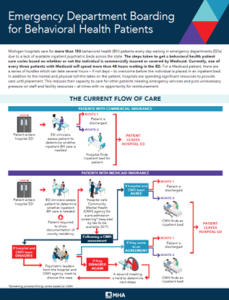
Infographic illustrating the differing processes that commercially insured patients go through to be assessed for a behavioral health need compared to a Medicaid beneficiary.
Infographic illustrating the differing processes that a Medicaid beneficiary goes through to be assessed for a behavioral health need compared to a commercially insured patient.

Under the current guidelines, LaPine explained, there are a series of arduous steps needed in order to get patients with Medicaid coverage inpatient behavioral healthcare. One of the biggest hurdles is that following an assessment by ED clinicians, a patient with Medicaid must receive a secondary pre-admission screening from a community mental health (CMH) agency.

This process can take hours – if not days – to complete. Meanwhile, a patient needing the same level of care who is commercially insured is not required to have the pre-admission screening by a CMH.

Last year, there were more than 1.2 million emergency room visits where behavioral health was one of the reasons for care. LaPine noted that pediatric and geriatric patients board for the longest periods of time.

One proposed solution to alleviate the process is to expand the three-hour assessment responsibility to allow clinically qualified staff to conduct pre-admission screenings in order to improve the delivery of care for behavioral health patients in Michigan hospital EDs.

“Emergency departments across the state are well-equipped to complete the pre-admission screening to determine if someone needs inpatient psychiatric care,” said LaPine. “Implementing this change will really help us to expand the number of available healthcare personnel that are able and available to conduct that pre-admission screening…it also allows Medicaid patients to be assessed in a similar manner as patients that have commercial insurance.”

According to recent survey data, there are more than 155 patients waiting in a hospital emergency department for access to behavioral health services; Whether that is an assessment through a CMH agency, an inpatient bed or a transfer to a short-term, residential setting.

The episode is available to stream on Apple PodcastsSpotifySoundCloud and YouTube.

How Could Medicaid Cuts Impact Michigan?

MiCare Champion Cast Header Photo

The MHA released a new episode of the MiCare Champion Cast exploring how proposed reductions to Medicaid could disrupt access to care and harm Michigan hospitals, patients and communities.

Laura Appel, executive vice president of government relations & public policy, MHA, first explored the history and purpose of Medicaid and the Healthy Michigan Plan, which has been hailed a success for improving access to care, reducing the uninsured rate and supporting economic stability for families across the state.

Appel explained the potential impact of recent federal proposals, which include instructions to cut Medicaid by at least $880 billion over 10 years. Changes like block grants, per capita caps and reduced federal matching rates could lead to a staggering $1.73 billion shortfall in the state budget, jeopardizing access to healthcare for millions.

“Cutting funding is cutting care,” said Appel. “Not every hospital is on the financial footing it wishes it were and there are a lot of hospitals across the country that are already in difficult financial straits…this could be the reason that they close all together.”

Michigan hospitals are asking members of Congress to protect the Medicaid program and oppose proposed reductions. Appel noted those interested in helping with this effort and reaching members of Congress are encouraged to visit the MHA Legislative Action Center.

Listeners can also expect to learn more about the impact proposed cuts would have on rural healthcare and Michigan’s economy. The episode is available to stream on Apple PodcastsSpotifySoundCloud and YouTube.

MHA Podcast Explores the Role of Artificial Intelligence (AI) in Healthcare

MiCare Champion Cast graphic featuring an episode focused on the role of Artificial Intelligence (AI) in Healthcare

The MHA released a new episode of the MiCare Champion Cast exploring the role artificial intelligence (AI) plays in healthcare today and what it will look like in the future. The episode features Bruce Brandes, president of Care.ai and Monica Holmes, a PhD candidate in bioinformatics at the University of Michigan and current member of the MHA AI Task Force.

Early in the discussion, Brandes and Holmes highlighted the ways smart technologies have been used for years when it comes to data analysis, disease diagnosis, radiology, clinical documentation, language processing and more.

“For the first time – maybe in my career in healthcare – it’s obvious that the status quo is no longer an acceptable option,” said Brandes, who has over 30 years of experience in executive management and entrepreneurial thought leadership. “This is real – you need to understand it, you need to be intentional and deliberate and have a strategic plan.”

Both Brandes and Holmes emphasized throughout the episode that AI cannot replace the essential role humans play in healthcare. The goal, in most cases, is to optimize a more efficient workflow, improve healthcare quality, advance diagnostics and enhance medical research.

“On the academic side, it’s improving our ability to do better research, which leads to better insights and ultimately better health outcomes for patients when it’s translated over to the bedside,” said Holmes, who also serves on the board of Trinity Health’s Chelsea Hospital as chair of patient quality and safety.

Listeners can expect to learn more about how patients and providers are responding to AI tools (including virtual nursing) and get answers to commonly asked questions related to transparency, health equity, regulation and cybersecurity.

Care.ai, an MHA endorsed business partner, powers more human care through the first and only AI-enabled Smart Care Facility Operating Platform, which deploys smart sensors throughout care facilities. These sensors continuously and ambiently monitor clinical and operational workflows, learning from them to predict, prevent and protect; alerting and engaging care teams in real-time and improving common challenges such as fall prevention, pressure injury prevention, hand hygiene compliance, rounding adherence, automated documentation, virtual rounding, virtual sitting and more.

The episode is available to stream on Spotify, Apple Podcasts, SoundCloud and YouTube. Those interested in learning more about Care.ai or the MHA EBP program can visit the business services webpage or contact Rob Wood at the MHA. Questions or idea submissions for future MiCare Champion Cast episodes can be sent to Lucy Ciaramitaro at the MHA.