MHA Race of the Week – Michigan Supreme Court

MHA RACE OF THE WEEK

The MHA’s Race of the Week series highlights the most pivotal statewide races for the 2024 General Election. The series will provide hospitals and healthcare advocates with the resources they need to make informed decisions on Election Day, including candidates’ views and background.

There will be two races for Michigan Supreme Court on the 2024 General Election ballot: One partial and one full-term seat. This Race of the Week highlights full-term candidates only. Once elected, this individual will take office at the start of the new term and serve for a full eight years.

CANDIDATES FOR MICHIGAN SUPREME COURT (FULL-TERM)

Kimberly Ann Thomas is a law professor at the University of Michigan Law School and co-founder of the university’s Juvenile Justice Clinic. Thomas also served on the bipartisan Michigan Task Force on Juvenile Justice Reform, which took a data-driven approach to understanding and making recommendations for improvement of our state’s juvenile system.

Thomas previously taught at the University College Cork School of Law in Cork, Ireland and was a U.S. Fulbright Scholar award recipient. She has been recognized for her service by the Criminal Defense Attorneys of Michigan and has served as an expert for the American Bar Association (ABA) Rule of Law Initiative. Thomas received her undergraduate degree from the University of Maryland, College Park and her law degree from Harvard Law School. For more information, visit  www.electkimberlythomas.com.

Andrew Fink (District 35) was elected to the state legislature in 2020 and currently serves as Republican vice chair of the House Judiciary Committee. Last term, Fink served as vice chair of the House Appropriations Subcommittee on Military and Veterans Affairs and State Police and also as a member of the House Licensing and Regulatory Affairs, Insurance and Financial Services and General Government Appropriations subcommittees, as well as the Health Policy Committee.

As a member of the House Judiciary Committee, Fink has taken up legislation related to trial court funding, estate planning, probate court rules, appeals court judge compensation, treatment courts, and many other issues. Fink graduated from Hillsdale College in 2006 with a B.A. in Politics and later earned his J.D. from the University of Michigan Law school in 2010. Prior to this, Fink was a Judge Advocate in the United States Marine Corps. To learn more, visit www.finkformichigan.com.

WHY IT MATTERS

The Michigan Supreme Court is the cornerstone of Michigan’s legal system and responsible for the general administrative supervision of all courts in the state. Those elected must set important legal precedents, ensure that laws and policies align with constitutional principles and maintain the checks and balances of the judicial system. Supreme Court officials play a critical role in healthcare policy and often have the final say when it comes to things like healthcare provider liability, public health policy, Medicaid expansion and insurance regulation. The decisions made by these elected officials have a direct impact on access to care for Michigan patients and communities.

For more information or to request 2024 Election materials, visit the MHA Election webpage or contact the MHA.
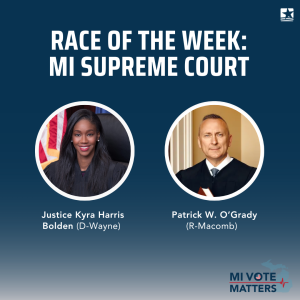
MHA Race of the Week – Michigan Supreme Court

MHA RACE OF THE WEEK

The MHA’s Race of the Week series highlights the most pivotal statewide races for the 2024 General Election. The series will provide hospitals and healthcare advocates with the resources they need to make informed decisions on Election Day, including candidates’ views and background.

There will be two races for Michigan Supreme Court on the 2024 General Election ballot: One partial and one full-term seat. This Race of the Week highlights partial term candidates only. Once elected, this individual will take office in January 2025 and fill the remainder of a term that is already underway. From there, the elected full-term candidate will take office at the start of the new term and serve for a full eight years.

CANDIDATES FOR MICHIGAN SUPREME COURT (PARTIAL TERM)

Justice Kyra Harris Bolden (D-Wayne) is an incumbent candidate serving her second year on the Michigan Supreme Court since being appointed in January 2023. A graduate of Southfield Public Schools, Justice Bolden received her bachelor’s degree from Grand Valley State University and went on to attend the University of Detroit Mercy School of Law. After receiving her Juris Doctorate, Justice Bolden became a criminal defense attorney and later a civil litigation attorney. She then served in the Michigan House of Representatives for two terms where she sat on the Judiciary Committee.

In her time, Justice Bolden has successfully passed pieces of critical bipartisan legislation into law, including the “Medically Frail” Prison Reform package, the revision of the Wrongful Imprisonment Compensation Act and the “Address Confidentiality for Survivors of Domestic Violence” package. For more information, visit www.boldenforjustice.com.

Patrick W. O’Grady (R-Macomb) previously served as the chief judge for the 15th Circuit Court and the Probate Court in Branch County. Over his 15-year tenure, O’Grady navigated diverse legal landscapes, from overseeing high-stakes criminal jury trials involving offenses such as murder, robbery, kidnapping, criminal sexual conduct, domestic violence, and child abuse, to adjudicating matters in civil law encompassing labor disputes, contractual intricacies, property rights, family law issues, auto negligence and medical malpractice.

Prior to his time as a circuit judge, O’Grady served in the Army Reserve, worked as a Michigan State Trooper and later as an assistant prosecuting attorney. He holds a law degree from Wayne State University. To learn more, visit www.judgeogrady4supremecourt.com.

WHY IT MATTERS

The Michigan Supreme Court is the cornerstone of Michigan’s legal system and responsible for the general administrative supervision of all courts in the state. Those elected must set important legal precedents, ensure that laws and policies align with constitutional principles and maintain the checks and balances of the judicial system. Supreme Court officials play a critical role in healthcare policy and often have the final say when it comes to things like healthcare provider liability, public health policy, Medicaid expansion and insurance regulation. The decisions made by these elected officials have a direct impact on access to care for Michigan patients and communities.

For more information or to request 2024 Election materials, visit the MHA Election webpage or contact the MHA.
Michigan Supreme Court Issues Ruling on Paid Sick Leave & Minimum Wage

The Michigan Supreme Court issued a ruling July 31 in Mothering Justice v. Attorney General that upholds voter initiative petitions on paid sick leave and minimum wage. Those laws, as originally enacted, will go into effect Feb. 21, 2025.

As a practical result, hospital employers should be aware of forthcoming changes to sick leave and minimum hourly wages starting in February 2025. The Improved Workforce Opportunity Wage Act, as enacted Public Act (PA) 337 of 2018, increases the state minimum hourly wage annually until 2030 and applies to all employers, regardless of size. Current estimates place the minimum hourly wage at $12.25 per hour, starting in February 2025, and reaching $15 by 2030.

The Earned Sick Time Act, as enacted PA 338 of 2018, applies to all employers and requires that an employee be provided one (1) hour of earned sick time for every 30 hours worked. That sick time may carry over year to year and allows increased usage of paid earned sick time for an employee of up to 72 hours per year. In addition, employers will be required to update their displayed informational posters on earned sick time.

Members with questions should contact Nancy McKeague at the MHA. Members with questions about Michigan’s existing laws should contact Elizabeth Kutter at the MHA.