
Michigan Hospital Collaboratives Launch to Improve Community Health

More than 50 Michigan hospitals are coming together to improve outcomes in maternal health, behavioral health and chronic disease across the state through new community benefit collaboratives launched by the Michigan Health & Hospital Association (MHA). The goal is to leverage community impact programming to maximize statewide improvements in these three areas.

The MHA will lead participating hospitals in implementing multi-year, scalable projects focused on enhancing group prenatal care, improving perinatal mood disorder screening and support, preventing postpartum depression and expanding food access and nutrition education. The collaborative topics were selected based on a review of all Community Health Needs Assessments completed by Michigan hospitals. Each collaborative is modeled after existing programs at Michigan hospitals and healthcare organizations designed to address healthcare barriers and improve health outcomes.

“This work reflects Michigan hospitals’ commitment to investing in their communities far beyond their four walls to improve population health,” said MHA CEO Brian Peters. “These collaboratives are designed to scale local success into making a statewide impact that advances the health and well-being of Michiganders where they live, work and grow.”

Each collaborative has various components that can be tailored to meet the unique needs of a hospital, depending on size, available resources and patient populations. The implementation of the collaboratives is supported by funding from the Michigan Health Endowment Fund. Public Policy Associates will facilitate program evaluations.

The list of participating hospitals for each collaborative is available below.

Behavioral Health Collaborative  

  • Henry Ford Health
  • MyMichigan Medical Center Alma
  • MyMichigan Medical Center Clare
  • MyMichigan Medical Center Gladwin
  • MyMichigan Medical Center Midland
  • MyMichigan Medical Center Mt. Pleasant
  • MyMichigan Medical Center Saginaw
  • MyMichigan Medical Center Sault
  • MyMichigan Medical Center Standish
  • MyMichigan Medical Center Tawas
  • MyMichigan Medical Center West Branch
  • ProMedica Monroe Regional Hospital
  • ProMedica Charles and Virginia Hickman Hospital
  • Trinity Health Ann Arbor
  • University of Michigan Health-Sparrow Lansing
  • University of Michigan Health-West

Chronic Disease Collaborative

  • Aspirus Iron River Hospital & Clinics
  • Aspirus Keweenaw Hospital & Clinics
  • Aspire Rural Health System Deckerville Community Hospital
  • Aspire Rural Health System Hills & Dales Healthcare
  • Aspire Rural Health System
  • Beacon Kalamazoo (formerly Borgess Hospital)
  • Bronson Battle Creek Hospital
  • Henry Ford Health
  • Kalkaska Memorial Health Center
  • Munson Medical Center
  • MyMichigan Medical Center Alma
  • MyMichigan Medical Center Clare
  • MyMichigan Medical Center Gladwin
  • MyMichigan Medical Center Midland
  • MyMichigan Medical Center Mt. Pleasant
  • MyMichigan Medical Center Saginaw
  • MyMichigan Medical Center Sault
  • MyMichigan Medical Center Standish
  • MyMichigan Medical Center Tawas
  • MyMichigan Medical Center West Branch
  • Scheurer Health
  • Schoolcraft Memorial Hospital

Maternal Health Collaborative  

  • Bronson Methodist Hospital
  • Corewell Health Lakeland Hospitals – St. Joseph Hospital
  • Henry Ford Health
  • MyMichigan Medical Center Alma
  • MyMichigan Medical Center Clare
  • MyMichigan Medical Center Gladwin
  • MyMichigan Medical Center Midland
  • MyMichigan Medical Center Mt. Pleasant
  • MyMichigan Medical Center Saginaw
  • MyMichigan Medical Center Sault
  • MyMichigan Medical Center Standish
  • MyMichigan Medical Center Tawas
  • MyMichigan Medical Center West Branch
  • Three Rivers Health Hospital (Beacon Health System)

To learn more about community benefit efforts across the state, visit the MHA Community Benefit webpage.

Based in Greater Lansing, the MHA is the statewide leader representing all community hospitals in Michigan. Established in 1919, the MHA represents the interests of its member hospitals and health systems in both the legislative and regulatory arenas on key issues and supports their efforts to provide quality, cost-effective and accessible care. The MHA’s mission is to advance the health of individuals and communities.
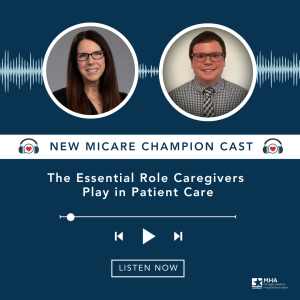
MHA Podcast Explores Resources for Family Caregivers

The MHA released a new episode of the MiCare Champion Cast for National Caregiver Month featuring Diane Mariani, LCSW, CADC, program manager for the department of social work and community health program at RUSH University Medical Center and Joshua Suire, MHA, BSN, RN, senior manager of safety & quality at the MHA Keystone Center.

One in five American adults – about 48 million individuals – are considered caregivers. With this in mind, the MHA Keystone Center is partnering with RUSH’s Center for Excellence in Aging to create an online learning series for hospitals interested in exploring how their staff can better integrate caregivers into a patient’s care team.

Throughout the episode, Suire and Mariani explore how the caregiving landscape has evolved and what resources are available to support caregivers in clinical and non-clinical settings. One of these tools includes a new learning module for hospitals looking to implement a caregiver navigation program within their organization, available to MHA members at no cost thanks to funding from the Michigan Health Endowment Fund.

“We’re focused on caregivers…their unique needs, trying to decrease their burden and really trying to improve their quality of life,” said Suire, who leads clinical grant-funded initiatives that help hospitals implement evidence-based quality improvement and patient safety practices. “As a part of the program, [hospitals] can take a gap analysis online, which is then processed into an individualized report and gives tangible next steps for implementing a caregiver program.”

Mariani manages the RUSH Caring for Caregivers (C4C) program that supports family and friend caregivers of adults 60 years and older. Funded by the RRF Foundation for Aging, C4C uses an evidence-based framework to improve care for older adults and caregivers through education, resources and support.

“It can be very individualized,” noted Mariani. “We support caregivers where they’re at.”

During the discussion, Mariani shared the critical role RUSH’s caregiver advisory council plays in lending first-hand insight to inform and advance their programming.

“We meet on a regular basis for feedback on how we can best identify, assist and understand caregivers – and understand how it’s impacting their physical and mental health,” said Mariani, who also leads an initiative funded by the John A. Hartford Foundation that focuses on sharing the C4C model with age-friendly health systems, area agencies on aging and other key stakeholders nationwide.

Additionally, the MHA Keystone Center partnered with Henry Ford Health’s Caregiver Assistance Resources and Education (C.A.R.E) Program team and Wayne State University’s Institute of Gerontology to create the Michigan Caregiver Navigation Toolkit – a resource to guide hospitals through operationalizing a caregiver support program within their systems.

Ongoing technical assistance and educational resources are available at no cost to MHA members interested in creating or expanding caregiver services.

The episode is available to stream on Apple PodcastsSpotifySoundcloud and YouTube.

Those interested in learning more about the MiCare Champion Cast can contact Lucy Ciaramitaro at the MHA. For more information on caregiver resources in Michigan, contact the MHA Keystone Center.

MDHHS and Michigan 211 Launches New Website for Grief and Bereavement Support

The Michigan Department of Health and Human Services (MDHHS), in partnership with Michigan 211, recently launched a new website aimed to providing support services for families who have experienced loss of a mother or infant. The website was made possible by a grant awarded to the MDHHS Division of Maternal and Infant Health by the Michigan Health Endowment Fund.

The goal of the website is to improve access to grief and bereavement support services for families during their time of need. The website serves as a resource hub where individuals can easily find and access a variety of services such as perinatal hospice care, palliative support, assistance with burial and cremation services, financial aid options, mental health resources and support resources for sudden loss.

The website allows users to search for services based on their geographic location using ZIP codes, ensuring that families can find local support that meets their specific needs. Any member of the community including bereaved families and healthcare professionals will be able to access resources through the site or by calling 211.

Members with questions may contact Lauren LaPine at the MHA.