MHA CEO Report — Patients Over Politics

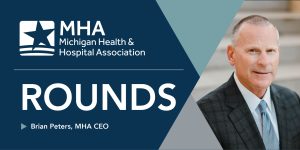
MHA Rounds image of Brian Peters

MHA Rounds graphic of Brian Peters“Happy are those who dare courageously to defend what they love.”  — Ovid

Most people will find themselves in a hospital at one point or another, whether it’s to hold a loved one’s hand, welcome a child or receive needed – perhaps even life-saving – care.

I’m no exception. Like many others have done before and since, my wife and I looked to the team at Corewell Health Devos Children’s Hospital to keep our daughter safe and healthy while she was fighting for her life in their neonatal intensive care unit some 19 years ago (a story I recently shared on the MiCare Champion Cast). Needless to say, it’s in those moments that we realize just how personal – and non-partisan – healthcare truly is.

As an association, it’s our job to protect Michigan hospitals and safeguard healthcare services for patients and communities. That’s why in recent months we’ve spoken out against attacks to Medicaid – and why now – we’re ringing the alarm on the devastating impact proposed House budget cuts would have if signed into law.

Political posturing aside, here are the facts: Michigan hospitals stand to lose more than $2.5 billion under House Bill 4706, which would directly impact patient access to care in hospital beds, labor and delivery units, emergency departments, cancer treatment and many other vital service lines across the state. As we stated repeatedly during the debate on “One Big Beautiful Bill Act (OBBBA),” when service lines and hospitals close, access is not only lost for Medicaid recipients – it is lost for everyone.  In addition, this funding keeps our incredibly dedicated healthcare workers employed. The House-proposed budget puts more than 20,000 Michigan hospital jobs at risk and could result in a $4.9 billion loss to the state’s economy.

While some politicians point fingers, Michigan hospitals are focused on patients. It’s time to put egos aside and act as a united front when it comes to protecting access to care, helping our communities thrive and showing up for those who care for us all in times of joy, uncertainty and crisis.

We cannot let partisanship put lives at risk. On behalf of our MHA family, I ask you to show courage in speaking truth to power. I ask you to join me in urging lawmakers on both sides of the aisle to protect essential hospital funding by visiting our MHA Legislative Action Center.

As always, I welcome your thoughts.
MHA Monday Report Sept. 16, 2024

Leaders Convene for Crucial Healthcare Workforce Discussion
The MHA hosted nearly 150 thought leaders from healthcare, post-secondary education and workforce talent development Sept. 11 in Lansing for a discussion to help strengthen connections across the sectors focused on building the pipeline for …


MDHHS Issues Final Maternal Infant Health Services Policy

The Michigan Department of Health and Human Services (MDHHS) issued a final Medicaid Policy Bulletin Sept. 9 to expand coverage for Maternal Infant Health Program services. ​​ The final policy was issued in response …


2024 Election Materials Available for Michigan Hospitals

The MHA is offering election communication materials geared toward hospital staff, volunteers, patients and visitors to encourage voter participation in the 2024 general election. Additionally, the MHA elections webpage will be updated regularly with relevant …


Michigan Doula Advisory Council Membership Application Opens

The Michigan Doula Advisory Council (DAC) invites doulas across the state to apply for membership as its first council term ends in Dec. 2024. The DAC works to improve doula services in Michigan, particularly with …


What’s Ahead in Healthcare? Insights from the American Hospital Association

The MHA released a new episode of the MiCare Champion Cast featuring Rick Pollack, president and CEO of the American Hospital Association. Pollack joined MHA CEO Brian Peters to discuss a variety of topics …


Keckley Report

The Presidential Debate will Frustrate Healthcare Voters

“The healthcare system per se is not a major concern to voters this year, but its affordability is. Out-of-pocket costs for prescription drugs, insurance premiums and co-pays and deductibles for hospitals and physician services are considered unreasonable and inexplicably high. They contribute to public anxiety about their financial security alongside housing and food costs. And majorities think the government should do more by imposing price controls and limiting corporate consolidation. …

Misinformation, disinformation and AI derived social media messaging are standard fare in winner-take-all politics. When used in addressing health issues and policies, they’re effective because the public’s basic level of understanding of the health system is embarrassingly low: studies show 4 in 5 American’s confess to confusion citing the system’s complexity and, regrettably, the inadequacy of efforts to mitigate their ignorance is widely acknowledged. Thus, terms like affordability, value, quality, not-for-profit healthcare and many others can be used liberally by politicians, trade groups and journalists without fear of challenge since they’re defined differently by every user. …

Long-term, the system will proceed incrementally. Bigger players will fare OK and others will fail. I remain hopeful thoughtful leaders will address the near and long-term future with equal energy and attention. Regrettably, the tyranny of the urgent owns the U.S. health system’s attention these days: its long-term destination is out-of-sight, out-of-mind to most. And the complexity of its short-term issues lend to magnification of misinformation, disinformation and public ignorance.

That’s why this debate will frustrate healthcare voters.”

Paul Keckley, Sept. 9, 2024


MHA in the News

WWMT-TV Newschannel 3 aired a story Sept. 9 on the radiology workforce shortage in hospitals, including a shortage of radiologists and radiology technicians. MHA Executive Vice President Laura Appel was interviewed for the story, explaining …

MHA Podcast Welcomes New Board Chair, Explores Healthcare Priorities in Michigan

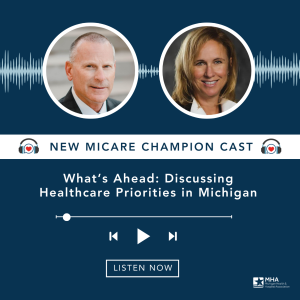
MHA Board Chair Julie Yaroch, DO, joined MHA CEO Brian Peters for an episode of the MiCare Champion Cast.

The MHA released a new episode of the MiCare Champion Cast kicking off the 2024-2025 program year discussing healthcare viability, workforce, cybersecurity, the upcoming election and more.

The episode, hosted by MHA CEO Brian Peters, features MHA Board Chair Julie Yaroch, DO, president of ProMedica Charles and Virginia Hickman Hospital. Listeners can expect to learn more about Yaroch’s journey becoming a healthcare leader, along with her aspirations for the new board and her longstanding passion for public health.

“Hospitals don’t have all the solutions,” noted Yaroch. “We can’t carry out all the directives, but we can bring people to the table. We all want to have healthy communities, and I do think we can achieve that goal, but we’ve got a lot of steps in front of us.”

Alongside Yaroch, officers of the 2024-2025 MHA Board of Trustees include Bill Manns, chair-elect; and Brittany Lavis, treasurer, among many others. With a record number of physician leaders serving, Peters and Yaroch spent time discussing healthcare priorities tied to workforce challenges and care delivery.

“In healthcare, we can’t always build it and people will come,” said Yaroch. “We have to really understand the patient population, the community and the directives of the providers. Without providers, we don’t have healthcare.”

Peters and Yaroch also spent time discussing key healthcare issues including mandated nurse staffing ratios, 340B, cybersecurity and more.

The episode is available to stream on Spotify, Apple Podcasts, SoundCloud and YouTube. Questions or idea submissions for future MiCare Champion Cast episodes can be sent to Lucy Ciaramitaro at the MHA.