
340B Protections Pass Senate Committee & Governor Delivers State of the State Address

Legislation that would implement 340B program protections advanced in the Senate Oversight Committee and Gov. Whitmer delivered her seventh annual State of the State address to the Michigan Legislature during the week of Feb. 24.

Deidra Wilson, senior vice president, government relations and public policy, McLaren Health Care; and Ben Frederick, associate vice president of advocacy and government relations, Memorial Healthcare testified Feb. 27 in the Senate Oversight Committee on legislation regarding 340B Protections.

Senate Bill (SB) 94, sponsored by Sen. Sam Singh (D-East Lansing), and SB 95, sponsored by Sen. Jonathan Lindsey (R-Allen), saw extensive action in the Senate Oversight Committee Feb. 27. SB 94 protects the 340B program in Michigan and is paired with SB 95, which requires hospital compliance with federal transparency laws. Two MHA members provided testimony during the committee in support: Deidra Wilson, senior vice president, government relations and public policy, McLaren Health Care; and Ben Frederick, associate vice president of advocacy and government relations, Memorial Healthcare.

SB 94 safeguards the 340B program, ensuring cost savings and preserves access to affordable healthcare services in both urban and rural Michigan communities. Further, this legislation adds first of its kind drug manufacturer transparency requirements, making Michigan’s legislation the strongest in the nation.

During testimony, Wilson first thanked the committee for their swift action on reintroduction of the bills and the importance of expediting this legislation to support communities. She discussed services for cancer patients across the state, such as covering copays, rural OB services and other vital services for vulnerable populations that are impacted when pharmaceutical manufacturers create restrictions around the 340B program. Wilson concluded her testimony by stating that hospitals prioritize the needs of patients and communities over the profits of drug manufacturers. Frederick emphasized the impact the 340B program has in rural communities, especially for independent and community hospitals, and shared how these rural areas can provide essential OB, cancer and family medicine services to preserve and improve access for patients. Following a successful hearing, the Senate Oversight Committee voted 5-0 to report SB 94 and SB 95 to the full Senate. The bills now await a full vote in the Senate before it can be sent to the House of Representatives.

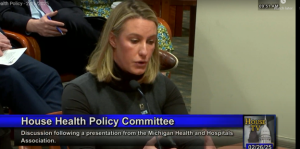
Elizabeth Kutter, senior director, government and political affairs, MHA testimony provided an overview of the 340B program in the House Health Policy Committee Feb. 26. 

The House Health Policy Committee also heard testimony on the importance of the 340B program in the state Feb. 26. Elizabeth Kutter, senior director, government and political affairs, MHA, provided an overview of the program, including examples of how the program benefits patients and communities across the state. Wilson and Frederick also testified, sharing how the program works for their hospital systems. The educational hearing enabled House Health Policy members to ask questions and engage in a constructive dialogue around the topic. The MHA continues to advocate for the 340B program and support Michigan hospitals’ efforts to expand access to quality, community-based care. Members are encouraged to use the MHA 340B Action Alert to contact their lawmakers in support of this legislation.

Lastly, Gov. Whitmer outlined her upcoming priorities to a joint convention of the Michigan Legislature in her State of the State address Feb. 26. One key highlight in her address included reducing medical debt for Michiganders. While no specific policies were discussed, she cited 700,000 Michiganders currently have medical debt and that legislators should work to find solutions for this issue going forward. In addition to this, the governor discussed working in a bipartisan fashion on issues like road funding, building affordable housing and lowering costs in the state.

Members with questions may contact Elizabeth Kutter at the MHA.


House Insurance Committee Hears Testimony on Bill to Protect 340B

Maureen D’Agostino, vice president of accreditation and regulatory CMS programs and provider and facility enrollment at McLaren Health Care testifying during The House Insurance and Financial Services Committee.

The House Insurance and Financial Services Committee convened June 5 to hear testimony on House Bill (HB) 5350, introduced by Rep. Alabas Farhat (D-Dearborn), which would protect access to affordable prescription drugs and healthcare services through the 340B Prescription Drug Pricing Program.

Testimony began with Marc Corriveau, JD, MHSA, vice president of corporate government affairs at Henry Ford Health, providing an overview of how savings from the 340B program allow vulnerable, uninsured patients to receive medical and behavioral healthcare services at little to no cost.

Sean Gehle, vice president of advocacy at Trinity Health Michigan, followed with additional examples of how the 340B program allows qualified safety net providers to extend scarce federal resources. Specifically, Gehle noted that the health system is able to provide financial assistance for prescription medications to patients in need.

Next, Ben Frederick, associate vice president of advocacy and government relations and Joseph Munroe, director of pharmacy at Memorial Healthcare, shared the impact the 340B Drug Pricing Program has in rural communities. Together, Frederick and Munroe explained how the program makes it possible for patients to receive routine and specialty care close to home including obstetrics, oncology, behavioral health and neurology care services.

Last to provide testimony was Maureen D’Agostino, vice president of accreditation and regulatory CMS programs and provider and facility enrollment at McLaren Health Care. D’Agostino overviewed how savings from the 340B program have helped McLaren offer comprehensive care for substance use disorder, cancer treatments and more. D’Agostino was accompanied by Deidra Wilson, vice president of government affairs at McLaren.

The MHA continues to advocate for the 340B program and uplift efforts by Michigan hospitals to expand access to quality, community-based care. Members with questions should contact Elizabeth Kutter at the MHA.