
CMS Releases FY 2026 LTCH Prospective Payment System Final Rule

The Centers for Medicare & Medicaid Services (CMS) recently released a final rule to update the Medicare fee-for-service (FFS) long-term care hospital (LTCH) prospective payment system (IPPS) for fiscal year (FY) 2026.

Specifically, the rule will:

  • Increase the standard LTCH PPS rate by a net 2.9% after the 0.7% productivity adjustment and budget neutrality adjustments from $49,383 to $50,824 for LTCHs that meet the CMS quality program reporting requirements. LTCHs that fail to meet these requirements are subject to a 2-percentage point reduction to the annual update.
  • Continue paying cases at the site-neutral rate if they fail to meet LTCH criteria.
  • Increase the high-cost outlier (HCO) threshold by 2.5% for standard LTCH cases from the current $77,048 to $78,936 to achieve the target of paying roughly 8% of aggregate LTCH payments as HCO payments.
  • Use the inpatient PPS cost outlier threshold finalized at $43,397 for site-neutral cases.
  • Increase the labor-related share of the rate from 72.8% to 72.9%.
  • Update the LTCH Quality Reporting Program to remove four standardized patient assessment data elements focused on social determinants of health and modifying the COVID-19 vaccine among patients and residents measure to exclude patients who expire.

The MHA continues to review the final rule and will provide LTCHs with an estimated impact analysis in the coming weeks. Members with questions should contact Vickie Kunz at the MHA.

CMS Releases FY 2026 Hospital Inpatient Prospective Payment System Final Rule

The Centers for Medicare & Medicaid Services (CMS) recently released a final rule to update the Medicare fee-for-service (FFS) inpatient prospective payment system (IPPS) for fiscal year (FY) 2026.

Highlights of the final rule include:

  • Increasing the standard operating rate by a net 1.9%, after the 0.7% productivity cut and budget neutrality adjustments, from $6,624.39 to $6,752.61, for hospitals that successfully comply with the CMS quality reporting program and electronic health record requirements. Hospitals that do not meet requirements for these programs are subject to a reduced annual update.
  • Increase the federal capital rate by 2.3%, from $512.14 to $524.15.
  • Decrease the cost outlier threshold by 12.6% from $46,217 to $40,397 to maintain the target of paying 5.1% of aggregate IPPS payments as outlier.
  • Rebasing and revising the labor-related share of the standardized operating rate from 67.6% to 66% for hospitals with a wage index greater than 1.0.
  • Increasing disproportionate share hospital and uncompensated care (UCC) payments by approximately $2 billion nationally. UCC payments will be allocated using the average of three most recent years of audited Worksheet S-10 data.
  • Adding five new Medicare Severity Diagnosis Related Groups (MS-DRGs) while deleting six MS-DRGs, with most changes within Major Diagnostic Category 05, Diseases and Disorders of the Circulatory System.
  • Removing four measures from the Hospital Inpatient Quality Reporting Program effective with the 2024 reporting and FY 2026 payment period:
    • COVID-19 vaccination coverage among health care personnel.
    • Hospital commitment to health equity structural measure.
    • Screening for social drivers of health.
    • Screen positive rate for social drivers of health.
  • Modifying the Hybrid hospital-wide readmission and mortality measures and the stroke mortality and elective total hip and knee arthroplasty measures.
  • Updating and codifying the Extraordinary Circumstances Exception (ECE) policy to clarify that the CMS has discretion to grant an extension in response to an ECE request from a hospital.
  • Removing the health equity adjustment from the hospital value-based purchasing program scoring methodology beginning with the FY 2026 program.
  • Modifying the six measures in the Readmissions Reduction Program to include Medicare Advantage (MA) beneficiaries in the patient cohorts and shortening the applicable performance period from three years to two years. For example, FY 2027 HRRP penalties would be based on performance July 1, 2023, through June 30, 2025. The CMS did not finalize its proposal to include MA data in the calculations of aggregate payments for excess readmissions; as a result, aggregate penalties are expected to include 2% instead of 13% under the proposed update.
  • Making a technical update to the National Healthcare Safety Network healthcare associated infection measures baseline.

The MHA continues to review the final rule and will provide hospitals with an updated estimated impact analysis and rule brief in the next few weeks. Members with questions should contact Vickie Kunz at the MHA.
CMS Releases FY 2026 Hospital IPPS Proposed Rule

The Centers for Medicare & Medicaid Services (CMS) recently released a proposed rule to update the Medicare fee-for-service inpatient prospective payment system (IPPS) for fiscal year (FY) 2026.

The rule proposes to:

  • Increase the standard operating rate by a net 3.2%, after the 0.8% productivity cut and budget neutrality adjustments, from $6,624.39 to $6,835.47, for hospitals that successfully comply with the CMS quality reporting program and electronic health record requirements. Hospitals that do not meet the requirements for these programs are subject to a reduced annual update.
  • Increase the federal capital rate by 3.3%, from $512.14 to $528.95.
  • Decrease the cost outlier threshold by 4.1%, from $46,217 to $44,305, to maintain the target of paying 5.1% of aggregate IPPS payments as outlier.
  • Rebase and revise the labor-related share of the standardized operating rate from 67.6% to 66% for hospitals with a wage index greater than 1.0.
  • Increase disproportionate share hospital and uncompensated care (UCC) payments by $1.5 billion nationally. UCC payments will be allocated using the average of three most recent years of audited Worksheet S-10 data.
  • Add seven new Medicare-Severity (MS) Diagnosis Related Groups, while deleting six MS-DRGs, with most changes within Major Diagnostic Category 05, Diseases and Disorders of the Circulatory System.
  • Remove four measures from the Hospital Inpatient Quality Reporting Program, effective with the 2024 reporting and FY 2026 payment period:
    • COVID-19 vaccination coverage among health care personnel.
    • Hospital commitment to health equity structural measure.
    • Screening for social drivers of health.
    • Screen positive rate for social drivers of health.
  • Modify the Hybrid hospital-wide readmission and mortality measures and the stroke mortality and elective total hip and knee arthroplasty measures.
  • Update and codify the Extraordinary Circumstances Exception (ECE) policy to clarify that the CMS has discretion to grant an extension in response to an ECE request from a hospital.
  • Remove the health equity adjustment from the hospital value-based purchasing program scoring methodology beginning with the FY 2026 program.
  • Include Medicare Advantage patients in the calculation of multiple claims-based measures across several programs, including the Hospital Readmissions Reduction program, beginning with the FY 2027 program.
  • Shorten the Hospital RRP’s performance period from three years to two years. For example, FY 2027 HRRP penalties would be based on July 1, 2023 through June 30, 2025 performance.
  • Seek stakeholder comments in response to the Request for Information on opportunities to streamline regulations and reduce administrative burden on providers, suppliers, beneficiaries and other interest parties in the Medicare program.

The MHA continues to review the proposed rule and will provide hospitals with an estimated impact analysis in the next few weeks. The MHA encourages hospitals to review the proposed rule and submit comments to the CMS by June 10 and to notify Vickie Kunz at the MHA regarding questions or issues identified by May 27.

CMS Releases FY 2025 Hospital Inpatient Prospective Payment System Final Rule

The Centers for Medicare & Medicaid Services (CMS) recently released a final rule to update the Medicare fee-for-service hospital inpatient prospective payment system (IPPS) for fiscal year (FY) 2025.

Highlights of the final rule include:

  • Increasing the standard operating rate by a net 1.7%, after budget neutrality adjustments, from $6,497.77 to $6,606.51, for hospitals that successfully comply with the CMS quality reporting program and electronic health record requirements. Hospitals that do not meet requirements for these programs are subject to a lower annual update.
  • Updating the federal capital rate by 1.3%, from $503.83 to $510.51.
  • Increasing the cost outlier threshold by 8%, from $42,750, to $46,152, to maintain the target of paying 5.1% of aggregate IPPS payments as outlier.
  • Revising core based statistical areas (CBSAs) as a result of the new Office of Management and Budget labor market delineations based on the 2020 Decennial Census.
  • Implementing a separate IPPS payment for small, independent hospitals, defined as those with 100 or fewer beds that are not part of a chain organization, to voluntarily establish and maintain a six-month buffer stock of one or more of 86 essential medicines. This separate payment will not be budget neutral.
  • Creating 12 new Medicare Severity Diagnosis Related Groups (MS-DRGs) and deleting 5 MS-DRGs, most of which are within Major Diagnostic Category 08 (Diseases of the Musculoskeletal System and Connective Tissue).
  • Establishing a new mandatory CMS Innovation Center model, Transforming Episode Accountability Model, that would provide bundled payment for five surgical procedures to hospitals in 188 selected CBSAs.
  • Using the average of FY 2019, 2020 and 2021 Worksheet S-10 uncompensated care cost (UCC) data for the UCC pool allocation, which comprises 75% of Medicare disproportionate share hospital (DSH) payments. After adjusting this pool for the percent of uninsured individuals, total DSH and UCC payments will be approximately $200 million less than FY 2024 payments.
  • Adding seven new measures, primarily focused on patient safety-related practices and outcomes to the inpatient quality reporting program, while removing five measures and modifying two existing measures, including the Hospital Consumer Assessment for Healthcare Providers and Systems survey measure.
  • Increasing the performance-based scoring threshold from 60 points to 70 points, beginning with the electronic health record reporting period in calendar year (CY) 2025, and from 70 points to 80 points in CY 2026.
  • Increasing the number of mandatory electronic clinical quality measures that hospitals must report for both the IQR and the Promoting Interoperability programs.
  • Modifying and making permanent weekly reporting by hospitals, including critical access hospitals, of acute respiratory illness data beginning Nov. 1, 2024, on confirmed infection of COVID-19, influenza and respiratory syntactical virus among hospitalized patients, hospital capacity and limited patient demographic information, including age.
  • Finalizing the proposal to separate the Antimicrobial Use and Resistance Surveillance measure into separate measures (an Antimicrobial Use Surveillance measure and an Antimicrobial Resistance Surveillance measure), beginning with the electronic health record reporting period in CY 2025.
  • Adopting severity level changes related to seven social determinants of health diagnosis codes (SDOH Z codes) that describe inadequate housing and housing instability, moving these from non-complication or comorbidity to complication or comorbidity for FY 2025.

The MHA continues to review the final rule and will provide hospitals with an updated estimated impact analysis in the next few weeks. Members with questions should contact Vickie Kunz at the MHA.

CMS Seeks Comments on Proposed Transforming Episode Accountability Model

The Centers for Medicare & Medicaid Services (CMS) included a proposal to create a new mandatory alternative payment model, the Transforming Episode Accountability Model (TEAM), in the fiscal year 2025 hospital inpatient prospective payment system (IPPS) proposed rule. 

The CMS proposes to mandate participation of all IPPS hospitals in selected core based statistical areas (CBSAs). The CMS proposes to randomly select 25% of 803 eligible CBSAs.

The CMS proposes to test the mandatory TEAM model for five years, beginning Jan. 1, 2026, and ending Dec. 31, 2030. Hospitals would be required to participate in all five surgical episodes and would be the episode initiators and bear financial risk if the model is finalized as proposed.

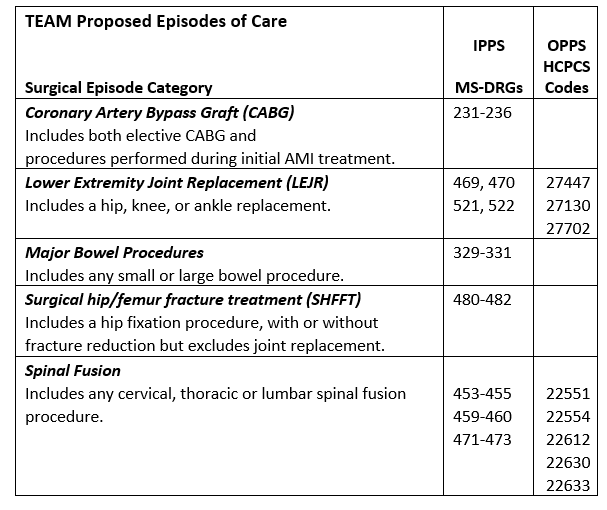
The model proposed to include five surgical episode categories for Medicare fee-for-service (FFS) beneficiaries:


chart that details the model proposed to include five surgical episode categories for Medicare fee-for-service (FFS) beneficiaries.

An episode would begin with a Medicare FFS beneficiary’s acute care hospital stay or a hospital outpatient procedure visit. The episode would end 30 days after hospital discharge and would include the surgical procedure and inpatient stay, and all related care covered under Medicare Parts A and B within 30 days of discharge. The episode would exclude unrelated services.

The CMS would evaluate hospitals by comparing a participating hospitals’ actual Medicare FFS spending to their target price. The CMS would also evaluate performance on quality measures:

  • Hospital readmission
  • Patient Safety
  • Patient-reported outcomes

The proposed model would not include Medicare Advantage plans, which currently cover 59% of Michigan Medicare beneficiaries. The CMS will accept comments until June 10 and anticipates release of a final rule Fall 2024.

Members with questions should contact Vickie Kunz at the MHA.

CMS Releases FY 25 Hospital IPPS Proposed Rule

The Centers for Medicare & Medicaid Services (CMS) recently released a proposed rule to update the Medicare fee-for-service (FFS) hospital inpatient prospective payment system (IPPS) for fiscal year (FY) 2025.

The rule proposes to:

  • Increase the standard operating rate by a net 2.6%, after budget neutrality adjustments, from $6,497.77 to $6,666.10, for hospitals that successfully comply with the CMS quality reporting program and electronic health record requirements. Hospitals that do not meet requirements for these programs are subject to a lower annual update.
  • Increase the federal capital rate by 2.5%, from $503.83 to $516.41.
  • Increase the cost outlier threshold by 15%, from $42,750, to $49,237, to maintain the target of paying 5.1% of aggregate IPPS payments as outlier. This will result in fewer cases qualifying for an outlier payment.
  • Update core based statistical areas as a result of the new Office of Management and Budget labor market delineations based on the 2020 Decennial Census.
  • Implement a separate IPPS payment for small, independent hospitals, defined as those with 100 or fewer beds that are not part of a chain organization, to voluntarily establish and maintain a six-month buffer stock of one or more of 86 essential medicines.
  • Create 10 new Medicare Severity Diagnosis Related Groups (MS-DRGs) and delete three MS-DRGs, most of which are within Major Diagnostic Category 08 (Diseases of the Musculoskeletal System and Connective Tissue) and specific to interbody spinal fusion devices.
  • Establish a new mandatory CMS Innovation Center model that would provide bundled payment for certain surgical procedures.
  • Use FY 2019, 2020 and 2021 Worksheet S-10 uncompensated care cost (UCC) data for the UCC pool allocation, which comprises 75% of Medicare disproportionate share hospital payments.
  • Add seven new measures, primarily focused on patient safety-related practices and outcomes, to the inpatient quality reporting program. Also remove five measures and modify two existing measures, including the Hospital Consumer Assessment for Healthcare Providers and Systems survey measure.
  • Increase the number of mandatory electronic clinical quality measures that hospitals must report for both the IQR and the Promoting Interoperability programs.
  • Require weekly reporting by hospitals, including critical access hospitals, of acute respiratory illness data beginning Oct. 1, 2024, on confirmed infection of COVID-19, influenza and respiratory syntactical virus among hospitalized patients, hospital capacity and limited patient demographic information, including age.
  • Change severity level designation for Z codes describing inadequate housing and housing instability from non-complication or comorbidity to complication or comorbidity for FY 2025.
  • Solicit input through requests for Information on:
    • Hospital resource usage for providing inpatient pregnancy and childbirth services to Medicare patients compared to non-Medicare patients.
    • Requirements and structure should be for a possible future obstetrical services conditions of participation.

The MHA continues its review of the proposed rule and will provide hospitals with an estimated impact analysis in the next few weeks. The MHA encourages hospitals to review the rule and submit comments to the CMS by June 10 and to notify the MHA regarding issues identified by May 24.

Members with questions should contact Vickie Kunz at the MHA.