BEAD Program Opens to Support Broadband Access in Michigan

The Broadband Equity, Access, and Deployment (BEAD) program recently opened its two-step application process through 4 p.m. April 9, 2025, with pre-applications required for submission by 4 p.m. March 10. The program is part of the $42.45 billion Infrastructure Investment and Jobs Act, which allocated $1.5 billion to expand broadband access in Michigan. Hospitals and healthcare providers are encouraged to apply for funding to improve telehealth services, enhance patient care and support digital tools.

Hospitals must identify as community anchor institutions and are eligible for funding if they lack broadband speeds of one (1) Gbps for both uploads and downlands with latency under 100 milliseconds. Funds can be used for broadband deployment, telehealth expansion and digital infrastructure improvements.

For more details, visit the BEAD Application page on the EGrAMs grant site or contact the Michigan High Speed Internet Office.

Members with questions may contact Lenise Freeman at the MHA.

MHA Webinar to Review 2025 MI-AIM Eligibility Requirements

The MHA will host an informational webinar at 2 p.m. Thursday, Feb. 6 to review 2025 eligibility requirements for hospital birthing units to receive maternal health quality payments through the Michigan Department of Health and Human Services. The funding is geared to members that are fully participating in the Michigan Alliance for Innovation on Maternal Health (MI-AIM) collaborative and have committed to participating in The Joint Commission’s Maternal Levels of Care Verification Program.

The webinar will provide time to answer questions and outline ongoing technical support being provided by the MHA Keystone Center. All birthing hospitals interested in pursuing the 2025 state funding opportunity are encouraged to register.

Additional information can also be found on the MHA’s Maternal Levels of Care webpage.

Members with questions may contact MHA Keystone Center.

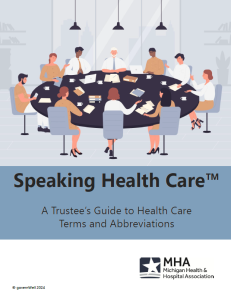
Speaking Health Care™ Guide Assists with Understanding Language

Orientating new trustees extends far beyond a single session. New members usually require months to get fully up-to-speed on strategic priorities and the basic expectations for trustees. A daunting challenge is interpreting language about operations, clinical care, insurance and regulation.

The MHA, other state hospital associations and governWell™ have collaborated to create the guide Speaking Health Care™, in efforts to help hospital and health system trustees better understand the complex and often confusing language that is used in healthcare. The glossary includes over 1,000 words with acronyms that are often used in briefings, documents and discussions in the boardroom.

The MHA encourages members to share this resource with governing board members, new employees and others who could benefit. Members with questions about the Speaking Health Care™ guide may contact Erin Steward at the MHA.

Important Healthcare Workforce Bills Reintroduced & Committee Assignments Announced

Important healthcare workforce bills related to the interstate medical licensure compact and prohibitions on non-compete agreements were reintroduced from the past legislative session by the Michigan Legislature during the week of Jan. 27. In addition, committee assignments were announced for the Michigan House of Representations.

House Bill 4032, sponsored by Rep. Rylee Linting (R-Grosse Ile), was introduced and referred to the Health Policy Committee. This legislation is a re-introduction from last term to eliminate the sunset on the interstate medical licensure compact, which streamlines the licensing process and allows physicians licensed in one state to practice in multiple, participating states.

By removing additional licensing requirements for physicians seeking to practice across state lines, patients experience increased access to care, especially in rural and underserved areas, by physicians included in the compact. In addition, states involved in the compact can share disciplinary and investigative information through the state medical board to strengthen public protection for patients and the program itself. Michigan’s participation in the compact is currently set to expire on March 28, 2025. The MHA supports this legislation and is working quickly with legislators to move it through the legislative process before the compact’s current expiration date.

Also, House Bill 4040 was reintroduced by Rep. Denise Mentzer (D-Mount Clemens) to prohibit employers from requiring employees agree to certain noncompete agreements. The bill has been referred to the Committee on Economic Competitiveness. The MHA is opposed to this legislation.

Another key legislative update from the week was the announcement of full House committee assignments. There are 18 Standing Committees this term, with notable committees including Appropriations, Education and Workforce, Health Policy, Insurance, Oversight and Regulatory Reform.

New to this term are the subcommittees on Oversight and traditional MDHHS appropriations. Both committees now include specific subcommittees addressing items like public health, while the Appropriations subcommittee is divided into three separate subcommittees on Human Services, Medicaid and Behavioral Health, and Public Health. Finally, there is a newly created Select Committee on Protecting Michigan Employees and Small Businesses. The MHA looks forward to working with legislators serving on these committees to best represent MHA members during the 2025-2026 legislative term.

Members with questions may contact Adam Carlson at the MHA.

MHA Monday Report Jan. 27, 2025

Legislation on Maternal Healthcare Access and Preserving Healthy Michigan Plan Coverage Becomes Law

Gov. Whitmer signed several bills Jan. 21 aimed at improving maternal healthcare access, equity and outcomes, as well as preserving eligibility for those under the Healthy Michigan Plan. The MHA worked extensively with bill sponsors …


Legislative Policy Panel Acts on AI & Credentialing Policy

The MHA Legislative Policy Panel met virtually Jan. 22 to develop recommendations on legislative and policy issues impacting Michigan hospitals. The meeting began with Carlos Jackson from The Cornerstone Group, the MHA’s Washington DC-based government …


Now Accepting Nominations for the 2025 MHA Ludwig Community Benefit Award

The MHA is now accepting nominations for its 2025 MHA Ludwig Community Benefit Award. Michigan hospitals and health systems have a long-standing commitment to offering a wide range of services that enhance the health and …


Medicare and Medicaid Enrollment Update

The MHA updated its analysis of Medicaid and Medicare enrollment based on December 2024 data. The analysis includes program enrollment as a percentage of each county’s total population and the split between fee-for-service and …


Registration Open for 2025 Human Resources Conference

Registration is now open for the 2025 MHA Human Resources Conference, scheduled for March 25 from 8:30 a.m. to 3:30 p.m. at the Crowne Plaza Lansing. The event offers attendees an opportunity to expand their …


YesRx Hosts Cancer Medication Donation Drive

The MHA is committed to efforts that expand access to services and mitigate barriers to timely and effective treatments. YesRx is a statewide cancer drug repository program, accepting donations of unopened cancer medications through partnerships …


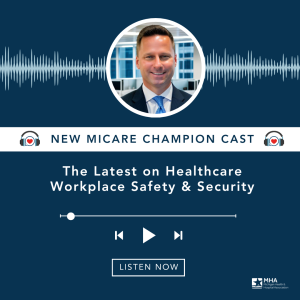
MHA Podcast Explores Strategies to Enhance Workplace Safety, Security

The MHA released a new episode of the MiCare Champion Cast exploring the latest on healthcare workplace safety with Brian Uridge, MPA, CPP, CHPA, CTM, senior director at the University of Michigan Department of Public …


Keckley Report

Game On: Team Trump aims to Shake up Healthcare with Rules, Laws, Appointments and Swagger

“Hovering over Team Trump’s agenda is the reality that Americans think the country is heading in the wrong direction and trust in its institutions including the health system is at a historic low. Restoring confidence will be a gargantuan task.

Team Trump will use Executive Orders, personnel appointments, court challenges, and legislation to advance its healthcare agenda powered by its ‘take no prisoners’ operating mode whereby the ends are justified by means. Every sector in healthcare will be impacted, some more than others. … Reacting to changes in the current environment of U.S. healthcare resulting from Team Trump is necessary and time-consuming, but neglecting thoughtful consideration about the system’s long-term future and its role in “improving the state of the world” is fatalistic.  Both need attention.”

Paul Keckley, Jan. 20, 2024


News to Know

The MHA will host the webinar How Federal Grant Funding Covers IT Department Costs Feb. 7 with Endorsed Business Partner Scaled Data Health to share how government funding, along with their innovative programs, can save hospitals significant dollars.

News to Know – Jan. 27, 2025

New to Know

The MHA will host the webinar How Federal Grant Funding Covers IT Department Costs Feb. 7 with Endorsed Business Partner Scaled Data Health to share how government funding, along with their innovative programs, can save hospitals significant dollars. Speakers will cover the brief grant submission process and timeline ahead of the April 1 deadline. There is no cost to attend and members can register online. Members with questions may contact Rob Wood at the MHA.

Now Accepting Nominations for the 2025 MHA Ludwig Community Benefit Award

The MHA is now accepting nominations for its 2025 MHA Ludwig Community Benefit Award. Michigan hospitals and health systems have a long-standing commitment to offering a wide range of services that enhance the health and wellness of individuals and communities throughout the state. The MHA Ludwig Community Benefit Award recognizes some of the outstanding ways Michigan hospitals are advancing the health and well-being of patients, the healthcare workforce and communities.

Examples of benefits provided by past award recipients include free or discounted services, health screenings, immunizations, family support services, meals, nutritional services and other assistance to the communities hospitals serve.

The 2025 MHA Ludwig Community Benefit Award will be presented during the MHA Annual Membership Meeting scheduled June 25-27, 2025.

Nominations will be accepted electronically until the close of business Feb. 19, 2025. Members seeking more information may contact Erica Leyko at the MHA.

Legislation on Maternal Healthcare Access and Preserving Healthy Michigan Plan Coverage Becomes Law

Gov. Whitmer signed several bills Jan. 21 aimed at improving maternal healthcare access, equity and outcomes, as well as preserving eligibility for those under the Healthy Michigan Plan. The MHA worked extensively with bill sponsors during the 2023-24 legislative term to share feedback and make language changes reflecting the importance of increasing access to care and improving equitable health outcomes, while maintaining essential partnerships with hospitals across Michigan.

Public Act (PA) 252 of 2024, sponsored by Rep. Laurie Pohutsky (D-Livonia), creates a licensure structure for freestanding birth centers. The MHA worked closely with the bill sponsor to incorporate changes allowing for hospitals to be valued collaborators and important partners with birth centers. These changes include allowing a hospital to own a birth center, requiring partnership and notification of a hospital and ensuring licensure structure in the state protects individuals that choose birth centers for their care.

PA 256 of 2024, sponsored by Rep. Mai Xiong (D-Warren), creates a doula scholarship program awarding one-time scholarships of up to $3,000 for Michigan residents seeking to become a doula. The MHA supported this legislation.

PA 244 of 2024 and PA 245 of 2024, sponsored by Rep. Cynthia Neeley (D-Flint) and Rep. Kimberly Edwards (D-Eastpointe), respectively, require coverage of blood pressure monitors for pregnant and postpartum women. The MHA supported these bills throughout the legislative process.

PAs 246, 247, 248, 249 and 250 of 2024, sponsored by Reps. Rachel Hood (D-Grand Rapids), Brenda Carter (D-Pontiac), Kristian Grant (D-Grand Rapids), Carol Glanville (D-Walker) and Kara Hope (D-Holt), respectively, create a multitude of changes in accessing maternal healthcare. The MHA worked extensively with the sponsors of each of these bills to address maternal health screenings (PAs 246 and 247), maternal levels of care (PA 249) and newborn insurance enrollment (PA 250). The MHA supported this legislation following changes that allow hospitals to address maternal health needs and effectively serve pregnant and postpartum individuals.

PA 251 of 2024, sponsored by Rep. Julie Rogers (D-Kalamazoo), eliminates the requirement that regular breast milk donors be tested every three months for HIV. This legislation maintains initial screening requirements as it relates to breast milk donations, while removing unnecessary barriers for both donors and hospitals. The MHA supported this legislation.

Lastly, PA 253 of 2024, also sponsored Rep. Rogers, removes workforce requirements under the Healthy Michigan Plan. A U.S. District Court issued a decision in 2020 invalidating Medicaid work requirements in Michigan. The MHA was relieved by this previous ruling and therefore supportive of this legislation codifying the court’s decision. With this legislation enacted, tens of thousands of Healthy Michigan Plan recipients can continue to receive coverage, allowing hospitals to continue to provide preventive care and help improve health outcomes for patients under this plan.

In addition to the slew of bills signed that impact maternal and infant health, as well as Medicaid recipients, the Michigan House of Representatives acted on the first bills introduced in the 103rd Legislature. After swift action last week in the House Select Committee on Protecting Michigan Employees and Small Businesses, the chamber voted 67-38 to adopt House Bill (HB) 4002, sponsored by Rep. Jay DeBoyer (R-Clay). The legislation makes important clarifications to the voter initiative petition on earned sick time that is scheduled to go into effect Feb. 21, 2025. HB 4002 provides vital clarifications regarding time accruals, employee notice provisions, sick time pay rates and exempts independent contractors and part-time employees. The MHA will continue to support this legislation as it moves onward to the Senate.

Members with questions may contact Adam Carlson at the MHA.

Medicare and Medicaid Enrollment Update

The MHA updated its analysis of Medicaid and Medicare enrollment based on December 2024 data. The analysis includes program enrollment as a percentage of each county’s total population and the split between fee-for-service (FFS) and managed care organization (MCO). Just over 27% of Michigan’s total population is enrolled in Medicaid and 22% is enrolled in Medicare.

Roughly two-thirds of Michigan’s 2.66 million Medicaid beneficiaries are enrolled in one of nine managed care plans.

Total Medicare enrollment is 2.25 million, with 62% of beneficiaries enrolled in a Medicaid Advantage (MA) plan and only three counties having less than 50% of total Medicare enrollment in MA plans. MA enrollment by county ranges from 45% to 77%, with 66 counties having 55% or more of their Medicare population enrolled in an MA plan, as highlighted below.

December enrollment is spread across 54 MA plans, with up to 29 plans covering beneficiaries in several Michigan counties and a minimum of 5 plans available in each county.

Members with enrollment questions should contact the MHA Health Finance team.

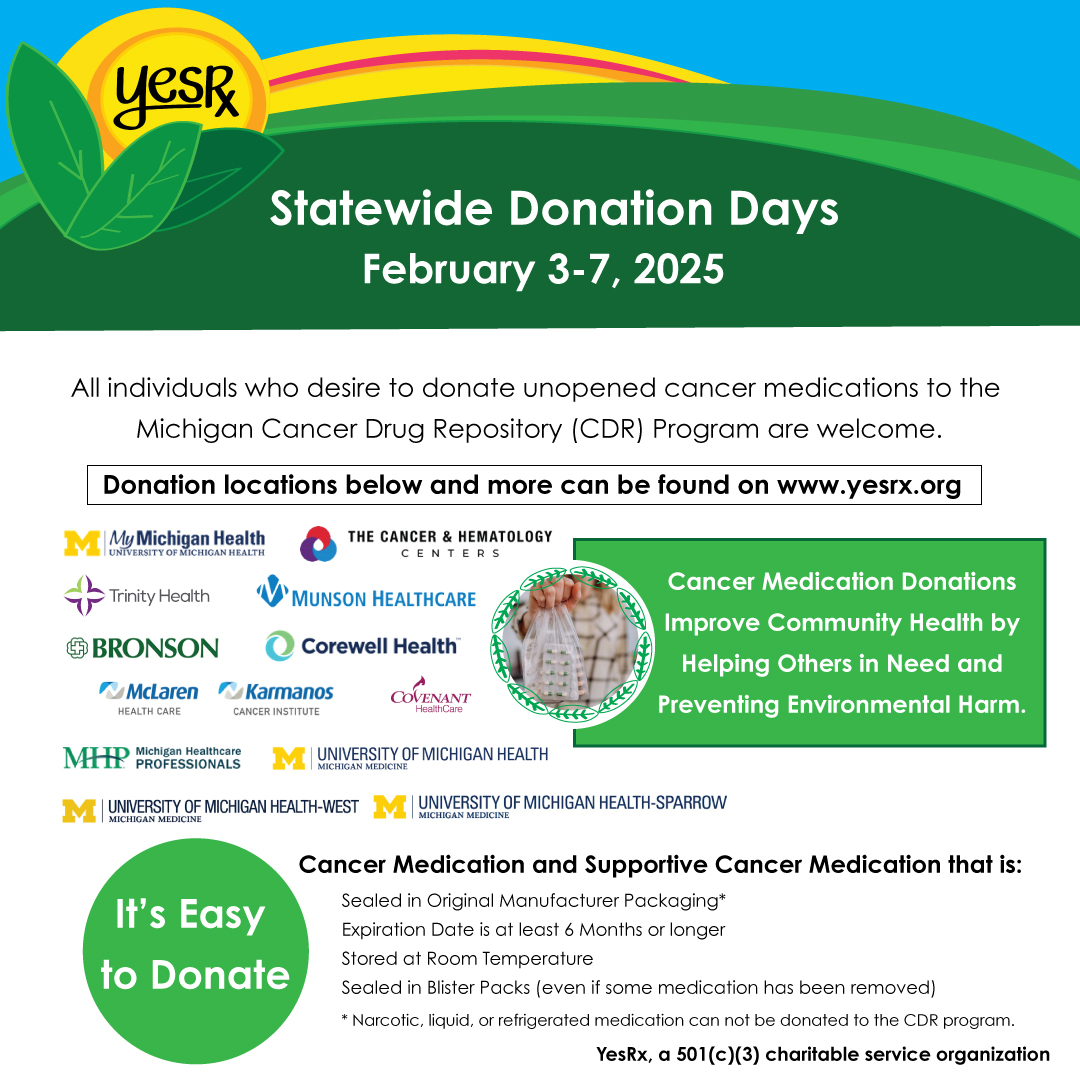
YesRx Hosts Cancer Medication Donation Drive

The MHA is committed to efforts that expand access to services and mitigate barriers to timely and effective treatments. YesRx is a statewide cancer drug repository program, accepting donations of unopened cancer medications through partnerships with clinicians to repurpose unused cancer medications. Medication are then donated to patients in need, thereby eliminating waste and expanding access for vulnerable and underserved patients.

More than 50% of patients diagnosed with cancer experience a financial hardship and YesRx is designed to fill that need. Since program inception, the YesRx network has provided more than $10 million in cancer medications to Michigan patients for free.

YesRx’s first donation drive for 2025 will be held Feb. 3-7, with medications being collected at numerous sites across the state.

Members can help by donating:

  • Medications used to treat cancer, or side-effects of chemotherapy.
  • Medication that is unopened and still in the original manufacturer packaging.
  • Medication with an expiration date that is more than six months.

Members are encouraged to share the donation drive flyer and social post with relevant provider teams.

Members with questions may reach out to Kelsey Ostergren at the MHA or YesRx.