
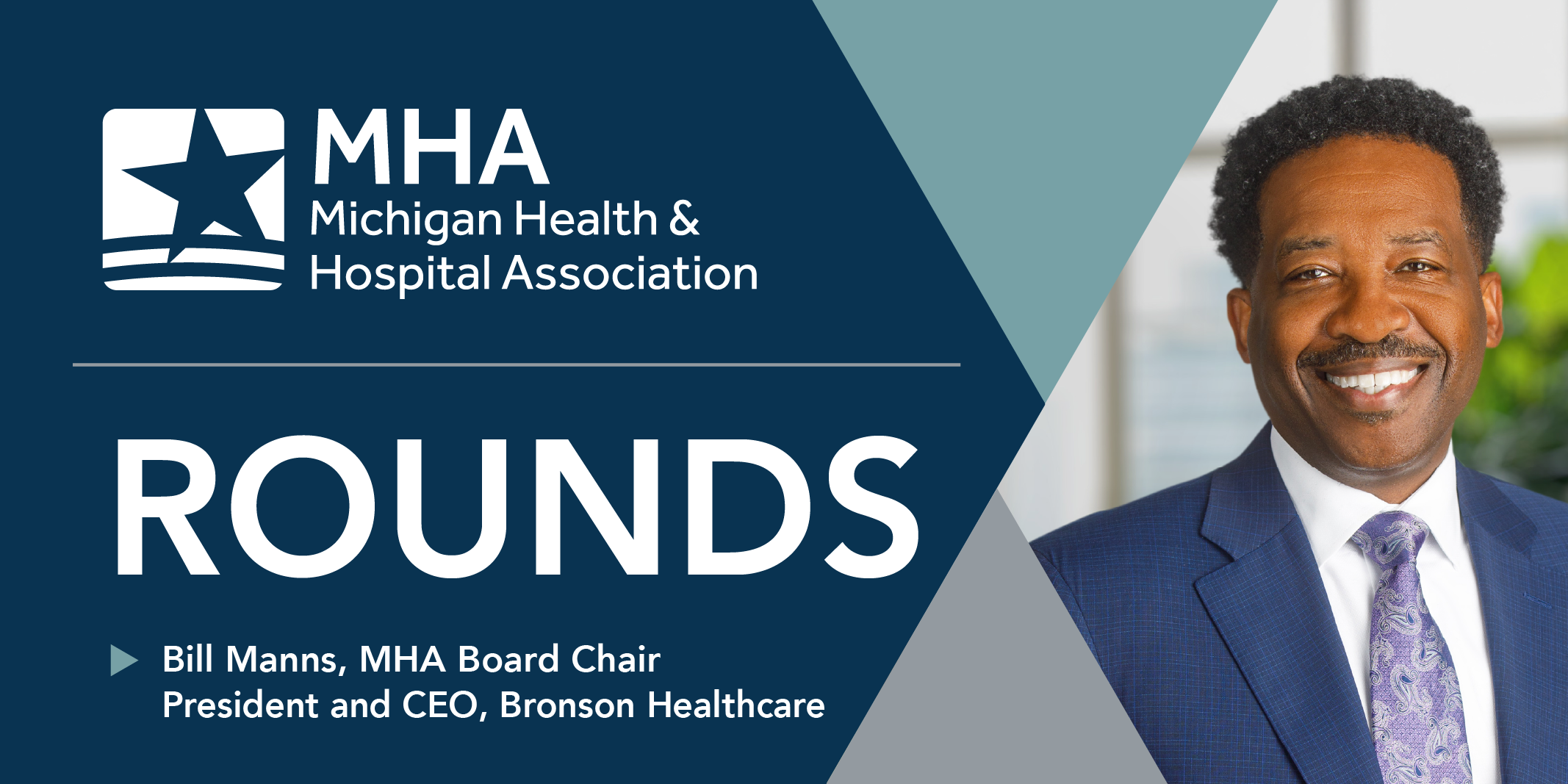
 MHA Board Chair Bill Manns, president and CEO, Bronson Healthcare
“Of all the forms of inequality, injustice in health is the most shocking and the most inhuman.” – Martin Luther King Jr.
Every February, Black History Month invites us to pause and reflect on the pioneers who have redefined what’s possible for communities across the country — often in systems that were not designed with them in mind.
This rings especially true in healthcare.
Dr. Joseph Ferguson, for example, was Detroit’s first Black doctor who practiced medicine through the Civil War and offered aid during the city’s race riots. Dr. Ethelene Crockett, Michigan’s first Black board-certified OB/GYN, grew up during the depression and committed herself to becoming an activist and humanitarian. Dr. C. Allen Alexander, Kalamazoo’s first Black surgeon, pursued his career through the racial turbulence of the 1920s.
These stories, among thousands of others, are reminders that excellence has existed in every community, even when opportunity has not.
In my own career, I’ve learned that credentials alone don’t tell a person’s full story. I’ve met brilliant clinicians and administrators whose resumes didn’t follow a straight line — colleagues who worked their way through school, who supported families while earning degrees, who became leaders within their local communities long before becoming executives.
When I stepped into my role at Bronson Healthcare, staffing demands were at their peak. Still, it was imperative that we approach recruitment in a way that was innovative and committed to recognizing talent in all forms.
We cast a wide net to recruit exceptional talent that reflects the communities we serve, partnering with regional universities and community colleges, community organizations, professional associations and local workforce programs to reach candidates whose paths into healthcare may differ from traditional pipelines. This work extends through K–12 community school partnerships and strengthened internal mentorship and advancement pathways, ensuring opportunity is not limited to linear careers.
As a result, 32.8% of our 2025 new hires identify as people of color. In healthcare, that matters. When our workforce reflects the diverse lived experiences of our patients, communication improves, trust deepens and outcomes are stronger. Healthcare is personal—and strongest when those delivering care understand the people they serve.
Honoring the pioneers who came before me means ensuring that our methods for attracting new talent are rooted in skills, ability, character and the broad range of perspectives that help us strengthen patient care.
This approach has paid off. Not only have we grown a more diversified team, but in 2025 the National Association for Business Resources named Bronson one of the Best and Brightest Companies to Work For® in the nation for the third consecutive year. We also earned elite status as West Michigan’s Best of the Best, scoring in the top 5% across every category.
Representation in healthcare shapes how we listen and lead. When our teams represent the communities they serve, decisions are inherently more informed. When a variety of voices are at the table, we reduce blind spots and can create a system that works better for everyone.
Since joining Bronson in 2020, Manns oversees a full range of services from primary care to critical care across more than 100 locations. With over 9,000 employees and more than 1,500 medical staff members, Bronson is the largest employer in southwest Michigan.