
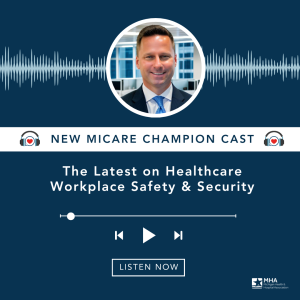
The MHA released a new episode of the MiCare Champion Cast exploring the latest on healthcare workplace safety with Brian Uridge, MPA, CPP, CHPA, CTM, senior director at the University of Michigan Department of Public Safety and Security (DPSS).
Those working in healthcare are five times as likely to suffer a workplace violence injury. With this in mind, the episode covers what safety issues are top of mind and what strategies are enhancing security for patients, visitors and staff at Michigan Medicine.
“In order to keep a healthcare system safe, you really have to use the same philosophies and strategies that you would use to keep a community safe,” said Uridge, who previously served as assistant chief of the Kalamazoo Department of Public Safety for 23 years. “Every hospital is a community, every floor is a neighborhood and every neighborhood is uniquely different.”
Gov. Whitmer signed into law MHA-supported public acts in 2023 which have been a positive step towards ensuring violence against healthcare workers is not tolerated. The association continues to support efforts that address violence committed against healthcare providers and have made anti-violence posters available to members.
As a sworn police officer for the university, Uridge manages over 300 public safety staff members for a system that has 40,000 employees and sees over four million patients a year. In this role, it’s a priority to create a culture of safety beyond moments when Uridge and his team are responding to a security threat.
“The way you keep a healthcare community safe is by building a relationship with the patients, the staff and the visitors,” noted Uridge. “It’s ambassadors first, police officer second. Our job is to reduce risk and reduce anxiety…we do that by building trust.”
The episode explores the integral role of Behavioral Threat Assessment and Management (BTAM) for identifying and managing safety threats, in addition to the ways healthcare security is evolving with advancements in artificial intelligence.
All UM Health resources are available for hospitals and health systems to use to enhance safety and security protocol. Those interested in learning more or collaborating with the UM Health DPSS team are encouraged to contact Uridge.
MHA members are also encouraged to explore resources from MHA Endorsed Business Partner Tarian, which offers a variety of programs and trainings for healthcare organizations to mitigate risk and effectively respond to safety threats. Contact Rob Wood at the MHA to learn more.
The episode is available to stream on Apple Podcasts, Spotify, SoundCloud and YouTube.
Those interested in learning more about the MiCare Champion Cast can contact Lucy Ciaramitaro at the MHA. For more information on caregiver resources in Michigan, contact the MHA Keystone Center.