
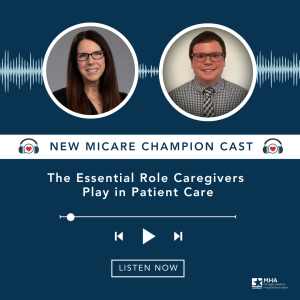
The MHA released a new episode of the MiCare Champion Cast for National Caregiver Month featuring Diane Mariani, LCSW, CADC, program manager for the department of social work and community health program at RUSH University Medical Center and Joshua Suire, MHA, BSN, RN, senior manager of safety & quality at the MHA Keystone Center.
One in five American adults – about 48 million individuals – are considered caregivers. With this in mind, the MHA Keystone Center is partnering with RUSH’s Center for Excellence in Aging to create an online learning series for hospitals interested in exploring how their staff can better integrate caregivers into a patient’s care team.
Throughout the episode, Suire and Mariani explore how the caregiving landscape has evolved and what resources are available to support caregivers in clinical and non-clinical settings. One of these tools includes a new learning module for hospitals looking to implement a caregiver navigation program within their organization, available to MHA members at no cost thanks to funding from the Michigan Health Endowment Fund.
“We’re focused on caregivers…their unique needs, trying to decrease their burden and really trying to improve their quality of life,” said Suire, who leads clinical grant-funded initiatives that help hospitals implement evidence-based quality improvement and patient safety practices. “As a part of the program, [hospitals] can take a gap analysis online, which is then processed into an individualized report and gives tangible next steps for implementing a caregiver program.”
Mariani manages the RUSH Caring for Caregivers (C4C) program that supports family and friend caregivers of adults 60 years and older. Funded by the RRF Foundation for Aging, C4C uses an evidence-based framework to improve care for older adults and caregivers through education, resources and support.
“It can be very individualized,” noted Mariani. “We support caregivers where they’re at.”
During the discussion, Mariani shared the critical role RUSH’s caregiver advisory council plays in lending first-hand insight to inform and advance their programming.
“We meet on a regular basis for feedback on how we can best identify, assist and understand caregivers – and understand how it’s impacting their physical and mental health,” said Mariani, who also leads an initiative funded by the John A. Hartford Foundation that focuses on sharing the C4C model with age-friendly health systems, area agencies on aging and other key stakeholders nationwide.
Additionally, the MHA Keystone Center partnered with Henry Ford Health’s Caregiver Assistance Resources and Education (C.A.R.E) Program team and Wayne State University’s Institute of Gerontology to create the Michigan Caregiver Navigation Toolkit – a resource to guide hospitals through operationalizing a caregiver support program within their systems.
Ongoing technical assistance and educational resources are available at no cost to MHA members interested in creating or expanding caregiver services.
The episode is available to stream on Apple Podcasts, Spotify, Soundcloud and YouTube.
Those interested in learning more about the MiCare Champion Cast can contact Lucy Ciaramitaro at the MHA. For more information on caregiver resources in Michigan, contact the MHA Keystone Center.