


Michigan Rural Health Transformation
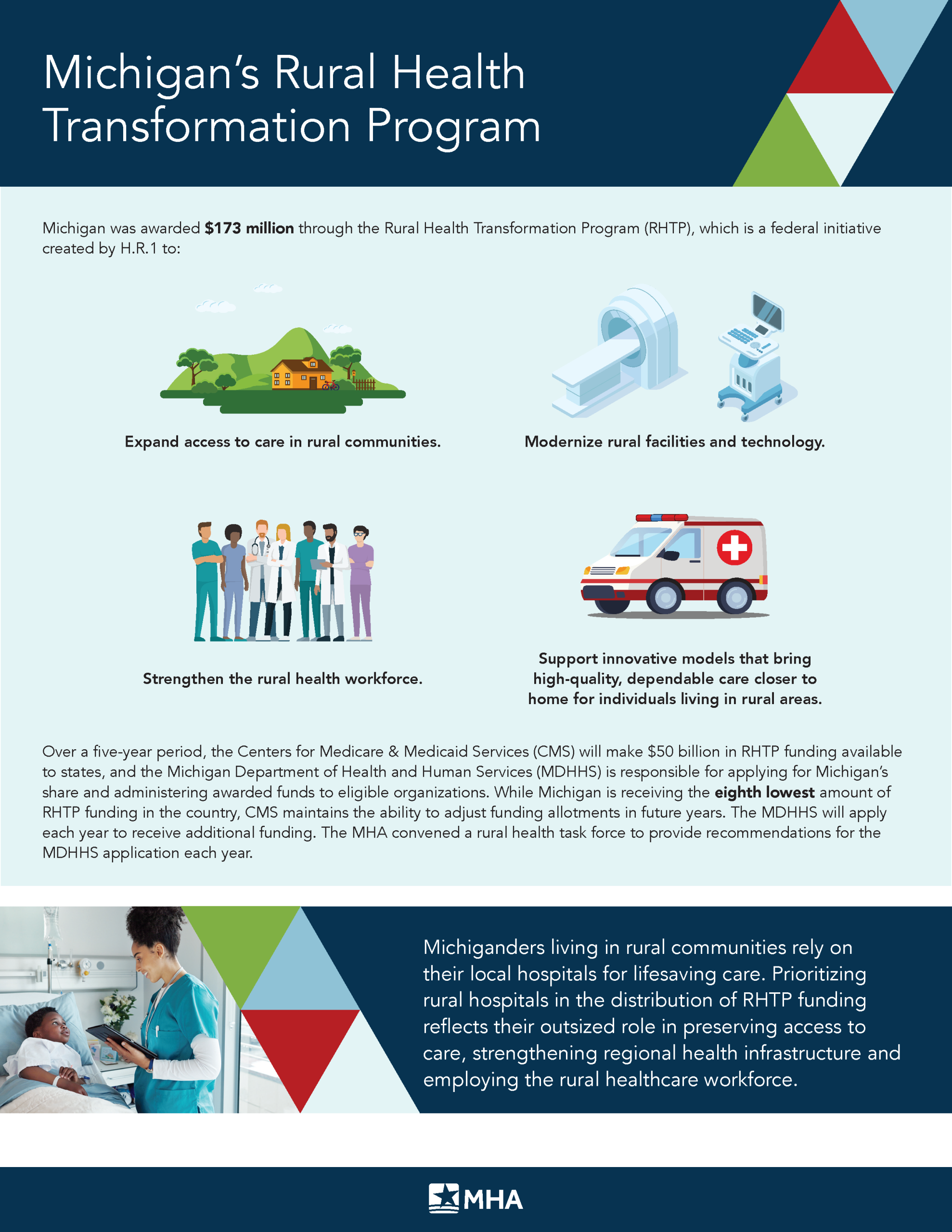
Michigan was awarded $173 million through the Rural Health Transformation Program (RHTP) for a multi-year federal initiative designed to strengthen rural healthcare systems, improve access to care and support long term sustainability for rural providers.
Centers for Medicare & Medicaid Services (CMS) administered the program nationally, while the Michigan Department of Health and Human Services (MDHHS) leads implementation across the state. Together, the agencies aim to support lasting improvements in the delivery of rural healthcare.
The RHTP was created by H.R.1 to expand access to care in rural communities, strengthen the rural health workforce, modernize rural facilities and technology, and support innovative models that bring high-quality, dependable care closer to home.
To administer the program, the Office of Rural Health Transformation was created to oversee it and support states in implementing rural health transformation plans.
Federal Funding Framework
RHTP is a $50 billion initiative which will distribute $10 billion per year for five years, from fiscal year (FY) 2026 through FY 2030. Each year, 50% of the funding will be split equally among all approved states, while the remaining 50% will be awarded based on applications submitted to CMS that enhance access and quality of care and are anticipated to have a significant impact on healthcare in rural communities.
Congress created the RHTP to invest $50 billion nationwide over five years to help states redesign and strengthen rural healthcare delivery.
Michigan’s Award
MDHHS applied for funds on behalf of the state, submitting a comprehensive strategy for how funds would be used and the rationale for proposed activities. Michigan was awarded $173 million for FY 2026. While Michigan’s award amount was less than requested, CMS approved all program activities Michigan proposed and MDHHS intends to keep all initiatives at a reduced scale.
MDHHS will lead Michigan’s RHTP efforts and administer a series of grant programs to accomplish the activities outlined in the application submitted to CMS. Grant programs will be made available to eligible organizations once MDHHS receives final budget approval from CMS.
Michigan will use these funds to support statewide and regional efforts that improve how care reaches rural residents. The program focuses on long–term system change and does not fund day-to-day hospital operations.
Members interested in how other states are using Rural Health Transformation funding, including award amounts and focus areas, can view CMS state-by-state overview.
Key Initiative Areas
The state’s RHTP application is structured around four major initiatives. Each will include multiple grant programs with specific objectives designed to advance the overarching goal.
Transforming Rural Health Through Partnerships
Builds regional hubs that connect hospitals, clinics, local health departments, and community organizations to improve care coordination, chronic disease management and access to services.
Workforce for Wellness
Expands recruitment, training, and retention of rural health professionals, including behavioral health providers, maternal health providers, emergency medical services and community health workers.
Interoperability in Action
Strengthens health IT infrastructure, electronic health record connectivity, and statewide health information exchange to improve data sharing, care coordination and administrative efficiency.
Care Closer to Home Blueprint
Expands community-based and home-based care models, reduces avoidable emergency department use, and improves access to primary, behavioral and maternal health services through local and virtual care options.
Rural Health Transformation (RHT) Advisory Council
MDHHS is forming an RHT Advisory Council to help guide implementation,which will include representatives from rural healthcare, community organizations and state agencies. While space for rural hospitals may be limited, MDHHS encourages individuals and organizations to apply.
The MHA will participate in the Advisory Council and share updates with members as information becomes available.
Implementation and Timeline
- 2025: State planning, stakeholder engagement and application submission
- 2026: CMS approval and initial program implementation
- 2026–2030: Phased funding, project implementation and performance monitoring