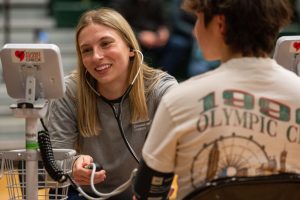
Student Heart Check Program volunteer with a student.
With back-to-school season in full swing, sports physicals and annual checkups are top of mind for many Michigan families. The teams at Corewell Health are committed to working year-round to ensure students have the tools and skills for a healthy future.
Sudden cardiac arrest is a leading cause of death in young athletes, often stemming from undiagnosed, pre-existing heart defects or abnormalities. Knowing this, the Student Heart Check (SHC) program at Corewell Health brings volunteer cardiologists, clinical staff and mobile diagnostic equipment into Michigan schools to deliver no‑cost cardiac screenings to students ages 13 to 18, regardless of athletic status.
The initiative aims to reduce barriers to lifesaving care, enhance community preparedness and meaningfully educate Michigan students and families about heart health.
At the events, students are given a free blood pressure screening, electrocardiogram (EKG) and echocardiogram. They’re also taught signs of cardiac arrest, how to perform hands-only CPR and operate an Automated External Defibrillator (AED).
“This program exists because there was no easy avenue for a student — especially someone asymptomatic — to have their heart checked with an EKG,” said Jen Shea, Corewell Health Children’s Student Heart Check Program Manager. “You also come across scenarios where a child might experience a symptom like chest pain while running but not realize it’s abnormal.”
The SHC team has screened a total of 22,500 students since 2007, referring more than 2,400 to follow-up appointments and temporarily restricting more than 240 from sporting events based on findings that require a more thorough cardiology exam.
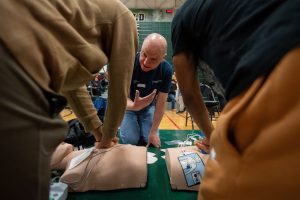
Students learning signs of cardiac arrest and how to perform hands-only CPR.
In 2024, the program led one all-state student athlete to discover he had Wolff-Parkinson-White (WPW) syndrome, a potentially life-threatening cardiac condition if left untreated. Because of the SHC screening, he was able to receive the necessary care in a timely manner and pursue a football career at Michigan State University.
A few months later, he attended the next SHC event and offered support to another athlete whose screening led to the same diagnosis.
“Unfortunately, cardiac events are much more prevalent than people think,” said Shea.
The SHC team has donated 109 AEDs to Michigan schools and sports teams in addition to mentoring educators on CPR/AED, emergency preparedness and drills that support eligibility for a MI HEARTSafe designation.
With SHC’s support, more than 140 schools have achieved HEARTSafe status.
Corewell Health teams work directly with schools to schedule clinic dates, typically coordinating events four to six times a year. Schools work with parents to register students and in the event clinic schedules aren’t filled, appointments open to the public.
“The most rewarding aspect of this work is knowing that our teams are helping save lives every time we teach someone CPR, conduct a screening or make sure schools are equipped to keep the next generation safe and healthy,” said Shea.
For questions or to find information about future screenings, visit the Corewell Health website. To learn more about how Michigan hospitals are always caring and always advancing, visit mihospitals.org or the Hospitals Help webpage.

Phone: (517) 703-8601
Fax: (517) 703-0628