MHA Submits Comments on Proposed Behavioral Health Medicaid Policy

The MHA recently submitted comments to the Michigan Department of Health and Human Services on proposed policy 2553-BH, which addresses reimbursement for specialty behavioral health services based on service location.

While the policy largely reflects current practice, the MHA identified several areas where additional clarity is needed related to allowable services and care settings.

Focus areas included:

  • Nursing Facilities: Clarification on whether additional services, such as group therapy, care coordination and medication review, would be allowable, as these services are currently included in other care settings.
  • Institutions for Mental Diseases (IMD): Clarification on the distinction in allowable length of stay between patients with serious mental illness and substance use disorder (SUD), as well as coverage parameters for SUD-related IMD stays.
  • Child Caring Institutions: Clarification on coverage limitations tied to facility licensure and patient diagnosis, particularly for children with serious emotional disturbance and intellectual and developmental disabilities.

The MHA will continue to monitor the policy and keep members informed of any updates.

Members with questions should contact Kelsey Ostergren at the MHA.

Keystone Quality and Safety Dashboard Provides At-a-Glance Insights

The MHA Keystone Center recently rolled out its Quality and Safety Dashboard, a resource that helps Michigan hospitals monitor performance, identify improvement opportunities and reduce patient harm. The dashboard provides an at-a-glance view of performance across key patient safety and quality metrics, supporting data-driven decision-making at both the hospital and health system levels.

The dashboard brings together multiple trusted data sources, including hospital administrative claims, the Centers for Disease Control and Prevention’s National Healthcare Safety Network infection data, maternal health indicators related to severe maternal morbidity, and select Agency for Healthcare Research and Quality Patient Safety Patient Safety Indicators focused on potentially preventable in‑hospital complications.

Clinicians can use the dashboard to understand variation in outcomes, support quality improvement initiatives and inform care team discussions. Healthcare leaders can use the tool to monitor performance trends, identify organizational risk and align systemwide quality priorities.

To learn more about how to use this resource, members are encouraged to attend one of the following Keystone Quality and Safety introduction sessions:

Access to the dashboard is available through a KeyMetrics account. Members can receive assistance with account setup or dashboard navigation by contacting the MHA Keystone Center.


State Senate Majority Leader Winnie Brinks Addresses MHA Board

The MHA Board of Trustees welcomed Senate Majority Leader Winnie Brinks (D-Grand Rapids) as a guest speaker at its April 8 board meeting at the MHA Capitol Advocacy Center in downtown Lansing. Sen. Brinks shared perspectives on navigating the political environment in Lansing, expressed support for the care hospitals provide, and highlighted the role hospitals play as major employers and economic drivers in the state. The MHA continues to work with the Majority Leader and other legislative leaders to support critical healthcare funding in the FY 2027 budget this spring, as well as other key priorities.

The board also approved the establishment of the MHA Center of Rural Excellence, a new subsidiary organization within the association to provide coordinated support for rural hospitals. Establishing the MHA Center of Rural Excellence will enable the MHA to create a board of rural hospital CEOs to provide leadership on funding opportunities, technical expertise and operational support.

The board approved the Type 3 membership applications of Brogan, Great Lakes Radiology Services, PLC and The North Group, as well as three individual physician members. Members with questions about the actions of the MHA Board of Trustees may contact Amy Barkholz at the MHA.

MDHHS Recommends Early Measles Vaccination in Select Counties and Extends RSV Immunization Season

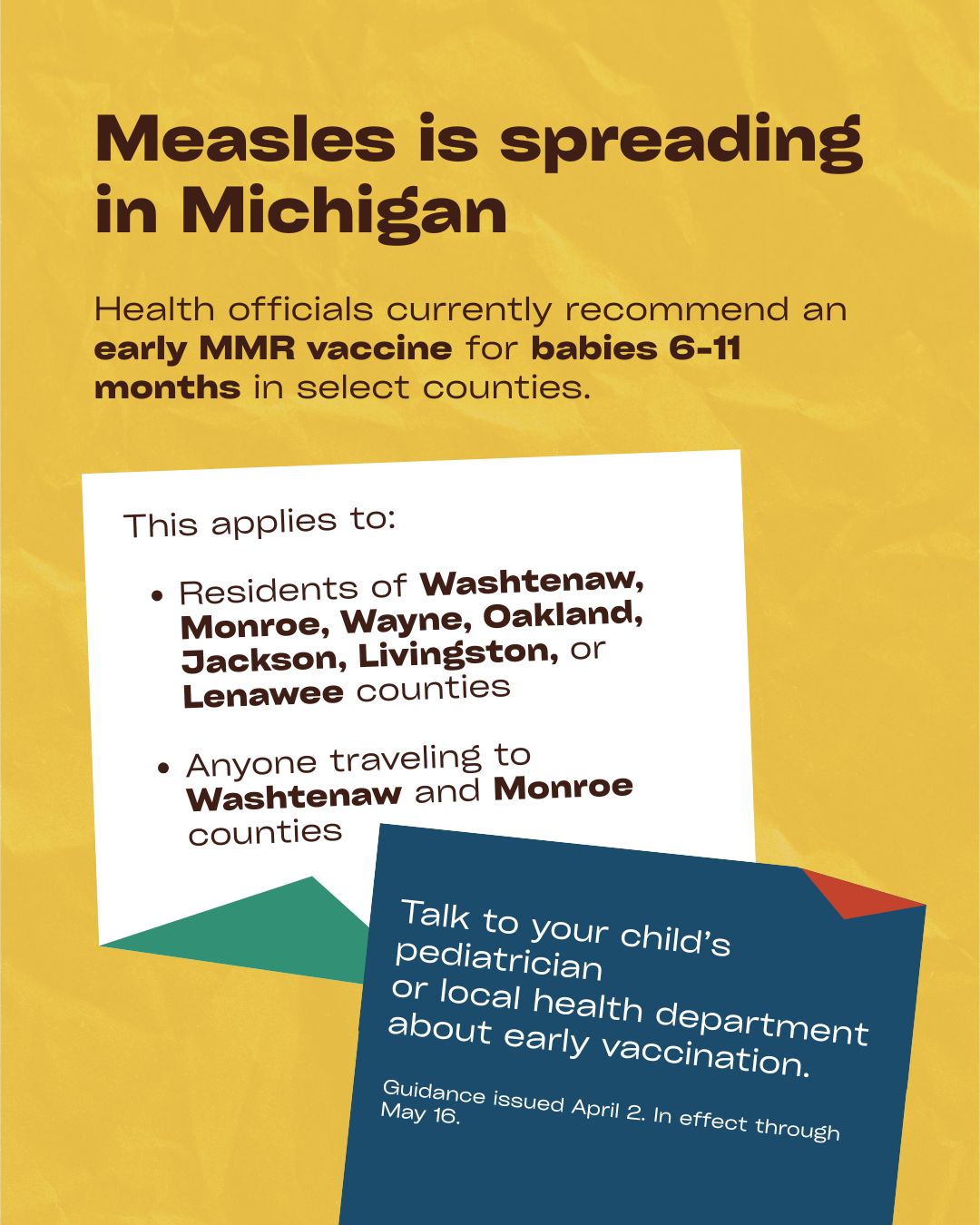
The Michigan Department of Health and Human Services (MDHHS) is recommending early measles (MMR) vaccination for infants in select southeast Michigan counties and extending the respiratory syncytial virus (RSV) immunization season through April 30, in response to continued virus activity.

The MDHHS is responding to confirmed measles cases in Washtenaw and Monroe counties and concerns of possible community transmission. Members are encouraged to review MDHHS measles guidance and share the flyer for patients and families. An accelerated measles, mumps and rubella (MMR) dose is recommended for infants ages 6-11 months who live in or travel to Washtenaw, Monroe, Oakland, Jackson, Livingston or Lenawee counties. This recommendation is in effect through May 16.

The MMR vaccine is typically administered beginning at 12 months; infants who receive an early dose will still need to complete the standard two-dose series after their first birthday.

Separately, due to continued increases in RSV-related emergency department visits and hospitalizations among young children, the MDHHS has extended the seasonal administration of RSV monoclonal antibody (mAb) products from March 31 to April 30.

Nationally, most states are also extending the timelines for RSV immunization. Members can read coverage on RSV trends, explore resources from the Association of Immunization Managers and view their RSV season extension map.

Providers are encouraged to continue administering RSV immunizations to eligible children, including:

  • Infants ages 0-8 months who have not received a dose.
  • Certain high-risk children 8-19 months entering their second RSV season.

Guidance for use remains unchanged aside from the extended timeline, and there is no preferred recommendation between available mAb products for infants under eight months old.

Members with questions may contact Kelsey Ostergren at the MHA.

CMS Releases FY 2027 Skilled Nursing Facilities Proposed Rule

The Centers for Medicare & Medicaid Services (CMS) recently released a proposed rule to update the Medicare fee-for-service (FFS) prospective payment system for skilled nursing facilities (SNFs) for fiscal year (FY) 2027. Key provisions of the proposed rule include:

  • Increasing the per diem federal rate by a net 2.3% after the market basket update, productivity adjustment and other adjustments. Facilities that fail to meet quality reporting requirements will be subject to a two-percentage-point reduction to the market basket update.
  • Updating the labor-related share of the per diem rate from 71.9% to 72%.
  • Continuing to use pre-reclassification and pre-floor hospital inpatient prospective payment system wage indexes while soliciting input on alternative data sources, such as Bureau of Labor Statistics data, for the wage index.
  • Removing two measures focused on COVID-19 vaccination for patients and healthcare personnel
  • Shortening the timeframe for quarterly submission of Minimum Data Set and National Healthcare Safety Network data from 4.5 months to 45 days, beginning with fiscal year 2029. For example, data for the quarter ending March 31, 2027, would be due to CMS by May 17, 2027.
  • Requiring submission of Minimum Data Set data for all residents receiving skilled care, regardless of payer, for patients admitted on or after Oct. 1, 2029.
  • Updating the dates used for calculating two value-based purchasing program measures: discharge function and falls with major injury.
  • Requesting information on potential updates to the Patient-Driven Payment Model.

The MHA will provide facilities with a facility-specific impact analysis and additional details on the proposed rule in the coming weeks. Members are encouraged to submit comments to the CMS by June 1 and notify Vickie Kunz at the MHA of any issues identified by May 22.

CMS Releases FY 2027 Inpatient Rehabilitation Facilities Proposed Rule

The Centers for Medicare & Medicaid Services (CMS) recently released a proposed rule to update the Medicare fee-for-service (FFS) prospective payment system for inpatient rehabilitation facilities (IRF) for fiscal year (FY) 2027.

Key provisions of the proposed rule include:

  • Increasing the inpatient rehabilitation facilities’ prospective payment system payment rate by a net 2.6% after all adjustments, from $19,371 to $19,881. Facilities that fail to comply with CMS quality reporting requirements are subject to a two-percentage-point reduction.
  • Using fiscal year 2025 claims and fiscal year 2024 cost report data to update case mix group weights and average lengths of stay.
  • Increasing the labor-related share from 74.4% to 74.5%.
  • Continuing to use pre-reclassification and pre-floor hospital inpatient prospective payment system wage indexes while soliciting input on alternative data sources, such as Bureau of Labor Statistics data, for the wage index.
  • Decreasing the cost outlier threshold by 14.3%, from $10,141 to $8,689, to achieve the 3% target for outlier payments compared with aggregate payments.
  • Updating and clarifying coverage rules, including:
    • Requiring all therapies to be initiated within 36 hours of admission, with therapy evaluations qualifying as initiation under this clarification.
    • Requiring preadmission screening documentation to include the patient’s current functional status upon admission.
    • Requiring the initial interdisciplinary team meeting to occur within four days of admission, with subsequent meetings held weekly.
  • Shortening the timeframe to submit quality reporting data following the end of each quarter from 4.5 months to 45 days, beginning with fiscal year 2029. For example, data from the quarter ending March 31, 2027, would be due to CMS by May 17, 2027.
  • Requesting information on modernizing the prospective payment system, including replacing the current system with new clinical categories and comorbidity score groupings.

The MHA will provide facilities with a facility-specific impact analysis and additional details on the proposed rule in the near future. Members are encouraged to submit comments to CMS by June 1 and notify Vickie Kunz of any issues identified by May 22.

CMS Releases FY 2027 Inpatient Psychiatric Facilities Proposed Rule

The Centers for Medicare & Medicaid Services (CMS) recently released a proposed rule to update the Medicare fee-for-service prospective payment system for inpatient psychiatric facilities (IPF) for fiscal year (FY) 2027.

Key provisions of the proposed rule include:

  • Increasing the IPF prospective payment system (PPS) federal per diem base rate by a net 2.2% after all adjustments, from $892.87 to $912.58 for IPFs that comply with the CMS IPF Quality Reporting Program (QRP) requirements. The rate for providers that fail to report quality data is $894.74.
  • Increasing the electroconvulsive therapy payment per treatment by a net 2.2% from $673.85 to $688.73 for IPFs that comply with IPF QRP requirements and $675.26 for IPFs that fail to report data.
  • Increasing the labor-related share from the current 79% to 79.1%.
  • Continuing to use the pre-reclassification and pre-floor hospital inpatient PPS wage indexes while soliciting input on alternative data sources, such as Bureau of Labor Statistics data for the IPF wage index.
  • Decreasing the cost outlier threshold by 3.9%, from $39,360 to $37,820, to achieve the 2% target for outlier payments compared with aggregate payments.
  • Limiting total outlier payments to no more than 20% of a facility’s total payments. If finalized, facilities that exceed this cap would no longer receive outlier payments.
  • Updating the IPF QRP to:
    • Remove two measures:
      • Alcohol Use Brief Intervention Provided or Offered and Alcohol Use Brief Intervention (SUB-2/2a) measure.
      • Tobacco Use Treatment Provided or Offered at discharge (TOB-3/3a) measure.
    • Implement the IPF-Patient Assessment Instrument (IPF-PAI) to collect and submit certain standardized patient assessment data beginning Oct. 1, 2027, for the FY 2029 payment determination. The CMS proposes two methods for IPF-PAI data submission: a free CMS-developed web application or two Fast Healthcare Interoperability Resource (FHIR) application programming interfaces. This would be the first time the CMS would include data submission via the FHIR standard in a QRP.

The MHA will provide facilities with a facility-specific impact analysis and additional details on the proposed rule in the coming weeks.  Members are encouraged to submit comments to the CMS by June 1 and notify Vickie Kunz at the MHA of any issues identified by May 22.

Hospitals Help: Hillsdale Works to Improve Access for Rural Residents

Rural hospitals are the heart of their communities, providing care close to home in addition to jobs, stability and reassurance that help is nearby in life’s most pivotal moments. Despite their essential role, rural providers across the state and country are challenged by limited resources, workforce shortages and constrained infrastructure.

Knowing this reality first-hand, the teams at Hillsdale Hospital are focused on advocating for rural communities and ensuring patients don’t lose access to routine or specialty care.

Personalized Primary Care

To address the unique needs of local residents, Hillsdale starts by listening. The hospital’s primary care team – spread across five local clinics – does this by focusing on understanding each patient’s needs to develop individualized health plans.

“Hillsdale Hospital’s core values include local access to care for our patients,” said Jeremiah J. Hodshire, president and chief executive officer, Hillsdale Hospital. “Everyone deserves access to healthcare, when and where they need it. That’s why expanding our primary care options is so important to us.”

In understanding that it can be difficult and time-consuming for patients to get to the hospital for lab draws, Hillsdale also decided to install outpatient laboratories inside their clinics. The decision has been well-received by community members and streamlines testing protocol for providers.

Hillsdale Spine Center was announced in January 2026 to provide a full continuum of neurosurgical spine care.

Addressing Specialty Needs

Knowing there was a local need for advanced neurosurgical care, Hillsdale responded by onboarding a neurosurgeon and opening their Hillsdale Spine Center. Residents can now receive a full spectrum of care, including minimally invasive spine surgery, spine fusion, spine fracture treatments and treatment for herniated discs. The team also recently completed their first lumbar total disc replacement, an innovative treatment that isn’t widely available.

“I couldn’t imagine where I’d be at if I didn’t get the surgery,” said the patient, who previously struggled with severe back pain for more than 15 years. “[The procedure] was the best thing I’ve ever done.”

Uplifting Rural Voices

Hillsdale teams are also finding meaningful ways to speak up for rural patients and providers. In a new podcast series titled, “Rural Health Fractured,” conversations center around sustainable solutions to today’s pressing rural healthcare issues.

Additionally, Hodshire will serve as board chair of the MHA Center of Rural Excellence, a 501(c)(6) organization created to formalize and strengthen the collective voice of rural hospitals through targeted advocacy and support tailored to the unique challenges Michigan’s rural providers face.

Those with questions or content ideas for the Hospitals Help series may contact Lucy Ciaramitaro at the MHA.

Council Workgroups Advance Care Delivery Strategies

The MHA Council on Health Access and Community Impact, established in June 2024, brings together voices from across the MHA membership to advance a shared commitment to improving healthcare and health outcomes. Over the past year, the council has transitioned from defining its scope and purpose to launching work that supports meaningful, systemwide change.

This shift led to the formation of workgroups aligned with key drivers of care delivery transformation, a priority in the MHA 2025-26 Strategic Action Plan. Collectively, the council and its workgroups aim to advance strategies that optimize operations across access, quality improvement, patient experience, community alliance and care integration.

Shared Focus, Clear Direction

Central to this work is a commitment to delivering safe, high-quality and reliable care to every patient, regardless of circumstance.

The council also recognizes that meaningful transformation requires moving beyond traditional clinical models. Integrated care must address the full range of factors shaping health, including social, structural, behavioral and clinical conditions, while elevating community voice and advancing population‑level impact.

Workgroup Purpose and Progress Highlights

Driven by this focus, the council workgroups share common objectives:

  • Develop practical roadmaps and tools for scalable implementation across member hospitals.
  • Outline approaches for integrating and operationalizing best practices.
  • Advance recommendations for statewide adoption to be presented to the MHA Board of Trustees.

Three workgroups are currently active and meet monthly. Highlights include:

  • Quality Improvement (QI): Members of the workgroup conducted stakeholder and subject-matter expert interviews with national, state and academic QI leaders. Insights from these conversations informed the development of a draft blueprint and implementation framework to guide statewide and hospital‑level QI initiatives, with an intentional focus on addressing persistent gaps in outcomes and advancing quality.
  • Patient Experience and Community Alliance: This workgroup is developing a framework that expands the patient journey beyond clinical encounters to strengthen partnerships with patients and communities by aligning engagement and communication strategies with lived experience and local context.
  • Care Integration: The workgroup is identifying gaps in how clinical and social care are operationalized across health systems, including staffing, IT infrastructure, policies and workflows, while informing scalable best practices and alignment across the state.

Looking Ahead

As the council and workgroups move forward, the focus remains on scalable solutions that advance care delivery transformation while centering community partnership and measurable impact.

Members with questions about the council’s work may contact Ewa Panetta at the MHA.

MHA Monday Report April 6, 2026

MHA EventsHospital HR Professionals Gather at MHA Human Resources Conference

The MHA welcomed human resources leaders from across the state for the 2026 MHA Human Resources Conference March 24 in Lansing. Attendees gathered for a day of learning, networking and discussions focused on the workforce …


CMS Issues Guidance on Updated Federal Dietary Guidelines

The Centers for Medicare & Medicaid Services (CMS) recently released a Quality & Safety Special Alert Memo reminding critical access hospital providers of their responsibilities for patient food and nutrition services under existing …


MHA Annual Membership Meeting Strengthens Statewide Collaboration

The MHA Annual Membership Meeting will be held June 24-26 on Mackinac Island. It will include education sessions that deliver tactics and perspectives to shape the future, recognition of prestigious individuals leading transformation and numerous …


Excellence in Governance Fellowship Offers Meaningful Dialogue Among Trustees and Experts

Applications are now being accepted for the 2026-27 cohort of the MHA Excellence in Governance Fellowship, a rigorous and comprehensive program delivering tools and knowledge in effective governance. Hospital and health system governing board members …


Hospitals Help: Kalkaska Memorial Walks Beside Patients at Discharge

Patients often feel most vulnerable during the transition from hospital to home – especially if questions linger, follow-up care is extensive or there’s any risk of complications. Knowing this, hospitals are finding ways to ensure …


MHA Rounds image of Brian PetersMHA CEO Report — Violence Is Not Part of the Job

Healthcare workers accept extraordinary responsibility in their role as caregivers for their community, but fearing for their own safety is never something they should have to accept as part of the job. …


March Recap

March was marked by a strong focus on National Nutrition Month, highlighting how hospitals are advancing Food as Medicine efforts across Michigan. The following articles recap key conversations and initiatives supporting improved health outcomes through nutrition.

Food as Medicine: How Trinity Health Is Advancing Health Through Nutrition

Food is Medicine. Health by Food. ProduceRx. The integration of healthy food into healthcare is gaining attention under many names, but the message remains the same: access to healthy foods as a part of care. …


Health Access & Community Impact Council Focuses on Food as Medicine

The MHA Health Access & Community Impact Council convened virtually March 5 to discuss strategies to improve health outcomes through stronger integration of social and clinical care. In recognition of National Nutrition Month, members also explored …


Hospitals Expand Food Access Through Community Benefit Collaboratives

As many observe National Nutrition Month, hospitals across the state are implementing programs to address chronic disease through nutrition education and expanded food access. This work is being done through the MHA Community Benefit Collaboratives, which support efforts to improve Michiganders’ health outcomes in …


Keckley Report

Reality Check: the New Healthcare Advisory Committee

“Last week, Secretary of Health and Human Services (HHS) Robert Kennedy and Centers for Medicare and Medicaid Services (CMS) Director Mehmet Oz announced appointments to the new Healthcare Advisory Committee (HAC).

Its 18 members were selected from 400 nominees and will serve two-year terms. The group includes 4 health system executives, 5 physician leaders, 4 policy analysts, 3 ‘others’ (including motivational speaker Tony Robbins) and 2 Ex Officio (Non‑Voting) Members (Kimberly Brandt, JD — CMS Deputy Administrator & COO Stephanie Carlton, CMS Chief of Staff). …

The U.S. health system is in chaos. Its long-term destination is unknown. It’s near-term is mired in political brinksmanship and discontent about its costs and affordability. It is unhealthy. Majorities in both parties, and independent voters think the system is broken but few know what a viable alternative might be. Lost but making record time!!!”

Paul Keckley, March 29, 2026


New to KnowNews to Know

  • MHA Endorsed Business Partner i2G Systems is hosting the webinar Pathway to Prevention April 22 from 11 a.m. to noon ET.
  • The American Hospital Association (AHA) is accepting applications for the 2027 AHA Foster G. McGaw Prize.

MHA in the News

The MHA received media coverage during the week of March 30 following Executive Vice President of Government Relations and Public Policy Laura Appel’s participation in two panels focused on key healthcare challenges and opportunities. WZMQ …