News to Know – Sept. 15, 2025

New to Know

New to KnowThe American Hospital Association (AHA) is accepting applications for the 2026 Dick Davidson NOVA Award. The award recognizes hospitals and health systems that demonstrate outstanding collaboration with community partners to improve health outcomes and community well-being. This annual award will honor up to five organizations, who will be recognized at the AHA Healthier Together Conference, May 12-14, 2026, in Dallas. Members are encouraged to apply by Oct. 14 and can visit the AHA’s NOVA webpage for more details.

MHA Hosts Successful Community Impact Advocacy Day

Hospital leaders from across the state of Michigan during the Community Impact Advocacy Day.

The MHA hosted more than 110 hospital leaders from across the state for a Community Impact Advocacy Day at the Michigan State Capitol on Sept. 10.

Hospital leaders spoke with lawmakers on pressing hospital and healthcare issues. Members kicked off the day with a call to action from MHA CEO Brian Peters, stressing the importance for the legislature to pass a real budget that supports patients, providers and hospitals by Sept. 30. Throughout the day, members met with nearly 90 lawmakers and staff to share legislative and budget priorities. Furthermore, hospital leaders had the opportunity to discuss the value and role hospitals play in their communities, including providing specialized healthcare services, investing in local communities, supporting local economies and ensuring all Michiganders have access to high-quality healthcare nearby.

The MHA extends sincere thanks to member hospital leaders, lawmakers and legislative staff who joined to discuss the essential role of Michigan hospitals in communities statewide.

Members with any questions related to the legislation and advocacy efforts may contact the advocacy team at the MHA.

Registration for 2025 Communications Retreat Closes Sept. 19

MHA Events

Registration closes Sept. 19 for the 2025 MHA Communications Retreat, which will be held from 8 a.m. to 4 p.m. on Wednesday, Oct. 1, at the Henry Center for Executive Development in Lansing.

This year’s retreat offers hospital communicators a chance to connect with peers across the state and participate in sessions that provide valuable skills and insights for both emerging and experienced professionals.

At the 2025 Communications Retreat, the lineup of presenters and topics includes:

  • Tim McIntyre, experienced communicator and former Domino’s Pizza executive, will share insights on reputation management, drawing parallels between his experiences and the issues hospitals face today, including rebuilding trust, creating transparency and simplifying the patient experience.
  • A crisis communication panel will feature MHA members, including Catherine Dewey, regional marketing communications manager, Munson Healthcare; Mark Geary, senior director, communications & external affairs, Corewell Health, and will highlight lessons learned from past crises in healthcare. The session will be led by crisis communications expert Jeff Gaunt, founder and principal of Gaunt Strategies, who will also facilitate a tabletop simulation where attendees respond to an incident in real time.
  • Laura Appel, executive vice president, government relations & public policy, MHA, will provide an update on state and federal healthcare priorities.

The registration fee is $35 per person. Breakfast, refreshments and lunch will be provided. Members are encouraged to register now to secure one of the few remaining seats.

Additional event details and registration information is available on the 2025 Communications Retreat webpage.

Members with questions regarding registration should contact Kennedy Walters at the MHA. Questions regarding the retreat should be directed to John Karasinski at the MHA.

Michigan Hospital Collaboratives Launch to Improve Community Health

More than 50 Michigan hospitals are coming together to improve outcomes in maternal health, behavioral health and chronic disease across the state through new community benefit collaboratives launched by the Michigan Health & Hospital Association (MHA). The goal is to leverage community impact programming to maximize statewide improvements in these three areas.

The MHA will lead participating hospitals in implementing multi-year, scalable projects focused on enhancing group prenatal care, improving perinatal mood disorder screening and support, preventing postpartum depression and expanding food access and nutrition education. The collaborative topics were selected based on a review of all Community Health Needs Assessments completed by Michigan hospitals. Each collaborative is modeled after existing programs at Michigan hospitals and healthcare organizations designed to address healthcare barriers and improve health outcomes.

“This work reflects Michigan hospitals’ commitment to investing in their communities far beyond their four walls to improve population health,” said MHA CEO Brian Peters. “These collaboratives are designed to scale local success into making a statewide impact that advances the health and well-being of Michiganders where they live, work and grow.”

Each collaborative has various components that can be tailored to meet the unique needs of a hospital, depending on size, available resources and patient populations. The implementation of the collaboratives is supported by funding from the Michigan Health Endowment Fund. Public Policy Associates will facilitate program evaluations.

The list of participating hospitals for each collaborative is available below.

Behavioral Health Collaborative  

  • Henry Ford Health
  • MyMichigan Medical Center Alma
  • MyMichigan Medical Center Clare
  • MyMichigan Medical Center Gladwin
  • MyMichigan Medical Center Midland
  • MyMichigan Medical Center Mt. Pleasant
  • MyMichigan Medical Center Saginaw
  • MyMichigan Medical Center Sault
  • MyMichigan Medical Center Standish
  • MyMichigan Medical Center Tawas
  • MyMichigan Medical Center West Branch
  • ProMedica Monroe Regional Hospital
  • ProMedica Charles and Virginia Hickman Hospital
  • Trinity Health Ann Arbor
  • University of Michigan Health-Sparrow Lansing
  • University of Michigan Health-West

Chronic Disease Collaborative

  • Aspirus Iron River Hospital & Clinics
  • Aspirus Keweenaw Hospital & Clinics
  • Aspire Rural Health System Deckerville Community Hospital
  • Aspire Rural Health System Hills & Dales Healthcare
  • Aspire Rural Health System
  • Beacon Kalamazoo (formerly Borgess Hospital)
  • Bronson Battle Creek Hospital
  • Henry Ford Health
  • Kalkaska Memorial Health Center
  • Munson Medical Center
  • MyMichigan Medical Center Alma
  • MyMichigan Medical Center Clare
  • MyMichigan Medical Center Gladwin
  • MyMichigan Medical Center Midland
  • MyMichigan Medical Center Mt. Pleasant
  • MyMichigan Medical Center Saginaw
  • MyMichigan Medical Center Sault
  • MyMichigan Medical Center Standish
  • MyMichigan Medical Center Tawas
  • MyMichigan Medical Center West Branch
  • Scheurer Health
  • Schoolcraft Memorial Hospital

Maternal Health Collaborative  

  • Bronson Methodist Hospital
  • Corewell Health Lakeland Hospitals – St. Joseph Hospital
  • Henry Ford Health
  • MyMichigan Medical Center Alma
  • MyMichigan Medical Center Clare
  • MyMichigan Medical Center Gladwin
  • MyMichigan Medical Center Midland
  • MyMichigan Medical Center Mt. Pleasant
  • MyMichigan Medical Center Saginaw
  • MyMichigan Medical Center Sault
  • MyMichigan Medical Center Standish
  • MyMichigan Medical Center Tawas
  • MyMichigan Medical Center West Branch
  • Three Rivers Health Hospital (Beacon Health System)

To learn more about community benefit efforts across the state, visit the MHA Community Benefit webpage.

Based in Greater Lansing, the MHA is the statewide leader representing all community hospitals in Michigan. Established in 1919, the MHA represents the interests of its member hospitals and health systems in both the legislative and regulatory arenas on key issues and supports their efforts to provide quality, cost-effective and accessible care. The MHA’s mission is to advance the health of individuals and communities.


MHA Monday Report Sept. 8, 2025

House Budget Threatens Hospitals, Workforce and Patient Access

The budget passed by the Michigan House of Representatives on Aug. 26 includes harmful cuts to hospitals that could jeopardize more than 20,000 jobs, according to the MHA. Estimates released Sept. 3 indicate the cuts …


MHA CEO Brian Peters Responds to House Speaker Comments

MHA CEO Brian Peters responded to negative comments made by Michigan House Speaker Matt Hall (R-Richland Township) during a press conference on Sept. 3. Speaker Hall’s press conference presentation included a segment on hospital funding, …


Sept. 24 Webinar Outlines the OBBBA Impact

The MHA will host the webinar Understanding the One Big Beautiful Bill Act (OBBBA) and Board Planning for the Impact from 8 to 9 a.m. on Sept. 24. The session is designed for trustees and …


2025 Communications Retreat Qualifies for APR CEU Credit

Registration remains open for the 2025 MHA Communications Retreat scheduled Wednesday, Oct. 1 from 8 a.m. to 4 p.m. at the Henry Center for Executive Development in Lansing. The retreat qualifies for one continuing education …


Webinar Explores Partnerships to Advance Integrated Behavioral Healthcare

The Center of Excellence for Integrated Health Solutions and the American Hospital Association will host the webinar Advancing Integrated Care Via Collaborative Partnerships: Hospitals, Health Systems, Community Mental Health Centers and Certified Community Behavioral Health Clinics, on Tuesday, …


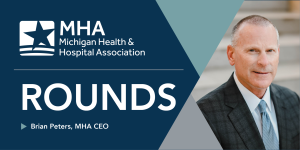
MHA Rounds graphic of Brian PetersMHA CEO Report — Patients Over Politics

Most people will find themselves in a hospital at one point or another, whether it’s to hold a loved one’s hand, welcome a child or receive needed – perhaps even life-saving – care.


Keckley Report

September 2025 for Healthcare: The Four Areas of Focus for Operators

“August passed with a flurry of events that produced emotional whip-lash in the public’s psyche: highs sparked by the engagement of pro-football all-star Travis Kelce to iconic superstar Taylor Swift and the return of college football to a low headlined by another mass casualty incident. This time, a mentally-ill lone gunman murdered two innocent kids and sent 17 wounded to Minneapolis hospitals for care. …

Summer is over. September is here. It’s the month when presumably normalcy returns in most communities and households. Schools start. Pro football starts. Routines are set. It’s the last month of fiscal year 2025 for the federal government and in Michigan and Alabama (46 states began FY26 July 1, NY started April 1 and Texas September 1). It’s when Congress returns from its August recess to wrap up unfinished business for FY25 and organize for FY26 initiatives. It’s when incumbent members of the House and Senate decide whether to run again or not, and when Supreme Court justices and clerks prep for their loaded 2025-2026 docket that features arguments about conversion therapy, the Chevron doctrine and more.

For healthcare organizations, September 2025 will not be normalcy. Business plans and strategies extending through 2027 will be impacted by actions and events that occur in the next 30 days. …“

Paul Keckley, Sept. 1, 2025


New to Know

News to Know

  • The American Hospital Association (AHA) is accepting applications for the AHA’s 2026 Dick Davidson NOVA Award.
  • MHA Endorsed Business Partner CyberForce|Q will host an in-person Coffee & Collab for cybersecurity leaders on Sept. 16 from 8:30 to 9:30 a.m. ET at CyberForce|Q headquarters in Plymouth, MI.
  • In the latest episode of the MiCare Champion Cast, MHA CEO Brian Peters and Tina Freese Decker, MHA, MSIE, FACHE, president & CEO, Corewell Health and 2025 chair of the AHA, explores state and federal healthcare priorities.

MHA in the News

The MHA received media coverage the week of Sept. 1 on the state budget and COVID-19 vaccines. Several news outlets published stories related to the harmful impacts to healthcare found in the state budget bill …


News to Know – Sept. 8, 2025

  • New to KnowThe American Hospital Association (AHA) is accepting applications for the AHA’s 2026 Dick Davidson NOVA Award. The award recognizes hospitals and health systems that demonstrate outstanding collaboration with community partners to improve health outcomes and community well-being. This annual award will honor up to five organizations, who will be recognized at the AHA Healthier Together Conference, May 12-14, 2026, in Dallas. Members are encouraged to apply by Oct. 14 and can visit the AHA’s NOVA webpage for more details.
  • MHA Endorsed Business Partner CyberForce|Q will host an in-person Coffee & Collab for cybersecurity leaders Sept. 16 from 8:30 to 9:30 a.m. ET at CyberForce|Q Headquarters in Plymouth, MI. This session will include insights from Adrienne Chase, chief compliance and integrity officer for area one, Trinity Health, with open dialogue, practical takeaways and shared best practices. Members with questions may contact Rob Wood at the MHA.
  • In the latest episode of the MiCare Champion Cast, MHA CEO Brian Peters and Tina Freese Decker, MHA, MSIE, FACHE, president & CEO, Corewell Health, and 2025 chair of the AHA, explore state and federal healthcare priorities. Peters and Freese Decker discusses healthcare innovation, affordability and how institutions like Corewell Health are bracing for the impact of the One Big Beautiful Bill Act (OBBBA). They also explore the future of growing the healthcare workforce talent pipeline, the role technology will continue to play in hospitals and the importance of fostering new partnerships across industries. The episode is available to stream on Apple PodcastsSpotifySoundCloud and YouTube. Questions or idea submissions for future MiCare Champion Cast episodes can be sent to Lucy Ciaramitaro at the MHA.

Media Recap: State Budget & Vaccines

The MHA received media coverage the week of Sept. 1 on the state budget and COVID-19 vaccines.

Several news outlets published stories related to the harmful impacts to healthcare found in the state budget bill passed by the Michigan House of Representatives.

Adam Carlson9&10 News aired a story Sept. 2 that includes an interview with Adam Carlson, senior vice president, advocacy, MHA, explaining the cuts found in the bill.

“It includes billions of dollars in cuts that impact things like maternal health care payments to physicians and all sorts of other healthcare related cuts that are completely unnecessary,” said Carlson.

The MHA issued a press release Sept. 3 sharing the House version of the budget endangers 20,000 hospital jobs and a $4.9 billion economic loss to the state. This led to a critical reaction from the House Speaker, resulting in stories from The Detroit News and Gongwer. A MHA media statement shared responding to the Speaker’s criticism was released that evening.

“We will not be bullied away from defending our patients. We remain steadfast in our commitment to protecting healthcare access throughout Michigan,” said Peters in the statement, that was included in the Gongwer story.

Lastly, Bridge published an article Sept. 4 providing information on how to access the COVID-19 vaccine. The MHA provided a comment for the story from Gary Roth, DO, chief medical officer, MHA.

“Our role is to support hospitals in their efforts to increase overall vaccination uptake and avoid the spread of vaccine preventable diseases, as the evidence is indisputable that vaccines are the best tool available to prevent severe illness and save lives,” said Roth.

Members with any questions regarding media requests should contact John Karasinski at the MHA.

MHA CEO Report — Patients Over Politics

MHA Rounds image of Brian Peters

MHA Rounds graphic of Brian Peters“Happy are those who dare courageously to defend what they love.”  — Ovid

Most people will find themselves in a hospital at one point or another, whether it’s to hold a loved one’s hand, welcome a child or receive needed – perhaps even life-saving – care.

I’m no exception. Like many others have done before and since, my wife and I looked to the team at Corewell Health Devos Children’s Hospital to keep our daughter safe and healthy while she was fighting for her life in their neonatal intensive care unit some 19 years ago (a story I recently shared on the MiCare Champion Cast). Needless to say, it’s in those moments that we realize just how personal – and non-partisan – healthcare truly is.

As an association, it’s our job to protect Michigan hospitals and safeguard healthcare services for patients and communities. That’s why in recent months we’ve spoken out against attacks to Medicaid – and why now – we’re ringing the alarm on the devastating impact proposed House budget cuts would have if signed into law.

Political posturing aside, here are the facts: Michigan hospitals stand to lose more than $2.5 billion under House Bill 4706, which would directly impact patient access to care in hospital beds, labor and delivery units, emergency departments, cancer treatment and many other vital service lines across the state. As we stated repeatedly during the debate on “One Big Beautiful Bill Act (OBBBA),” when service lines and hospitals close, access is not only lost for Medicaid recipients – it is lost for everyone.  In addition, this funding keeps our incredibly dedicated healthcare workers employed. The House-proposed budget puts more than 20,000 Michigan hospital jobs at risk and could result in a $4.9 billion loss to the state’s economy.

While some politicians point fingers, Michigan hospitals are focused on patients. It’s time to put egos aside and act as a united front when it comes to protecting access to care, helping our communities thrive and showing up for those who care for us all in times of joy, uncertainty and crisis.

We cannot let partisanship put lives at risk. On behalf of our MHA family, I ask you to show courage in speaking truth to power. I ask you to join me in urging lawmakers on both sides of the aisle to protect essential hospital funding by visiting our MHA Legislative Action Center.

As always, I welcome your thoughts.

MHA CEO Brian Peters Responds to House Speaker Comments

MHA CEO Brian Peters responded to negative comments made by Michigan House Speaker Matt Hall (R-Richland Township) during a press conference on Sept. 3.

Speaker Hall’s press conference presentation included a segment on hospital funding, in which he continually refuted information provided by the MHA regarding House Bill 4706 and its harmful cuts to hospital funding and access to healthcare. Further, the Speaker made direct personal attacks to MHA CEO Brian Peters during the press conference.

Following the press conference, the MHA issued a statement reaffirming Peters’ commitment to protecting healthcare access throughout Michigan.

“The Speaker is wasting Michiganders’ time and resources doubling down on defending these disastrous budget cuts and resorting to personal attacks. Attacking me does not change the real cuts his budget threatens to make against patients, healthcare workers and hospitals. I’m happy to be the target of his outrage and criticism if that distracts him from cutting funding for those who report to work every day to save lives,” said Peters.

The MHA encourages members to contact their lawmakers through its action alert and continue to advocate for a real budget by Sept. 30 that puts patients, providers and hospitals first.

Members with questions may contact the MHA advocacy team.

House Budget Threatens Hospitals, Workforce and Patient Access

The budget passed by the Michigan House of Representatives on Aug. 26 includes harmful cuts to hospitals that could jeopardize more than 20,000 jobs, according to the MHA. Estimates released Sept. 3 indicate the cuts could also result in a $4.9 billion loss to Michigan’s economy if House Bill (HB) 4706 is signed into law.

The estimates consider the more than $2.5 billion in potential hospital funding cuts included in HB 4706. The impact on jobs would be particularly profound, as on average, 60% of a hospital’s budget is due to labor. Such a cut could have an additional estimated induced and indirect economic loss of $2.4 billion on the economy. More than one million jobs are directly, indirectly or induced by healthcare in the state.

The proposed House budget includes:

  • New language placing $2.5 billion of hospital provider-tax funded payments in contingency, requiring unnecessary administrative and legislative actions that could jeopardize timely hospital payments.
  • Elimination of at least $100 million of funding from the Specialty Network Access Fee, which provides reimbursement to support physicians caring for patients with Medicaid coverage.
  • Elimination of $10 million to support the Maternal Levels of Care verification for birthing hospitals.
  • No funding to support providers who have not been reimbursed by the Michigan Department of Corrections contractor Wellpath.

Furthermore, Michigan hospitals already stand to lose more than $6 billion over the next 10 years due to federal budget cuts. Further reducing funding that supports delivering healthcare services and the nurses, physicians and other staff employed by hospitals harms Michigan and its more than 10 million residents.

The MHA opposes any and all threats to hospital funding and continues to advocate for a real budget passed by Sept. 30 that supports healthcare and the hospital workforce who serve Michigan communities.

The MHA urges members to contact their lawmakers through an action alert to oppose these harmful cuts to hospital funding and access to care.

Members with additional questions should contact the MHA advocacy team.